Molecular Basket: How Scientists Spotted Electrons at the Edge ✛
The triptycene molecule looks like a three-pointed star. When such stars are scattered on a lead surface, they self-assemble into a pattern reminiscent of a woven basket: triangles and hexagons alternate, and each node hosts a pair of stars. Theorists have long argued that special electrons should live at the edges of such a basket, but no one had managed to see them.
Scientists from Japan and Germany used large molecules instead of atoms. Each molecule is a ready-made node, and electrons can hop from one node to another. On the lead surface, the molecules arranged into neat islands with zigzag edges. A scanning tunneling microscope, which probes the surface with a fine tip, found a bright peak at a voltage of 1.42 volts along these edges.
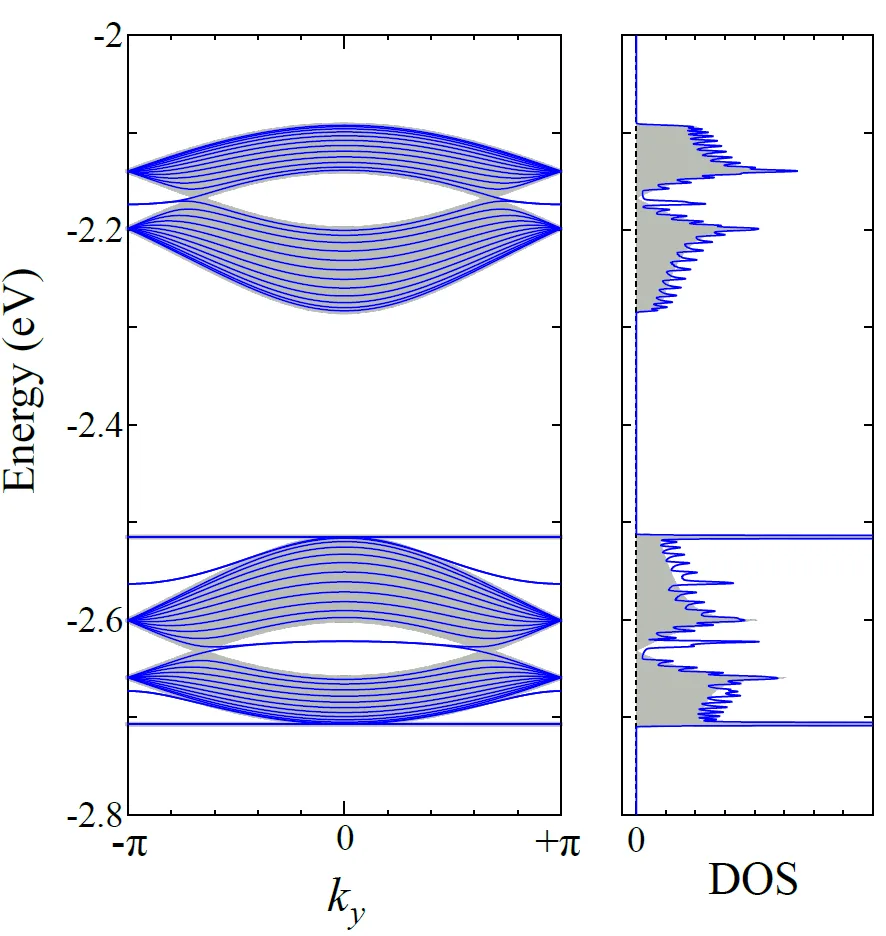
Electrons that live only at the edge are a hallmark of topological materials. Inside such a material, electrons behave one way; at the edge, they behave differently, and this difference is insensitive to minor defects. In graphene, such edge states arise on zigzag edges, and now their counterpart has been found in a molecular lattice. Calculations show that these electrons are protected by the crystal's geometry, just as a fortress is protected by the shape of its walls.
Previously, such protection could only be computed on paper. Now it has manifested as a chain of bright spots on a conductivity map. The molecular construction kit proved more precise than the atomic one: it allows assembling a lattice with the desired geometry. The same approach could be applied to other molecules to create materials with predetermined electronic properties.
Triptycene molecules have a rigid Y-shaped form, resembling a three-pointed star. Thanks to this, they spontaneously assemble into a kagome lattice, much like magnetic needles align into patterns on a plane.
The idea of creating materials with tailored electronic properties from molecular building blocks resonates with the concept of 'programmable matter' from science fiction, for instance in Neal Stephenson's novel 'The Diamond Age'.