Zigzag at the Edge: How a Molecular Lattice Mimics Graphene's Electronic States ✛
Context
Related papers in the archive focus on magnetic and electronic properties of kagome lattices and graphene, exploring flexibility of atomic layers, twisted crystals, magnetic mosaics, and electrons freezing into patterns. This article stands apart because it assembles a diatomic kagome lattice not from atoms but from large organic molecules. This approach yields a nearly perfect two-dimensional structure with a desired geometry and allows direct testing of theoretical predictions about edge states that previously remained only on paper.
Methods
Triptycene molecules with phenazine groups (Trip-Phz) were deposited onto a Pb(111) surface at room temperature. The molecules spontaneously assembled into ordered islands via π–π interactions between aromatic planes. Geometry and electronic structure were studied with a scanning tunneling microscope (STM) at 4.5 K: topography was recorded at different bias voltages, differential conductance dI/dV was measured as a function of energy, and dI/dV maps were acquired to visualize the local density of states. Tight-binding calculations with parameters derived from density functional theory were used for interpretation. The island edges were predominantly zigzag-shaped, allowing the study of this specific boundary type.
Results
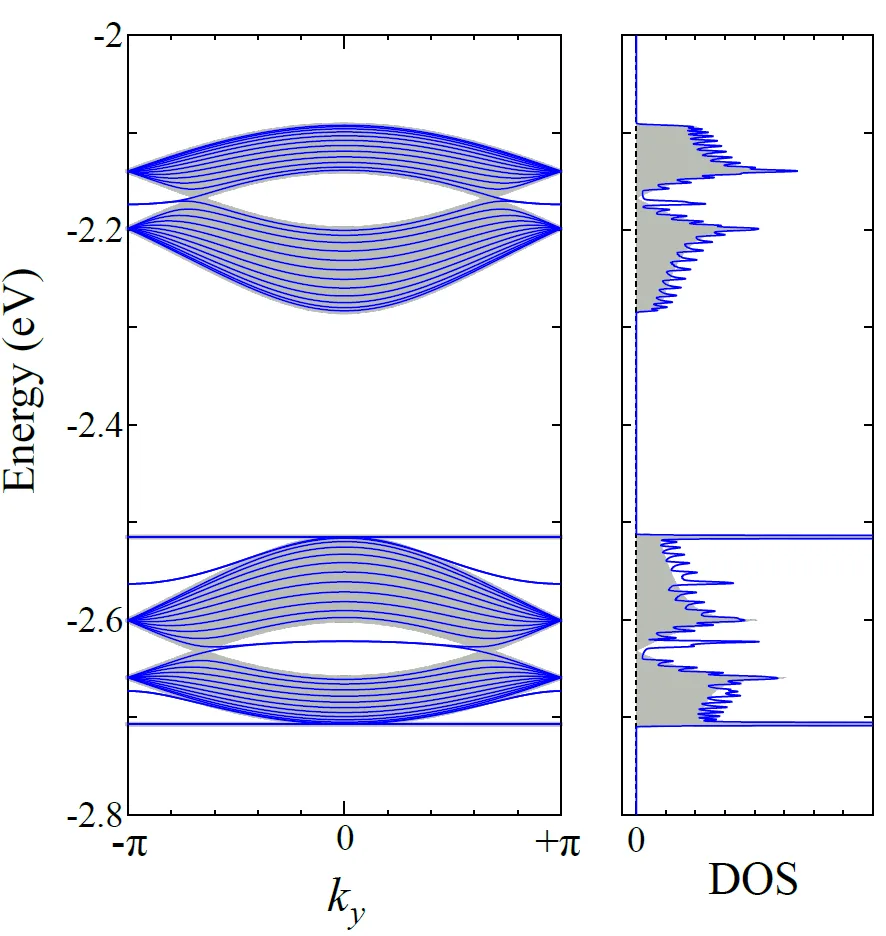
In dI/dV spectra taken away from the edge, peaks appear at bias voltages of 0.99, 1.11, 1.39, and 1.48 V, corresponding to van Hove singularities in the Dirac and flat bands. Near the zigzag edge, an additional bright peak emerges at 1.42 V, localized within the first three molecular rows. dI/dV maps at this voltage show a chain of bright spots along the edge, directly indicating edge states. Tight-binding calculations reproduce this peak and show that it is associated with states ES5, which exist in the band gap between the upper Dirac bands. The spatial distribution of these states also matches the experiment: they are concentrated in the first three rows. Additional features at 1.05, 1.20, and 1.31 V may be related to other edge states (ES1, ES2, ES3), but their identification is less certain.
Implications
This work demonstrates, for the first time, edge states in a diatomic kagome lattice realized via supramolecular assembly. Unlike related studies where kagome lattices were created from inorganic layers or by confining metal surface states, here the lattice is built from molecular orbitals, ensuring nearly ideal geometry and weak coupling to the substrate. This allows a direct connection between experiment and tight-binding model, confirming the topological nature of the states through Zak phase quantization. This approach opens a new route for engineering quantum materials with controllable topology.
Future development
The molecular approach can be extended to other non-planar π-conjugated molecules, such as triptycene-triphenylene (TTA), which forms layered crystals with a breathing kagome lattice. By varying the molecule length or the substrate, one can tune the ratio of hopping parameters t0/t1 and switch the system's topology. Corner states of second order are also theoretically predicted and could be sought in such structures. Further development of supramolecular technology will enable the creation of lattices with exotic electronic properties, including flat bands and topological superconductivity.
Impact
The results may be useful for developing new quantum materials based on molecular lattices and for testing theoretical models of topological phases in artificial structures.
Next steps
Immediate next steps include searching for corner states in the same system and synthesizing and studying other molecules with tunable geometry to adjust topological properties.
Key open problems
This work directly addresses the fundamental challenge of realizing predicted topological phases in real materials. Molecular lattices circumvent difficulties associated with imperfect crystal structure and unwanted interactions that often plague inorganic systems. This opens the way to systematic studies of correlated topological states, such as the quantum anomalous Hall effect and superconductivity in kagome lattices.
The knowledge machine's view
This section is addressed to the author of the paper and their colleagues. Neighbouring works were found by meaning-based search across our archive, not by word overlap. We do not review: we show the field around the work.
What the work does
The study demonstrates edge states in a two-atom Kagome lattice assembled from organic triptycene molecules on a lead surface. Using STM and tight-binding calculations, the authors observed localized density-of-states peaks at zigzag edges and linked them to topologically protected states quantized by the Zak phase.
Where its strength is
The strength of the work lies in the fact that molecular self-assembly yields a nearly perfect two-atom Kagome lattice with a predefined geometry and weak coupling to the substrate, providing direct experimental confirmation of theoretical predictions about edge states.
Where it could go next
- It might be interesting to see how magnetic ordering, similar to that studied in magnetic Kagome lattices, affects edge states in the molecular Kagome lattice.based on: A Magnetic Mosaic: How Atoms Divide Roles arXiv:2603.21203
- A related work on edge states in graphene is nearby; comparing with graphene edges might reveal common patterns and differences in topological protection.based on: The Edge of Graphene: How the Rim of Two-Dimensional Carbon Behaves arXiv:2602.17906
- It would be interesting to consider how twisting layers or changing intermolecular interactions could modulate edge states in such supramolecular lattices.based on: Twisted Graphene at a Preset Angle arXiv:2604.15639
Worth trying
- Test whether edge states persist when the substrate is changed (e.g., to a surface with different symmetry).
- Investigate the influence of magnetic impurities or a magnetic field on edge states in the molecular Kagome lattice.
- Try functionalizing the molecules to control the band structure and observe new edge states.
Why this may matter
This approach paves the way for creating quantum materials with tunable topology based on molecular self-assembly, which could lead to new spintronic and quantum computing devices.
Nearby works in our archive
- Flat Bands Sing in Unisonsimilarity 0.55
- A Magnetic Mosaic: How Atoms Divide Rolessimilarity 0.53
- Magnetic Patterns in Graphenesimilarity 0.53
- A Four-Partner Dance in Graphenesimilarity 0.52
- Quantum semimetal: electron and spin ghostsimilarity 0.52
- Twisted Graphene at a Preset Anglesimilarity 0.51
- The Edge of Graphene: How the Rim of Two-Dimensional Carbon Behavessimilarity 0.51
The archive is sparse around this work: the closest review is only 0.55, against a usual 0.64. It looks like few have drilled nearby.
Triptycene molecules have a rigid Y-shaped form, resembling a three-pointed star. Thanks to this, they spontaneously assemble into a kagome lattice, much like magnetic needles align into patterns on a plane.
The idea of creating materials with tailored electronic properties from molecular building blocks resonates with the concept of 'programmable matter' from science fiction, for instance in Neal Stephenson's novel 'The Diamond Age'.
Key numbers
- lattice constant: 1.92 ± 0.04 nm
- edge state peak voltage: 1.42 V
- number of localization rows: 3
- hopping parameter t0: -0.141 eV
- hopping parameter t1: -0.096 eV