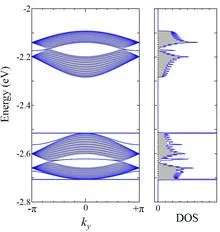
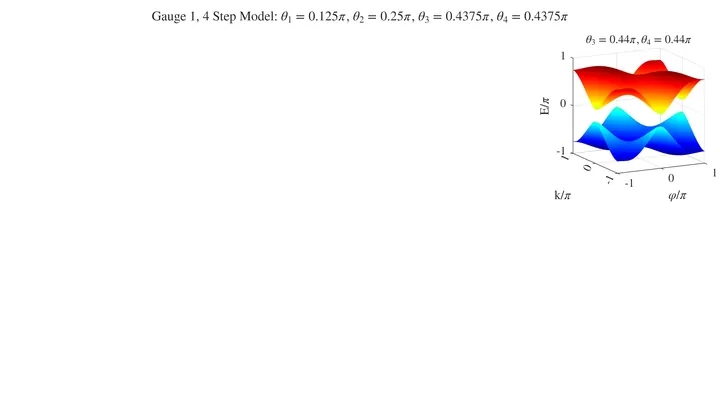
In 1928, Felix Bloch, working on his dissertation under Heisenberg, pondered: how to describe an electron in a crystal where the atoms are arranged periodically? The answer turned out to be surprisingly elegant: the wave function must be 'Bloch-like' — the product of a plane wave and a function repeating with the lattice spacing. This naturally led to the idea of energy bands: some energy intervals are allowed, others forbidden. Thus band theory was born, explaining the difference between metals, dielectrics, and semiconductors.
History
In 1928, Felix Bloch, completing his dissertation under Werner Heisenberg in Leipzig, rigorously proved that the electron wave function in a periodic potential must have the specified form. This immediately led to an understanding of the band nature of the spectrum and became the key to the theory of metals and insulators. Later the theorem was generalized to the case of an external magnetic field (Rama-Showen theorem), as well as to systems with strong spin-orbit coupling and topological phases.
How it works
The theorem is strictly valid only for ideal infinite crystals. Impurities, boundaries, defects, and thermal vibrations break translational symmetry, and Bloch states cease to be proper. Nevertheless, for most real materials, the Bloch approximation works excellently. To account for electron-electron correlations, one must go beyond the single-electron picture; modern methods include density functional theory and dynamical mean field theory.
In practice
The entire band theory of solids rests on Bloch's theorem. Without it, it is impossible to understand why some materials conduct electricity and others do not, and to design a transistor, LED, or laser.
Fun fact
Bloch left his mark in various fields: there are 'Bloch walls' in magnetism and the 'Bloch sphere' for qubits, but his theorem on waves in a crystal is a separate masterpiece.
The triptycene molecule resembles a three-pointed star with rigid arms. When such stars are scattered on a lead surface, they spontaneously assemble into a pattern like a woven basket: triangles and hexagons alternate, and at each node sits not one star but a pair.
A sculptor looks at a block of marble and sees the figure within, waiting to be freed from excess material. Instead of adding clay, he removes everything that is not part of the form. The authors of a new study on magnetic resonance took a similar approach: rather than complicating the tissue model by adding ever more details, they stripped away the superfluous to reveal the essence.
In the world of crystals, there is a hidden geometry. When an electron runs through a two-dimensional insulator, its path is twisted by an invisible force — topology. This twist is described by the Chern number, an integer that cannot be changed by smooth deformation.
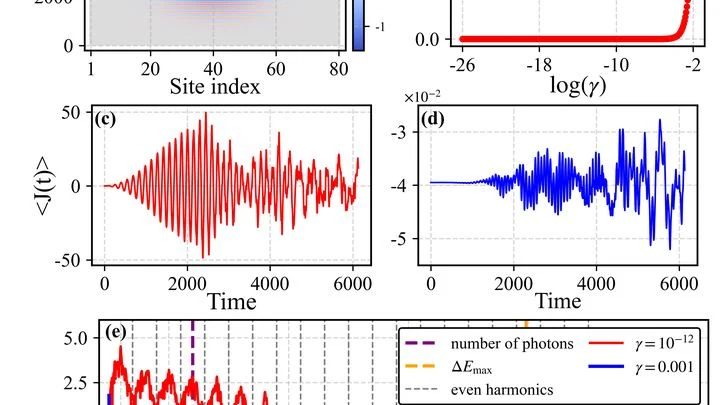
A guitar string plucked exactly at its middle produces only odd overtones. The same prohibition holds in symmetric crystals: when light knocks out electrons, their re-emitted radiation contains only odd harmonics. But physicists have found a way to bypass this rule — without shifting a single atom.
The secret is electric current.
In a crystal, electrons are not distributed randomly. Their waves obey the lattice symmetry, like ripples on water taking the shape of a hoop thrown into it. The new work shows that at high-symmetry points, this ripple must have nodes — places where electron density is strictly zero.
A tuning fork struck once rings pure and long. But if you shake the fork itself while it sounds, the tone wavers and dies out quickly. Something similar happens to electrons in any piece of matter. Atoms in a lattice never stay put: thermal vibrations keep them jittering.
Plasma is not just hot gas; it's an entire orchestra of charged particles, each group playing its own part. Heavy ions (atoms that have lost electrons) set the slow rhythm, while light electrons dart around ten thousand times faster.
For over a century, astronomers puzzled over the capricious behavior of RR Lyrae stars: their brightness periodically waxed and waned with unpredictable amplitude, like a lighthouse with a faulty mechanism. The Blazhko effect, discovered in 1907, taunted scientists for decades.
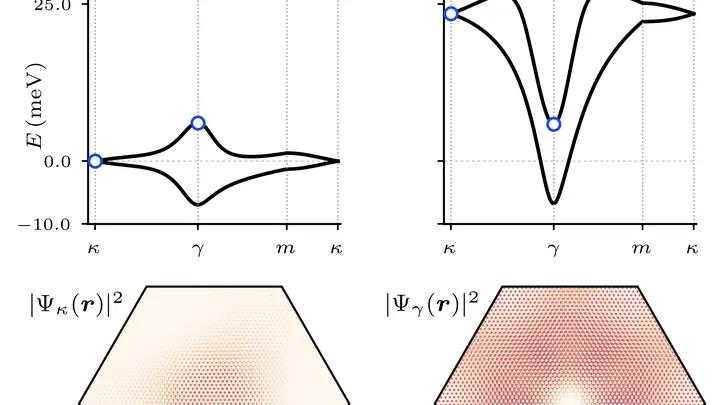
In the world of two-dimensional materials, states sometimes emerge that are as extraordinary as they are fragile. One of them — the fractional anomalous Hall crystal (FAHC)—is like a quantum centaur: half ordered lattice, half topological liquid.
In the center of almost every large galaxy lurks a supermassive black hole, whose gravitational abyss was first mathematically described by Karl Schwarzschild. When it swallows gas, a dazzling active nucleus is born — a quasar.
A regular object moves along a predictable path, like a ball. In the quantum world, a particle is smeared into a probability cloud. To find order in this fog, scientists have recast Schrödinger's equation in the language of flowing water.
Creating a material with desired properties is an art that long relied on intuition and luck. Nature gives no hints: dozens of elements in the periodic table, and the number of their combinations tends to infinity. Previously, materials scientists resembled alchemists, trying everything in a row, or relied on statistical models that lost power beyond the known.
Electrons in a crystal are like cars on city streets: some race down avenues, others get stuck in traffic jams. In certain lattices, motion freezes entirely — velocity stops depending on energy, and electrons become "flat." This isn't a traffic jam but a special rhythm of the network where waves cancel each other out.
In 1958, Philip Anderson showed that strong disorder can stop a wave. Since then, physicists have discovered that between complete stoppage and free travel there are intermediate regimes. A particle can not only stand still or fly, but also jitter in place, pulse, or combine several types of motion at once.
The paradox of the young solar wind has long puzzled heliophysicists. Measurements showed that near the Sun, proton beams aren’t smeared out but sharply compressed, as if someone had neatly hammered them into the shape of a hammerhead.
A tellurium crystal resembles a tiny spiral staircase: its atoms are twisted into a helix. When heat runs through such a crystal, it is carried not by electrons but by sound waves — vibrations of the lattice itself. These waves don't just push back and forth; they also rotate around their axis like a spinning top.
A time crystal resembles an eternal clock: its atoms spontaneously perform rhythmic movements. In ordinary clocks, a pendulum is driven by a spring or battery, but here the motion arises without an energy supply — the system simply returns to its initial state at regular intervals. This idea was proposed by Frank Wilczek in 2012.
The pendulum of an old clock swings because a spring mechanism gives it a regular nudge. Now imagine a pendulum that decides on its own when to swing, and does so with a steady rhythm, just because the room is warm and there's a slight draft. That's exactly how time crystals behave, born in clumps of light and matter inside a semiconductor chip.
A stone falls into a pond, and ripples spread across the water. They reflect off the shore, overlap, and die out. All this motion unfolds in space. But what if the pond itself changed its depth or density for an instant — not at one point, but everywhere at once? A temporal boundary is exactly such a jump in properties over time, not space.
A hot spoon in a cup of tea — heat runs along the metal from the hot end to the cold one. Textbooks describe this process as atoms jiggling and passing on their jolts to each other. But atoms don't just jiggle: they also spin, like tiny tops. Until now, physicists had no common language to describe both motions at once.
The authors of the work built such a language.
Hundreds of people on a dance floor stand at equal distances from each other — strict order, like in a crystal lattice. Slow music is thermal vibrations, making dancers sway slightly. If the music gets louder and faster, order collapses: everyone mixes. That's how thermal motion destroys ordered states of electrons in solids.
An ordinary crystal is like an apartment building: electrons move through shared hallways and staircases, influencing each other through the walls. Now, imagine removing all the walls, leaving just a single line of apartments. How would the residents behave?
Hydrogen has nothing to do with it, but the collective behavior of electrons takes center stage.
Electrons in a crystal sometimes behave like a stadium crowd doing the wave: areas of higher density alternate with nearly empty ones. This wave blocks the free flow of charges — under normal conditions, the material is not superconducting. But apply pressure, and the wave vanishes, letting electrons move without resistance.
Toss a handful of pebbles into a pond, and the spreading ripples intersect, creating splashes and calms. That’s roughly how gravitational waves, predicted by Einstein, behave. Except it’s not water that’s oscillating, but spacetime itself.
An electron inside a crystal is like a traveler walking through a city with winding streets. Its direction of motion constantly changes depending on where it is. Physicists call this feature the geometric Berry phase, and it determines how a material conducts electricity or responds to a magnetic field.
A magnesium oxide crystal is like a row of soldiers: atoms stand in neat lines, and an electron runs along them. But if the electron lingers, the nearest atoms shift slightly from their positions, like neighbors in a rank turning their heads. The electron finds itself in a dip made of displaced atoms and can no longer move freely.
Diamond is not just a gemstone. This crystal can conduct electricity when free charge carriers, electrons and holes, appear in it. But how fast do they move? In scientific papers, numbers vary by tens of times. One lab reports a mobility of 1000 cm²/(V·s), another 4000.
A crystal without a center of symmetry is like a staircase where all the steps are tilted in the same direction: electrons, given a kick by light, roll predominantly in one direction. This is how a direct current is born — the photogalvanic effect.
Time crystals pulse in time, like a perpetual metronome that never needs winding. The idea was proposed by Frank Wilczek almost ten years ago. Previously, to keep such a metronome from losing its beat, disorder was deliberately introduced into the system — a paradox, but chaos helped the rhythm.
Open systems exchange energy with their surroundings, like a guitar string fading into the air. Scientists built such a system out of light, twisting the beams into corkscrews and forming an artificial lattice — a maze where losses can be controlled at every step. Light in this maze always moves at the maximum possible speed, but its energy can fade or grow.
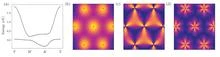
Electronic charge is a tumbleweed that moves camp depending on energy. In tungsten selenide (WSe₂) crystals, this is seen with utmost clarity: at a bias of −1.4 V, near the K point of the Brillouin zone, the maxima of tunneling current sit in the centers of hexagons, where there are no atoms.