A honeycomb lattice is a two-dimensional arrangement of points where each point has six nearest neighbors, forming a pattern of regular hexagons that resembles a honeycomb. In physics, this lattice structure is famous because it is the arrangement of carbonatoms in graphene, but it also appears in other materials and artificial structures. When printed for optical applications, a honeycomb lattice can act as a photonic crystal, controlling the flow of light in ways that are impossible in ordinary materials.
History
The honeycomb lattice's importance in physics was highlighted after the isolation of graphene in 2004, which earned Andre Geim and Konstantin Novoselov the Nobel Prize in Physics in 2010. The concept of photonic crystals was developed in the 1980s by Eli Yablonovitch and Sajeev John.
How it works
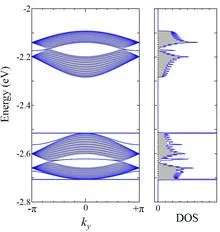
The honeycomb lattice has a unique electronic band structure, featuring Dirac cones—points where the energy-momentum relationship is linear, making electrons behave like massless relativistic particles. In photonic crystals, the periodic variation of the refractive index in a honeycomb pattern creates photonic band gaps, which are frequency ranges where light cannot propagate. By introducing defects or engineering the lattice geometry, researchers can create waveguides, cavities, and other optical components on a microscopic scale.
In practice
Honeycomb photonic crystals are used in integrated optical circuits, where they guide and manipulate light for telecommunications and sensing. They are also being explored for quantum information processing, where they can confine and route single photons.
Fun fact
In a honeycomb lattice, electrons can behave as if they have no mass, moving at a constant speed regardless of their energy—a phenomenon that has been directly observed in graphene.
The triptycene molecule resembles a three-pointed star with rigid arms. When such stars are scattered on a lead surface, they spontaneously assemble into a pattern like a woven basket: triangles and hexagons alternate, and at each node sits not one star but a pair.
The laser beam in an optical tweezer is not just a spot of light but a force bag. A particle caught in it usually rolls toward the brightest point, like a ball into a dimple.
A honeycomb made not of wax but of atoms is graphene — a flat crystal just one atom thick. Electrons in it are like runners at an intersection: they speed up here, slow down there, but never get stuck at the edge. Physicists call such a sheet "topologically trivial," meaning its edges are perfectly ordinary, with no special properties.
Now, let's knock out a single atom from the honeycomb.
A pendulum that swings almost half a quadrillion times per second. This isn't mechanics: it's the pulse of light trapped by ytterbium atoms. Instead of gears, there's an optical lattice — a standing wave that holds atoms at its nodes like peas in a pod.
In a crystal of water and caustic cesium, oxygen and cesium atoms sit in place like beads in a rigid lattice. Hydrogen atoms behave differently: they are like passengers constantly changing seats. In this layered material, each oxygen is linked to three neighbors via hydrogen bridges, forming a honeycomb-like pattern.
The glow of an ultrathin sandwich made of two semiconductor layers, molybdenum selenide and tungsten selenide, resembles a tangled musical score: many narrow colored lines that merge into a general background. Figuring out which line comes from where is nearly impossible.
The authors did not try to disentangle the lines one by one.
The crystal Co2SeO3Cl2 resembles a layered cake, with each layer being a buckled honeycomb grid of cobalt atoms. When cooled to 25.4 K (−247.75 °C), the magnetic moments of the atoms begin to align like compass needles, but not all at once — rather in four steps, at 25.4, 16.8, 11, and 3 K. Each step brings a new pattern of magnetic order.
A thin crystal of hexagonal boron nitride is a relative of graphite, but transparent and insulating. Occasionally, single defects appear in its lattice: a boron or nitrogen atom is missing, leaving a trap for electrons. Such a trap can absorb light and re-emit it, like a tiny flashlight.
A handful of lead sulfide nanocrystals coated with charged molecules spontaneously assembles into a perfect crystalline lattice. Each nanocrystal is like a brick just a few nanometers across, while the charged molecules on its surface act as the mortar.
Light from a distant galaxy travels toward us for billions of years, but along the way it can run into a massive galaxy cluster. Its gravity acts like curved glass: it bends the path of rays, so instead of one image, we see several — sometimes arcs, sometimes points.