The Iron Chain: Haldane Gap in a Coordination Polymer ✛
Context
One-dimensional antiferromagnetic spin chains are a canonical example of how quantum fluctuations affect the ground state. Haldane's conjecture established a qualitative difference between half-integer and integer spin chains: for an isotropic spin-1 chain, the ground state is non-degenerate and separated from the lowest triplet excitation by a finite gap. The search for materials realizing this physics has led to molecular and atomically engineered chains. This work stands alongside studies of quasi-one-dimensional spin-1 compounds and nanowires, but focuses on a coordination polymer where the spin state, exchange, and anisotropy arise from the metal–ligand coordination environment.
Methods
Spin-model parameters were obtained from density functional theory calculations with spin–orbit coupling (VASP, vdW-DF2-B86R functional, DFT+U with Ueff = 1 eV) followed by mapping of magnetic energies onto a Heisenberg Hamiltonian with single-ion anisotropy. We used 42 configurations (21 magnetization directions in both ferromagnetic and antiferromagnetic orderings). The resulting spin Hamiltonian was solved by exact diagonalization (QuSpin, up to N = 16) and DMRG (TeNPy, up to N = 100). The dynamical spin structure factor was computed using the Lanczos continued-fraction method for N = 12.
Results
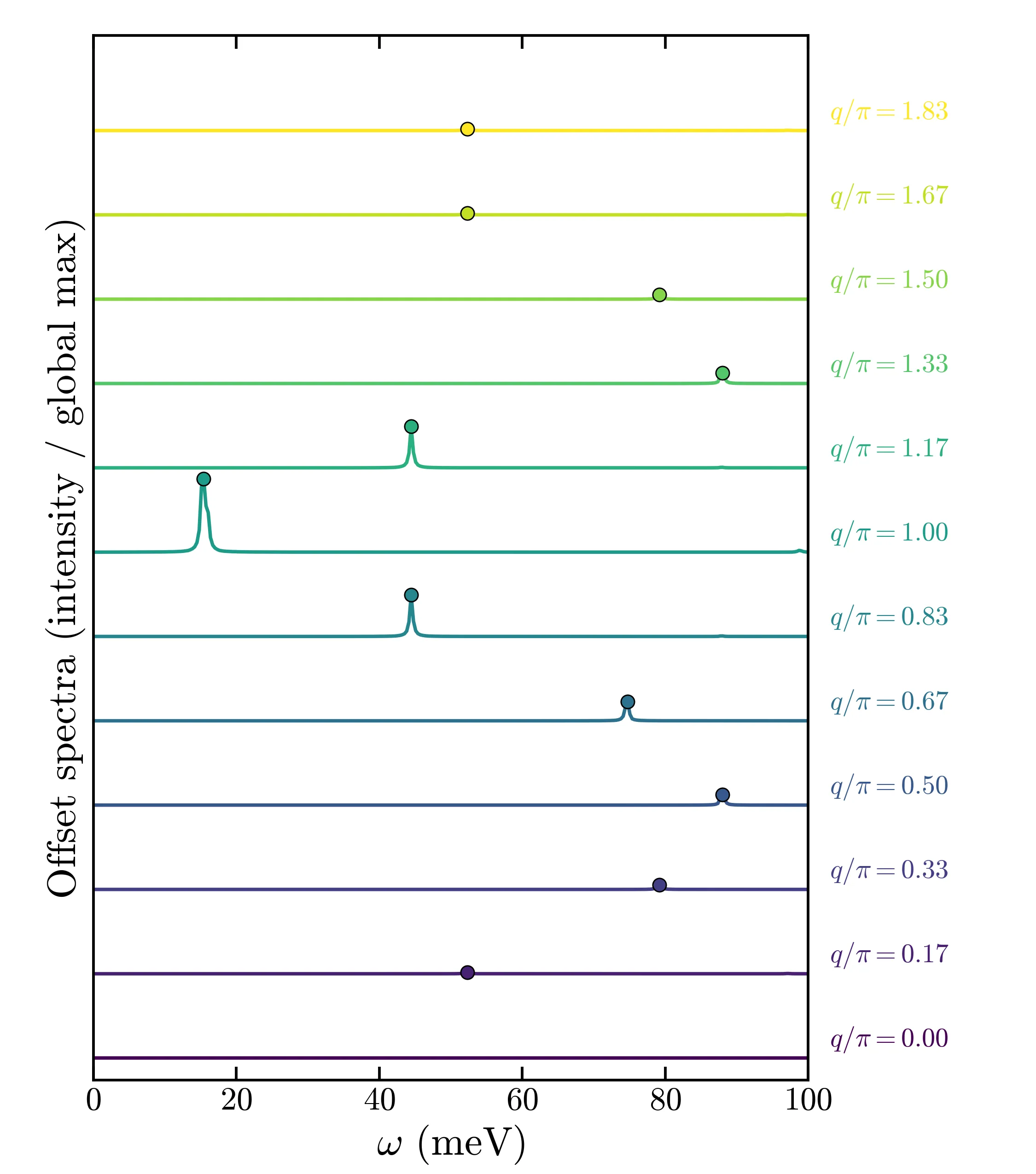
The exchange tensor is nearly isotropic: diagonal components are about −16 meV, off-diagonal components are less than 0.06 meV. The isotropic exchange is JH = 32.206 meV. Single-ion anisotropy is weak: Dxx = −0.152 meV, Dyy = −0.089 meV, Dzz = 0.241 meV. Exact diagonalization gives a gap of 13.695 meV in the isotropic limit, and with anisotropy three branches appear: 13.382, 13.516, and 14.196 meV. DMRG for N = 100 yields 13.232 meV (anisotropic model) and 13.537 meV (isotropic), consistent with ED. The dynamical structure factor shows the largest intensity near q = π at an energy of about 15–16 meV for N = 12, with a small splitting of components due to anisotropy.
Implications
This work demonstrates that the microscopic interactions of the specific coordination polymer Fe–dehydroindigo place it in the gapped regime consistent with Haldane-chain physics. Unlike neighboring studies that investigate graphene nanostructures or magnetic alloys, here we show for the first time that an Fe-containing spin-crossover polymer approaches the isotropic spin-1 Heisenberg limit. This expands the class of candidate materials for realizing the topological Haldane phase.
Future development
The topic could develop toward a full characterization of topological order: computing the nonlocal string order parameter, the entanglement spectrum, and edge states for open chains. Also promising is the inclusion of the Ag(111) substrate to understand how screening and hybridization renormalize the model parameters.
Impact
The results will impact research in molecular magnetism, spintronics, and quantum materials, where one-dimensional systems with nontrivial topology are sought.
Next steps
Next steps include computing topological invariants and modeling the chain on a silver substrate for comparison with experimental data.
Key open problems
This work is connected to the unresolved problem of finding stable materials that realize the Haldane phase at room temperature, and to the question of how a substrate affects the topological properties of molecular chains.
The knowledge machine's view
This section is addressed to the author of the paper and their colleagues. Neighbouring works were found by meaning-based search across our archive, not by word overlap. We do not review: we show the field around the work.
What the work does
This work explores whether Haldane-chain physics can be realized in the coordination polymer Fe-dehydroindigo. First-principles calculations yield the parameters of an effective spin model (a nearly isotropic exchange coupling JH = 32.206 meV and weak single-ion anisotropy), and exact diagonalization together with DMRG then reveals a nondegenerate ground state with a gap of 13-14 meV. The dynamic spin structure factor shows that the low-energy weight is concentrated near q=π.
Where its strength is
The work stands out because, for a specific coordination polymer, Fe-dehydroindigo, it demonstrates proximity to the isotropic spin-1 Heisenberg limit and shows that a gapped Haldane phase is realized. This widens the pool of candidate materials for topological spin phases, building on careful first-principles calculations and reliable methods for solving the spin model.
Where it could go next
- It could be interesting to compare the resulting gapped phase with the magnetic properties of ultrathin films, where dimensionality and interface effects also shape the ground state. In particular, our archive holds an analysis of a study on the magnetism of monolayers that discusses one-dimensional magnetic correlations and the role of anisotropy.based on: An Atom-Thick Magnet: Power in a Single Layer arXiv:2605.22783
- A possible next step involves studying the topological aspects of the ground state: a neighboring analysis of a study on the magnetic alloy Co₂FeGe examines the topological properties of magnetic materials, which could be useful for analyzing edge states in a Haldane chain based on Fe-dehydroindigo.based on: Magnetic Co₂FeGe Alloy: A Metal with Two Faces arXiv:2505.24836
- There is also a nearby work on twisted tungsten layers that discusses the link between topology and superconductivity; ideas of this kind might help us view the Haldane chain in the context of multilayer or interface systems built from coordination polymers.based on: Twisted Tungsten Layers: Topology on the Road to Superconductivity arXiv:2607.15611
Worth trying
- Use DMRG with open boundary conditions to check how finite chain length and edge states affect the dynamic structure factor.
- Probe the temperature dependence of the magnetic susceptibility and compare it with predictions for a Haldane chain in order to assess the role of single-ion anisotropy.
- Consider doping or ligand modification as a way to enhance single-ion anisotropy and drive the system toward other phases (for example, the large-D phase).
Why this may matter
Realizing a Haldane chain in a coordination polymer opens a route to new materials with topologically protected edge states, which matters for spintronics and quantum technologies. What is more, the first-principles approach combined with mapping onto a spin model can be applied to a broad class of metal-organic frameworks to predict exotic magnetic phases.
Nearby works in our archive
- Twisted Tungsten Layers: Topology on the Road to Superconductivitysimilarity 0.48
- Magnetic Co₂FeGe Alloy: A Metal with Two Facessimilarity 0.47
- Eccentricity: a magnifying glass for gravitational wavessimilarity 0.46
- Triple Quantum Entanglement: The Whole Is Greater Than the Sum of the Pairssimilarity 0.46
- The shape of the xenon nucleus is no longer a mysterysimilarity 0.46
- An Atom-Thick Magnet: Power in a Single Layersimilarity 0.45
The archive is sparse around this work: the closest review is only 0.48, against a usual 0.64. It looks like few have drilled nearby.
The Haldane gap in this chain is about 13–14 meV, which corresponds to a temperature of roughly 150–160 K. This means that quantum entanglement effects persist even when cooled with liquid nitrogen.
Key numbers
- exchange interaction JH: 32.206 meV
- Haldane gap (ED): 13.382–14.196 meV
- Haldane gap (DMRG, N=100): 13.232 meV
- temperature corresponding to JH: about 374 K