Galaxy Blows Metals into the Early Universe ✛
In a village smithy, the blacksmith pumps the bellows, and sparks fly into the darkness. So too in the galaxy AEON-z5, an active nucleus, like a red-hot forge, hurls metal-enriched material far beyond the stellar disk. The James Webb Space Telescope caught this process just a billion years after the Big Bang, when the universe was still in its infancy.
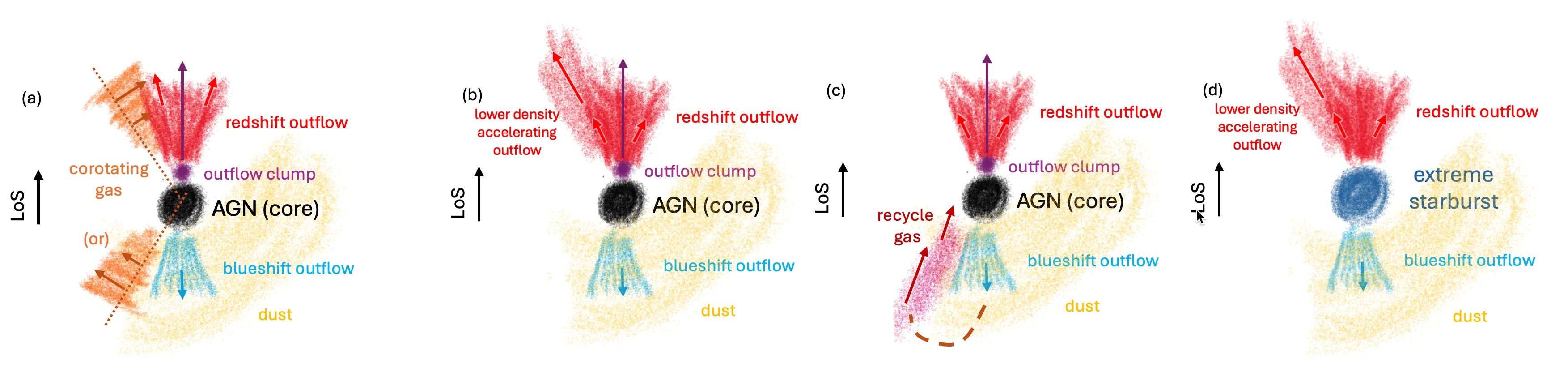
The gas in the Hα+[N ii] line extends to a projected radius of more than 4 kiloparsecs, which is 2–2.5 times the effective radius of the stellar component, whose mass is about 2×$10^{10}$ solar masses. The central line profile splits into three components: a narrow core with a width of 88 km/s, a blue wing shifted by −288 km/s, and a dominant red asymmetric flow with a mean shift of +489 km/s and a width of 630 km/s. The high-velocity wing reaches 792 km/s, and a possible separate clump has a velocity of about 2800 km/s. It is as if the forge were throwing out not just sparks but entire red-hot chunks of metal.
The [N ii]λ6584/Hα ratio is 0.49 in the core and 0.33 in the nebula, corresponding to metallicities of 0.98 and 0.76 solar, respectively, according to the AURORA calibration. Even after correcting for excitation by the active nucleus and systematic errors, the metallicity remains above 0.37 solar. In other words, the gas has already passed through stars, which, like furnaces, smelted heavier elements from hydrogen and helium. Modeling of the spectral energy distribution yields an accretion disk luminosity of 4.1×$10^{45}$ erg/s, enough to power an outflow with a kinetic power of up to 6.6×$10^{42}$ erg/s.
Previously, it was unclear whether active galactic nuclei could, within the first billion years after the Big Bang, eject metal-enriched gas to the outskirts of galaxies and into the surrounding medium. Now a galaxy, AEON-z5, has been found where nitrogen and hydrogen emission is traced out to 4 kiloparsecs, and the gas metallicity is close to solar. This points to real transport of chemically processed material. The spatial distribution of the emission lines was compared with the size of the stellar disk, and gas velocities were measured from line shifts in the slitless spectrum.
The result can serve as a benchmark for interpreting future observations of metal absorbers and for calibrating feedback models in the early universe. The sparks from the forge are flying ever farther, and at last we see them settling into the surrounding darkness, enriching it with metals for future generations of stars and planets.
The speed of the possible clump, 2800 km/s, is 10 times the speed of a bullet. If such a clump is indeed associated with the galaxy, it would cover the distance from Earth to the Moon in two minutes.
In Stanislaw Lem's novel "Fiasco," humanity attempts to make contact with a civilization hidden behind powerful ejections of energy and matter. AEON-z5 reminds us that even solitary galaxies can expel matter over vast distances, creating structures we are only beginning to discern.