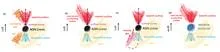
Galactic winds are large-scale outflows of gas and dust driven by intense star formation or the activity of a supermassive black hole at a galaxy's center. These winds can travel at hundreds to thousands of kilometers per second, carrying material far beyond the galactic disk. They play a crucial role in regulating star formation by removing the gas needed to form new stars, and they enrich the intergalactic medium with heavy elements forged in stars.
History
The concept was developed in the 1960s and 1970s, with early theoretical work by astronomers like Lyman Spitzer and William Mathews. Observations of starburst galaxies in the 1990s provided direct evidence for these outflows.
How it works
The wind is powered by the combined energy of supernova explosions and stellar winds from hot, massive stars, or by the accretion disk around a supermassive black hole. This energy heats the surrounding gas to millions of degrees, causing it to expand and accelerate outward. The hot gas can also sweep up cooler clouds of gas and dust, dragging them along. The wind's speed and structure depend on the balance between the energy input and the gravitational pull of the galaxy.
In practice
Galactic winds are key to understanding galaxy evolution, including why massive galaxies stop forming stars and how heavy elements spread through the universe. They are also studied as potential sources of cosmic rays.
Fun fact
The wind from the Milky Way's central black hole, Sagittarius A*, is so powerful that it carves out a 'chimney' of hot gas extending thousands of light-years above and below the galactic plane.
In a village smithy, the blacksmith pumps the bellows, and sparks fly into the darkness. So too in the galaxy AEON-z5, an active nucleus, like a red-hot forge, hurls metal-enriched material far beyond the stellar disk. The James Webb Space Telescope caught this process just a billion years after the Big Bang, when the universe was still in its infancy.
A harbor lives by the tide schedule. Water rises and falls, and with it everything changes: the level at the dock, the composition of the sediment on the bottom, even the salinity in the far corners. A galaxy works similarly, except instead of water it has gas, and instead of the Moon, it has its own stars and neighboring clouds.
At the center of an ultra-compact dwarf galaxy, a very dense stellar system spanning tens of light-years, there is a vacuum cleaner at work. But instead of dust, it sucks in gas shed by dying stars. This gas does not fly off in all directions; instead, it spirals into a funnel, a rotating disk that gradually settles onto the black hole.
A black hole with a mass of 35,000 Suns drifts through a galaxy's gas like a barge through fog. Its gravity rakes the material ahead of it, leaving a dense trail behind — a wake of gas. Some of that gas gets pulled into the black hole, and it grows.
Pulsar PSR J1740+1000 is a city-sized star spinning faster than a kitchen blender. After a supernova explosion, it left behind a dense core that accelerates particles to near-light speeds. These particles fly into space, and previously it was thought they scatter in all directions, like splashes from a stone thrown into water.
A whirlpool gulps down water, but splashes most of it back out. That's roughly how a black hole behaves when too much matter falls onto it. In a new study, astrophysicists ran 32 computer simulations to understand how a black hole's parameters — mass, spin, and "appetite"—control these cosmic fountains.
A globular cluster, a dense swarm of hundreds of thousands of stars, plows through a galaxy like a bullet through water. In ordinary dark matter (the invisible mass that holds galaxies together), it should quickly lose speed due to dynamical friction.
A bright lantern in thick fog seems dim, while a weak flame in clear air can be seen a kilometer away. A similar oddity baffled astrophysicists almost half a century ago.
A disk of gas and dust spins around the young star HV Tau C, nearly edge-on to us. The James Webb Space Telescope examined its spectrum and detected the glow of hot molecular hydrogen (H₂). This revealed a wide, bipolar wind blasting from the inner regions far beyond the disk.
A gas disk with a mass of four hundred thousand suns encircles the black hole at the center of the Milky Way. Its gravity works like a gravitational rudder: slowly but inexorably turning the orbits of binary stars, driving them into the region where tidal forces tear the pair apart.
295 000 meters per second. Not even particles in solar coronal ejecta move that fast. But at the center of the galaxy cluster H1821+643, hot gas does exactly that. The quasar at its heart takes a breath, and its breath stirs everything around for 60 thousand light-years.
In 1,433 pairs of galaxies scattered across the sky, astronomers noticed an unusual pattern. Neighbors located 'above' or 'below' a massive stellar system contain up to a quarter more oxygen than those lying in the plane of its disk.
The fastest wind in the Universe travels at 0,58 times the speed of light. It covers the distance from Earth to the Moon in two seconds. This wind is not a jet stream but a broad flow of gas erupting from the center of a galaxy. Not all black holes work the same: some create such hurricanes, while others produce narrow plasma beams.
A branch falls into a whirlpool. It gets spun and broken, but sometimes a powerful fountain of water bursts from the center. Similarly, a black hole tears apart a passing star, and occasionally a blinding plasma jet, a jet, shoots into space.
The event horizon's edge is never calm. Quantum vacuum boils there, and particles sometimes burst out of this foam: that is how Stephen Hawking in 1974 discovered black hole radiation, forever linking gravity with quantum field theory.
In 5 billion years, the Sun, having exhausted its fuel, will start to swell, turning into a red giant. Like a balloon losing air, the star will weaken its gravitational grip, and Earth — a grain of sand on an invisible thread — will drift to a more distant orbit.
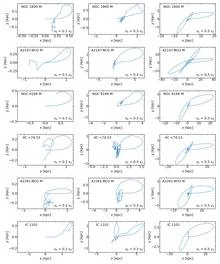
At the heart of nearly every large galaxy lives a supermassive black hole — a silent giant around which stars, gas, and other, smaller black holes orbit. From time to time, one of these objects breaks free from its orbit and begins to fall toward the central monster in a tightening spiral.
A vast city lights new streetlamps every night. But then a hurricane sweeps in, rips all the fuel from the warehouses, and the lamps go out one by one. Something similar has been spotted by astronomers in a galaxy whose light has traveled 12.5 billion years to reach us.
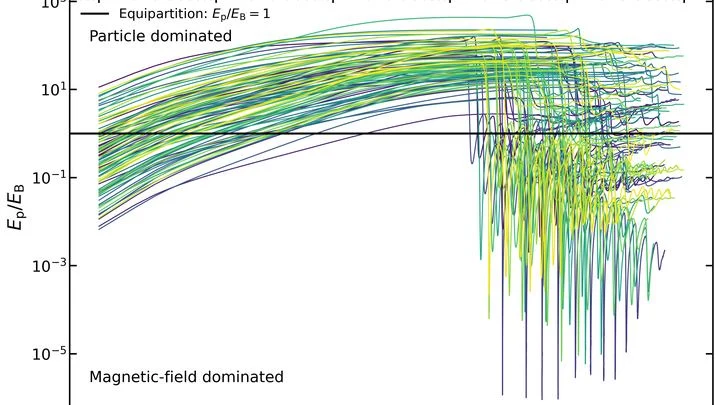
Blacksmith's bellows fan the fire by forcefully pushing out air. In space, the shock wave from a supernova, a concept introduced by Fritz Zwicky, acts like such bellows: it catches up with a giant bubble of charged particles and magnetic fields formed around a spinning neutron star…
In an orchestra, each musician plays their own part, but at a certain moment all instruments pause on a single note. Cosmic rays behave somewhat like this — particles flying toward us from distant stars.
A stream of scorching gas races away from a star, and suddenly stalls, as if it hit an invisible wall. That's exactly what researchers saw when they tried to reproduce a stellar eruption on a laboratory scale. They used a laser to create a plasma jet and shot it through a magnetic field — first weak, then strong, like that of many stars.
In cold clouds of interstellar gas, long, dense filaments stretch out. Inside them, like overcrowded incubators, future stars are maturing. For a long time, it was thought that within such filaments, everything was governed by gravity: matter smoothly flows toward the centers, where density increases and eventually a star ignites.
Interstellar space is not empty: it is filled with tenuous gas, which is warm in some places and cold in others. The boundaries between such regions resemble the walls between soap bubbles.
The James Webb Space Telescope is gazing more and more at exoplanets — worlds orbiting alien stars. Some of them are scorching rocky spheres, tidally locked with one side forever facing their star. There, rock melts into oceans of liquid lava. How does this lava move?
In the cold gas clouds where giant stars are born, everything is churning with motion. Gas compresses, swirls, and fragments into clumps — the future stars. For a long time, it was thought that the magnetic field brought order here: like invisible threads, it stretched clumps perpendicular to itself. But new observations showed the opposite.
Dough rises faster when it already contains yeast. Similarly, galaxies may have assembled faster if they already had black holes inside. Astrophysicists considered a scenario where the universe contained primordial black holes from the very beginning — objects that could have formed in the first instants after the Big Bang.
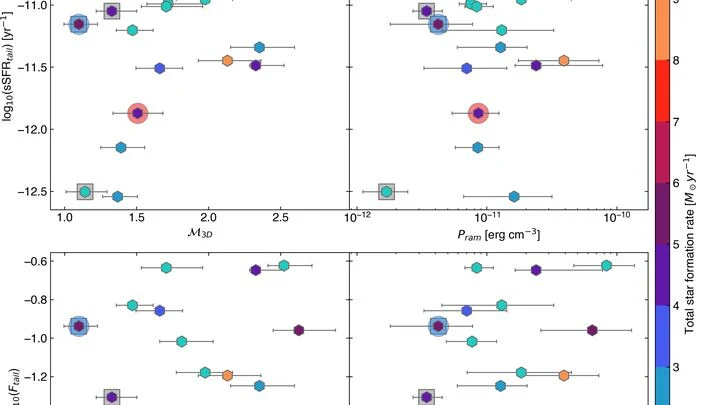
A galaxy plunges into a dense cluster like a runner into a crowd. The oncoming gas, known as the intracluster medium, strips away its own gas, stretching it into a long, glowing tail. Astronomers call these galaxies jellyfish: they have a body and flowing tentacles of stripped material. But only in a few do new stars ignite within those tentacles.
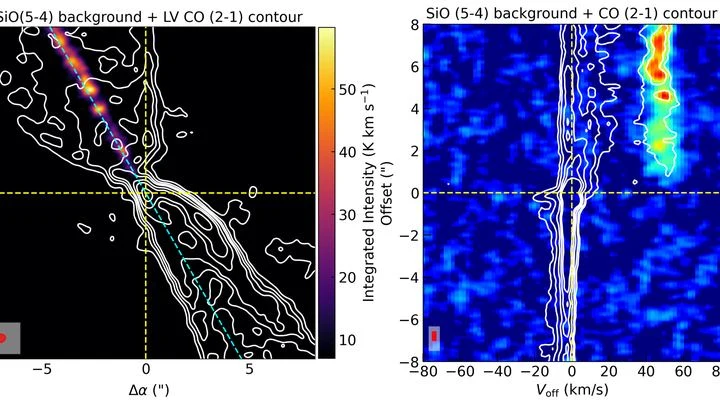
A young star that hasn't yet ignited its thermonuclear furnace is surrounded by a rotating disk of gas and dust. To gain mass, it needs to shed excess rotation — otherwise, material won't fall onto the star but will keep orbiting. Usually, this excess is carried away by two narrow gas jets that shoot from the star's poles in opposite directions, like two fountains.
A giant planet circles too close to its star. With each orbit, it tugs on the star with its gravity, and waves are born deep inside the star, like ripples from a stone dropped into water. These waves damp the planet's orbit, and it spirals into the star. The star swallows the planet and starts spinning faster.
Stellar rotation is the key clue.
The young star RY Tau is like a finicky spinning top. Around it whirls a flat disk of gas and dust — the leftovers of the cloud from which the star was born. The star pulls some of the disk's matter toward itself like a vacuum cleaner, and flings some back out in a narrow wind cone like a fountain.
In the cold clouds of gas and dust where stars will one day ignite, some atoms have lost electrons and become charged. Charged particles feel the magnetic field, while neutral ones do not, so the charged ones slip through the neutral ones like water through a sieve. Astronomers have measured this drift speed: about a hundred meters per second.
On large scales, the universe resembles a giant spiderweb: bright galaxy clusters are connected by long filaments of galaxies, gas, and dark matter. Previously, it was thought that matter flows along these filaments like water through pipes, heading toward the clusters.
A young star is surrounded by a flat, rotating disk of gas and dust — the construction site for future planets. The disk lives its own life: gas flows toward the star, dust clumps together, and from outside, harsh ultraviolet light from neighboring hot stars presses down on it all, like wind blowing leaves off a path.
At the center of galaxy VV 340a lies a supermassive black hole — an object with gravity so strong that even light cannot escape it. It emits a relativistic jet: a narrow stream of matter accelerated to near-light speeds.
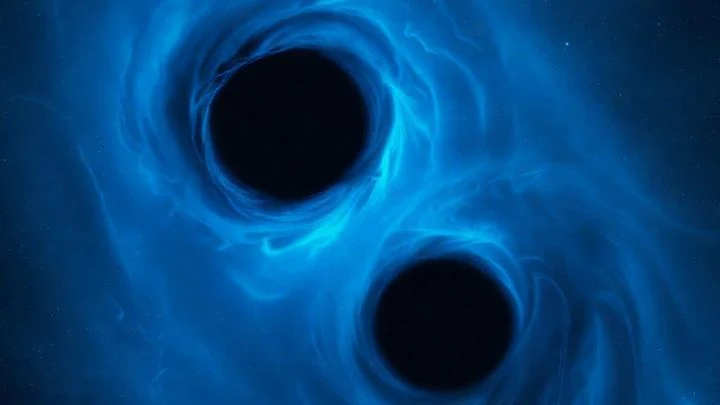
At the centers of almost all galaxies lurk black holes — invisible giants. When two galaxies collide, their black holes become a pair doomed to dance around each other. But to merge into one, they must close the gap from vast distances to just kilometers, in the final instant unleashing a burst of gravitational waves.
A hair dryer aimed at a block of ice strips vapor and droplets from its surface, and the ice slowly melts. The wind from the center of our Galaxy works in much the same way: it picks up cold gas clouds and carries them away, heating and shredding them along the way.
Astronomers decided to systematically search this flow for molecules, the coldest and densest form of gas, for the first time.
An exoplanet — a planet outside our solar system — follows a slightly elongated orbit. With each revolution, it swings closer to its parent star and then farther away.
At the centers of many galaxies lurk supermassive black holes, surrounded by disks of gas, cosmic dust, and stars. Their collisions can spawn gravitational waves — ripples in spacetime.
At the center of galaxy NGC 1600, 200 million light-years away, astronomers spotted a dense cluster of stars. It looked like a bright knot against the diffuse glow, and that was unexpected.
About 25,000 light-years from Earth, in the constellation Sagittarius, a dense veil wraps around the neutron star GX 13+1. It scatters X-ray photons the way fog scatters streetlight, and for a long time it hid the source's true power from astronomers.