Galaxy Blows Out Metals at the Dawn of the Universe ✛
Context
This work stands somewhat apart in the study of galactic outflows and the enrichment of the intergalactic medium. Neighboring studies examine metal absorbers, galactic winds, and neutral gas in the early universe, but almost all are limited to absorption lines or one-dimensional spectra. AEON-z5 stands out because it provides a spatially resolved image of emission lines on the scales of the outer interstellar medium and the inner circumgalactic medium. This is a rare opportunity to see the actual process of metal expulsion, not just its aftermath.
Methods
The team used deep NIRCam images from the James Webb Space Telescope in eight filters and slitless spectroscopy in the F444W band, which captures the Hα and [N ii] lines. The spatial distribution of the gas was reconstructed from the difference of images in the F410M and F444W filters, which separate the continuum and emission lines. The core kinematics were modeled in two dimensions with three components: a narrow core, a blue-shifted flow, and a broad asymmetric wing. For the extended nebula, the centroid shift of the Hα line was measured along each row of the spectrum, accounting for the spatial offset in the direct image. Additionally, spectral energy distribution modeling was performed separately for the core and the nebula using the BEAGLE code.
Results
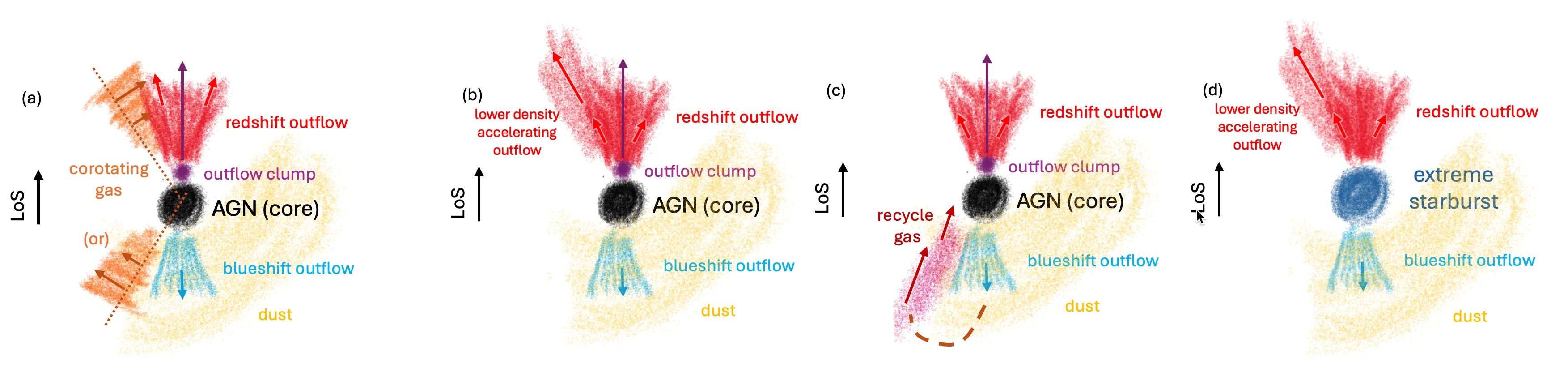
The gas in Hα+[N ii] extends to a projected radius of more than 4 kiloparsecs, which is 2–2.5 times the effective radius of the stellar component, which has a mass of about 2×$10^{10}$ solar masses. The central line profile decomposes into three components: a narrow core with a width of 88 km/s, a blue wing with a shift of −288 km/s, and a dominant red asymmetric flow with an average shift of +489 km/s and a width of 630 km/s. The high-velocity wing reaches 792 km/s, and a possible separate clump has a velocity of about 2800 km/s. The [N ii]λ6584/Hα ratio is 0.49 in the core and 0.33 in the nebula, corresponding to metallicities of 0.98 and 0.76 solar, respectively, according to the AURORA calibration. Even after correcting for excitation by the active nucleus and systematic errors, the metallicity remains above 0.37 solar. Spectral energy distribution modeling gives an accretion disk luminosity of 4.1×$10^{45}$ erg/s, which is sufficient to power an outflow with a kinetic power of up to 6.6×$10^{42}$ erg/s.
Implications
Unlike neighboring studies that detect metals in absorption or see outflows only near the core, this work for the first time at z>5 directly traces the emission of enriched gas on the scales of the outer interstellar medium and the inner circumgalactic medium in a galaxy without a bright quasar. This is the first test of the hypothesis that active nuclei could have mixed chemically processed gas with their surroundings within the first billion years. The work also shows that NIRCam slitless spectroscopy can reveal such extended structures without preselection based on quasars.
Future development
The topic could advance through systematic surveys using slitless spectroscopy to search for similar nebulae around galaxies without bright quasars. The next step would be to obtain high-resolution integral field spectroscopy to build a two-dimensional velocity map and distinguish rotation from accelerated outflow. It is also important to measure the systemic velocity using cold gas, for example via molecular hydrogen or carbon lines, to refine the kinematic zero point.
Impact
The results will affect models of active galactic nucleus feedback and estimates of the enrichment rate of the intergalactic medium during the epoch of reionization. They will also provide a benchmark for interpreting future observations of metal absorbers at high redshifts.
Next steps
Immediate next steps include confirming the high-velocity clump with higher signal-to-noise observations and searching for cold molecular gas with ALMA. Spectra in other wavelength ranges are also needed to check the contribution of shocks and refine the ionization state.
Key open problems
This work is directly connected to the unresolved problem of the origin of metals in the intergalactic medium at z>5. Until now, it has been unclear what contribution stellar winds made versus active nuclei, and how quickly enriched gas left galaxies. AEON-z5 shows that in at least some systems, the active nucleus could have been the primary carrier of metals as early as 1.1 billion years after the Big Bang. The question remains open as to how typical such objects are and what fraction they contribute to the overall metal budget.
The knowledge machine's view
This section is addressed to the author of the paper and their colleagues. Neighbouring works were found by meaning-based search across our archive, not by word overlap. We do not review: we show the field around the work.
What the work does
The paper presents galaxy AEON-z5 at z=5.23 with extended Hα+[N II] emission out to >4 kpc, twice the size of its stellar disk. The nuclear spectra are decomposed into three components: a narrow one, a blue wing, and a red asymmetric outflow reaching 792 km/s. The gas metallicity is near solar (0.98 in the nucleus, 0.76 in the nebula), indicating chemical enrichment by stars. The accretion disk luminosity of 4.1×10^45 erg/s is sufficient to power the outflow.
Where its strength is
Spatially resolved emission of enriched gas on scales of the outer ISM and inner CGM at z>5 is a rare opportunity to directly witness the process of metal ejection, not just its aftermath.
Where it could go next
- It might be interesting to compare the observed metal outflow with models of enrichment of neighboring galaxies, which consider cross-pollination by metals in the early Universe.based on: Cosmic Cross-Pollination: How Galaxies Enrich Their Neighbors with Metals arXiv:2607.24929v1
- Closely related is the analysis of nitrogen excess in early-Universe stellar populations; comparing with their chemical patterns could clarify the origin of the observed N/O ratio in the nebula.based on: Star Chefs of the Early Universe: Nitrogen Excess arXiv:2607.15515v1
- It would be interesting to explore the connection with the broad emission region of the black hole: perhaps the mechanisms responsible for the extended emission echo processes near the active nucleus.based on: A Red Dot Behind the Bullet Cluster: Peering into the Broad Emission Region of a Black Hole arXiv:2507.20684
Worth trying
- Try applying the extended emission extraction methods from paper 2507.20684 to AEON-z5 data to test whether part of the nebula results from scattered nuclear light.
- Compare measured line ratios with stellar nitrogen nucleosynthesis models from paper 2607.15515v1 to assess the contribution of Population III stars to enrichment.
- Assess whether the observed outflow can explain the enrichment of neighboring galaxies, using mass loading estimates from paper 2607.24929v1.
Why this may matter
Direct observation of metal outflows at z>5 fills the gap between local outflow studies and absorber statistics, allowing calibration of feedback models in the early Universe.
Nearby works in our archive
- Star Chefs of the Early Universe: Nitrogen Excesssimilarity 0.58
- Hunting the Mysterious Light at the Galaxy's Centersimilarity 0.57
- Chemistry Around Galaxies: What Their Outskirts Breathesimilarity 0.57
- Cosmic Downpour at the Dawn of Timesimilarity 0.57
- Galactic Wind: How Stars Blow Gas Out of a Galaxysimilarity 0.56
- A Red Dot Behind the Bullet Cluster: Peering into the Broad Emission Region of a Black Holesimilarity 0.56
- Cosmic Cross-Pollination: How Galaxies Enrich Their Neighbors with Metalssimilarity 0.55
The archive is sparse around this work: the closest review is only 0.58, against a usual 0.64. It looks like few have drilled nearby.
The speed of the possible clump, 2800 km/s, is 10 times the speed of a bullet. If such a clump is indeed associated with the galaxy, it would cover the distance from Earth to the Moon in two minutes.
In Stanislaw Lem's novel "Fiasco," humanity attempts to make contact with a civilization hidden behind powerful ejections of energy and matter. AEON-z5 reminds us that even solitary galaxies can expel matter over vast distances, creating structures we are only beginning to discern.
Key numbers
- high-velocity wing speed: 792 km/s
- possible clump: 2800 km/s
- emission extent: >4 kpc
- nebula metallicity: 0.76 solar
- accretion disk luminosity: 4.1×1045 erg/s