A gas disk is a rotating, flattened structure of gas and dust that forms around a central massive object, such as a young star, a black hole, or a galaxy's center. These disks are fundamental to astrophysics because they are the primary sites where matter accretes onto the central object, and they also serve as the birthplaces of planets. The disk's rotation and internal dynamics govern how material spirals inward, releasing gravitational energy and often producing intense radiation.
History
The concept of accretion disks was developed in the mid-20th century, with key theoretical work by Soviet physicist Yakov Zeldovich and others in the 1960s, and later refined by Nikolai Shakura and Rashid Sunyaev in 1973.
How it works
Gas disks are held in a delicate balance between gravity pulling matter inward and centrifugal force from rotation pushing it outward. Friction and turbulence within the disk cause angular momentum to be transported outward, allowing gas to slowly lose energy and drift inward toward the central object. This process, called accretion, converts gravitational potential energy into heat, making the disk glow across many wavelengths, from infrared to X-rays.
In practice
Gas disks are studied to understand planet formation, black hole growth, and the evolution of galaxies; observations of disks around young stars guide the search for exoplanets.
Fun fact
The dust in gas disks can be sculpted into rings and gaps by young planets, as seen in the disk around the star PDS 70, where a forming planet has carved a dust ring.
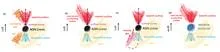
In a village smithy, the blacksmith pumps the bellows, and sparks fly into the darkness. So too in the galaxy AEON-z5, an active nucleus, like a red-hot forge, hurls metal-enriched material far beyond the stellar disk. The James Webb Space Telescope caught this process just a billion years after the Big Bang, when the universe was still in its infancy.
At the center of an ultra-compact dwarf galaxy, a very dense stellar system spanning tens of light-years, there is a vacuum cleaner at work. But instead of dust, it sucks in gas shed by dying stars. This gas does not fly off in all directions; instead, it spirals into a funnel, a rotating disk that gradually settles onto the black hole.
A black hole with a mass of 35,000 Suns drifts through a galaxy's gas like a barge through fog. Its gravity rakes the material ahead of it, leaving a dense trail behind — a wake of gas. Some of that gas gets pulled into the black hole, and it grows.
At the heart of the giant galaxy Hydra-A, there's a hive of activity. A supermassive black hole shoots out two powerful plasma jets. They punch through the surrounding cloud of hot gas and inflate giant bubbles within it.
The world around us is three-dimensional, but perhaps that's just an illusion. Some theories allow for extra dimensions of space, curled up or stretched in special ways. One such model depicts a five-dimensional universe with a "diluted" dimension (called a linear dilaton).
The cosmic spectacle unfolds on the stage of Galaxy галактики Centaurus A. In the lead role: a supermassive сверхмассивная чёрная дыра with a powerful jet that pierces space for hundreds of thousands of light-years.
In accelerators like the Large Hadron Collider, heavy nuclei collide at enormous speeds. For an instant, quark-gluon plasma (QGP) is born — a state of matter where quarks and gluons float freely, just like in the first microseconds after the birth of the universe.
This plasma is not just hot.
When a giant planet grows, it pulls in gas. Some of that gas swirls around it into a small disk — called a circumplanetary disk. It is in such disks that moons are thought to form. For the planet PDS 70 c, located 370 light-years away, such a disk was directly observed using the ALMA antenna array in the millimeter range.
Cosmic black holes at the centers of galaxies are like giant banyan trees: their aerial root‑filaments stretch for kiloparsecs to harvest nourishing matter. For decades astronomers have debated: how does cooling gas from cluster atmospheres fall into the sphere of influence of a supermassive hole?
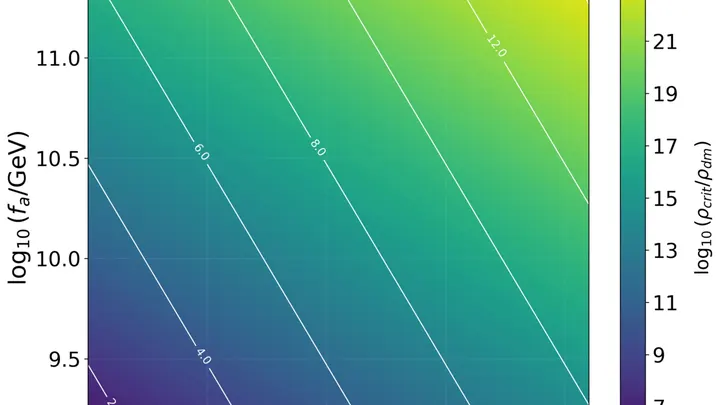
The universe is full of invisible substance that governs the movement of galaxies. In the 1970s, astronomer Vera Rubin showed: without dark matter, stars on the outskirts would have long since flown apart. But what it's made of remains unknown.
Recently, astronomers spotted three interstellar comets coming from deep space. One of them, 3I/ATLAS, turned out to be unexpectedly large: its nucleus is several kilometers across.
A stone falls into a pond — near the shore, the ripples are barely visible, while the water churns at the point of impact. The electric field around a charge behaves similarly: close in, it's sharp and tangled, but at a distance it stretches into a smooth wave that carries energy away. Physicists call this distant region the radiation zone.
A distant city seen through a fogged-up window: bright lights blur, details are lost. That's roughly how astronomers see gas with magnesium ions (magnesium) in our galaxy — the strongest spectral lines "peg the needle," preventing us from knowing how much material is really there.
On a playground, a merry-go-round has just been set spinning. In the first moments, kids are still crowding, grabbing the rails, and the overall picture is chaos. But a couple of seconds later, centrifugal force lines them up in a circle, giving the motion a clear shape.
Previously, astronomers calculated galaxy mass as if they were perfect spheres. But a galaxy is a flat pancake. The new 'Lost and Found' model takes the actual shape into account: it sums up the gravitational pull from all parts of the disk, not just the central bulge. The result is stunning: many galaxies need a third less invisible dark matter than previously thought.
A coin spinning on a table is a familiar sight. At first it rotates quickly, then it tilts, and its rattling becomes faster and faster. In the last seconds it seems to hover: the rotation slows, but the coin just won't finally lie flat. This final moment is a real puzzle for physicists.
On a deserted road at night, a streetlight flickers rarely but at full power. That's how WZ Sge-type stars behave: they smolder barely noticeably for years, then suddenly flare hundreds of times brighter. Astronomers decided to check what happens in their gas disks during quiescence, and found almost emptiness.
Dust in space is not just grime: it's the raw material for future stars and planets. But how it is distributed in our galaxy has long been a puzzle: dust is hard to measure directly, and it blocks the light of distant stars. Now astronomers have peered through this veil using data on five million stars: their brightness, color, and precise positions in the sky.
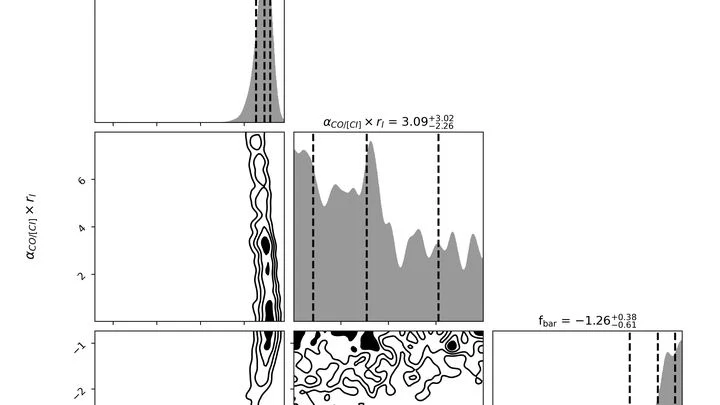
Three distant galaxies spin like giant carousels. Their stars and gas move along spiral arms, and from the speed of this motion you can calculate how much total matter the galaxy contains — visible and invisible.
Astronomers combined two views: radio telescopes revealed cold gas, while the James Webb Space Telescope showed the stars.
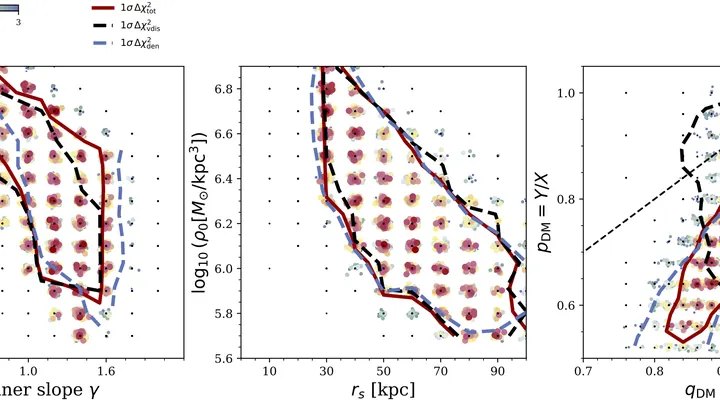
The Milky Way's stellar disk is like a glowing pinwheel, and тёмное вещество is an invisible cloud around it. For the first time, its shape has been precisely measured. Astronomers tracked the motions of millions of stars and built a 3D map of the тёмное гало out to 160,000 light-years.
The James Webb Space Telescope has spotted a scattering of compact objects in the early universe, nicknamed 'little red dots.' They are too red and too dim to be ordinary quasars, and astrophysicists are scratching their heads over what powers them.
A homogeneous dust sphere begins to contract under its own gravity. Inside it, like a rescue bubble, a region of negative pressure inflates: the de Sitter bubble. It expands, slows down near the very edge of the fall, and freezes at the Schwarzschild radius.