Reversibility is the property of a system to return to its original state after the cause of a change is removed. In physics, it is a central concept for understanding elasticity, thermodynamics, and information theory. A perfectly reversible process leaves no trace of its occurrence, like a spring that returns to its exact initial length after being stretched and released. In contrast, irreversible processes, such as plastic deformation or heat flow, permanently alter the system and increase entropy.
History
The concept was formalized in the 19th century by Rudolf Clausius and William Thomson (Lord Kelvin) in the context of thermodynamics, where they defined reversible processes as idealized limits. Earlier, Robert Hooke described elastic reversibility in 1678 with his law of elasticity.
How it works
At the microscopic level, reversibility arises when the forces holding a material together are conservative — the energy stored during deformation is fully recovered when the stimulus is removed. For example, in an elastic polymer, long chains uncoil under stress and then recoil, driven by entropy, to their original configuration. In quantum systems, reversibility is linked to unitary evolution, where the wavefunction evolves without loss of information, allowing time-reversalsymmetry to hold.
In practice
Reversibility is exploited in shape-memory alloys, which return to a pre-set shape when heated, and in rubber elasticity used in tires and seals. In computing, reversible logic gates are studied to reduce energy dissipation.
Fun fact
In quantum mechanics, a perfectly reversible process is described by a unitary operator, which is why quantum computers can in principle erase information without generating heat, unlike classical computers.
A transparent film of bismuth tungstate sits on a substrate and does not conduct electricity. Three minutes in a cloud of nitrogen plasma, and it turns black, with resistance dropping by a factor of a billion.
Hot water sometimes freezes faster than warm water: this odd fact is known as the Mpemba effect. Now something similar has been found in the quantum world: a state with weak entanglement (a special quantum connection between particles) can beat a more entangled one to the finish line.
In the quantum world, a fact becomes objective when its value is imprinted on many independent fragments of the environment, like a notice posted on hundreds of bulletin boards across the city. Each copy alone adds no new information, but it changes the rules of the game for anyone trying to erase that information.
An ocean current hundreds of kilometers wide lives its own life, fed by energy from tiny eddies. Something similar happens in the atmosphere: small swirls pass their power on to huge air currents. This process, the inverse energy cascade, has been known for a long time.
The early universe underwent a rapid expansion — inflation. In a tiny fraction of a second, minuscule quantum jitters were stretched to galactic scales and became the seeds of all large-scale structure.
Sugar dissolves in tea, and then with a single motion gathers back into the spoon. In an ordinary kitchen, you won't see that — viscosity and disorder get in the way. But in the world of ultra-slow motions, where inertia vanishes, such tricks become reality.
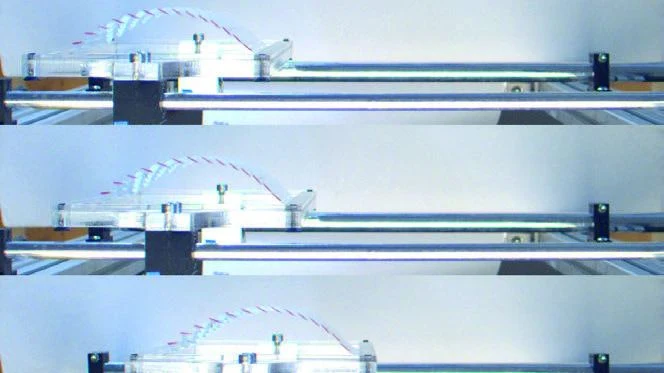
A flat sheet with slits in a flow of water or air behaves like self-adjusting blinds. The pressure opens the gaps, and each strip of material tilts, turning into a miniature wing. Thus, even a sheet placed perpendicular to the flow generates not only drag but also significant lateral lift.
When you press your finger on a piece of soft putty, it obediently dents and then slowly returns to its original shape. But if you press on a window pane, it either holds or cracks — no smooth deformation. Both materials are amorphous: their atoms are not arranged in a strict crystal lattice like in metal. Yet they behave completely differently.
A thin thread in a water flow is like a hair in a shower stream. If you jerk the water back and forth, the hair either stretches out with the flow or crumples up. The researchers took real protein threads (actin, which makes up muscles) and placed them in a microscopic channel where the fluid oscillated at different frequencies.
A water droplet falls onto a lotus leaf and bounces off without leaving a trace. Nature has perfected this self-cleaning marvel over millions of years, and engineers have long tried to replicate it. But if the droplet hits too fast, it shatters into splashes, losing mass and leaving wet marks on the surface.