The Planet That Got Struck Off by Mistake
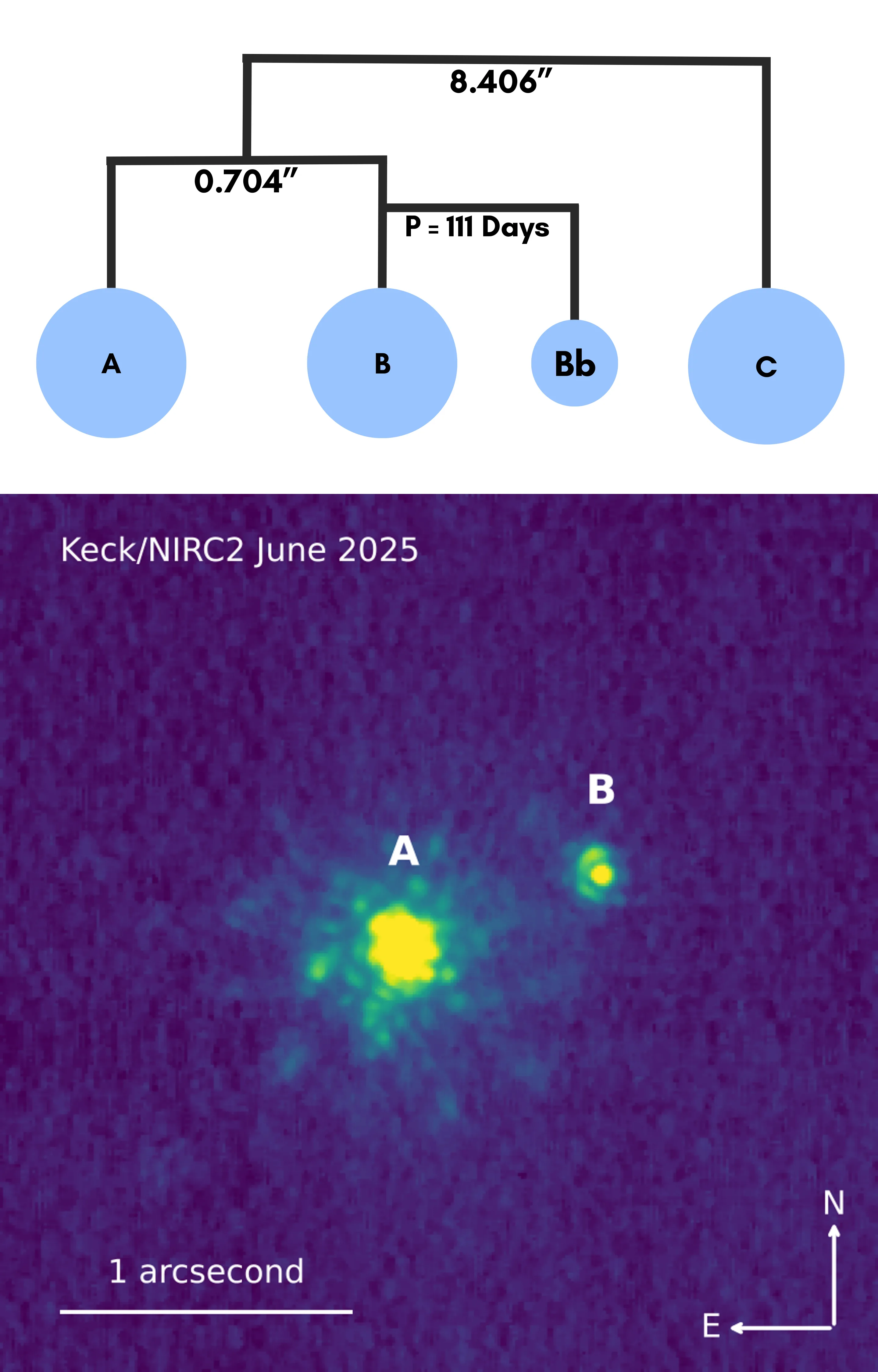
For years the Kepler telescope stared at the stars, catching the moments when planets crossed in front of them. A star would dim slightly for a few hours, and from that dip in light astronomers could tell: there's a planet. But sometimes the light from two stars blended together, and the dip looked like a false alarm. That's how a signal from the KOI-1623 system got struck off the candidate list.
Scientists took the old data and re-analyzed it with new, precise coordinates. Then they pointed a powerful telescope at the system and saw that it holds not two stars but three. It turned out that the planet, if it exists, passes in front of the second star, not the main one. It's roughly the size of Jupiter, and its 110.9-day orbit places it in the zone where liquid water is possible. True, the planet itself is most likely a gas giant with no life on it, but it could have moons.
Now the object's mass needs to be measured to say for sure whether it's a planet or a brown dwarf, something bigger than a planet but smaller than a star. But the real discovery is something else: out of five hundred similar rejected signals, about 70 may be genuine planets. Which means there are more of them out there than we thought, and the old archives are worth going through all over again.
The candidate planet KOI-1623.01 has a radius roughly like Jupiter's, but it orbits a star that is twice as light as the Sun. If it really is a planet, it is one of the few giants found in the habitable zone of a K dwarf.