Rescued from a False Alarm: A Giant Planet in the Triple System KOI-1623
Context
Neighboring papers in the archive explore similar themes: some search for planets around Alpha Centauri A, others dig through years of observations of binary systems, and still others catch shadows cast by distant worlds. All of them wrestle with the same question: how do you tell a real planet from a nuisance when there is not one star in the frame but two or three? KOI-1623 sits in the same lineup, but with an important difference: here the authors did not just find a planet in a binary system, they showed that an entire class of rejected signals may have been crossed out by mistake. This is the first study to quantify the scale of that error for the Kepler sample.
Methods
The authors combined four independent data sources. First, they recalculated the centroid shifts for all Kepler targets, using precise Gaia DR3 coordinates instead of older catalogs. Then they obtained new high-resolution images with the Keck telescope's adaptive optics and spectra from Keck/HIRES to separate the close pair of stars. The transit light curve was modeled with Gaussian processes to remove noise from stellar granulation. Finally, a pixel-level analysis with Transit-APP compared the observed and modeled difference images to determine which star is being eclipsed.
Results
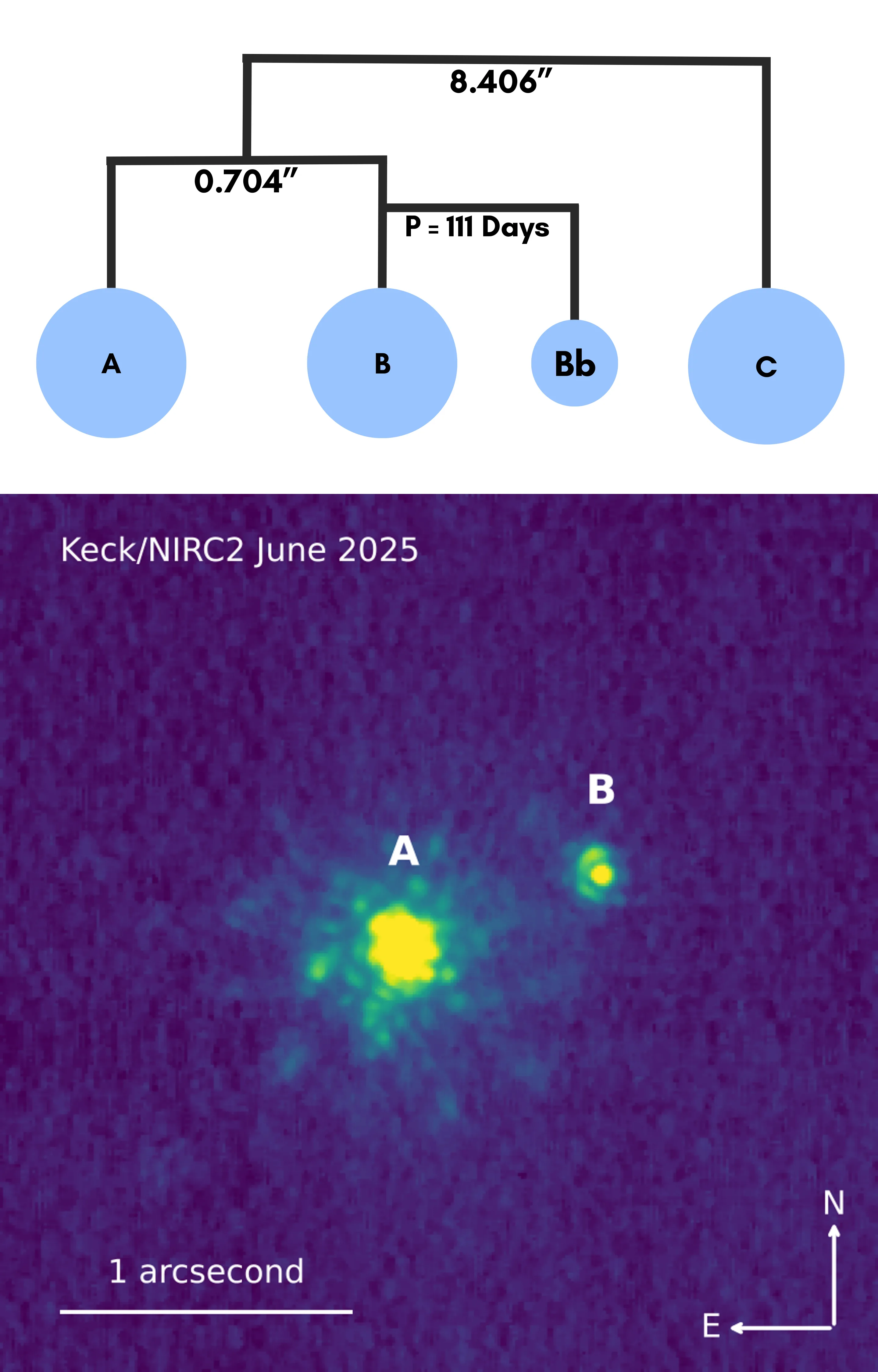
The KOI-1623 system turned out to be triple: a solar-type primary star, a secondary K dwarf at a distance of about 305 astronomical units, and a distant tertiary component. The pixel-level analysis confidently points to the secondary star as the source of the transit: a model with a planet around the secondary beats the primary one by 27.7 ELPD units, with an error of 6.9. If the planet really orbits the secondary star, its radius is 10.02+0.44−0.31 Earth radii, and its orbital period of 110.9 days places it in the "optimistic" habitable zone. A statistical check with triceratops gives a median false-alarm probability of 1.07×10⁻⁶, but without a mass measurement one cannot rule out that this is a brown dwarf or a low-mass star. The authors also estimated that of roughly 500 candidates rejected solely on the basis of centroid shift, about 70 could be real planets in binary systems.
Implications
This work stands apart from neighboring studies in that it does not simply add one more planet in a binary system, it exposes a systematic error in the Kepler catalog. If about 70 false rejections turn out to be real planets, that will noticeably shift estimates of planet frequency around binary stars and the completeness of the sample for long-period planets. Such a revision matters for demographic studies that have so far relied on incomplete data.
Future development
The immediate next step is to obtain radial velocities for KOI-1623B using high-resolution spectrographs such as HISPEC on Keck. That will make it possible to measure the object's mass and definitively distinguish a giant planet from a brown dwarf. More broadly, a systematic survey of all candidates rejected because of centroid shift, using adaptive optics and Gaia, will help uncover other missed planets and refine their statistics.
Impact
The results will affect exoplanet catalogs and studies of planetary systems around binary and multiple stars, as well as assessments of habitability in such systems.
Next steps
Carry out spectroscopic observations of KOI-1623B to measure the mass of the transiting companion. Then perform a systematic survey of all candidates flagged with a single centroid-shift signal, using adaptive optics and Gaia data.
Key open problems
The work speaks directly to the problem of exoplanet sample completeness: how many planets do we miss because they sit in binary systems and their signals get wrongly rejected? This affects estimates of planet frequency, especially for long-period planets and giant planets around low-mass stars.
The candidate planet KOI-1623.01 has a radius roughly like Jupiter's, but it orbits a star that is twice as light as the Sun. If it really is a planet, it is one of the few giants found in the habitable zone of a K dwarf.
Key numbers
- planet radius (if around the secondary): 10.02+0.44−0.31 Earth radii
- orbital period: 110.9 days
- distance between primary and secondary: 305 astronomical units
- estimate of missed planets: about 70 out of 500 false rejections
- false-alarm probability: 1.07×10⁻⁶ (median)