Rescued from a False Alarm: A Giant Planet in the Triple System KOI-1623
Every night the Kepler telescope stared at the same patch of sky, catching tiny dips in the light of distant stars. If a star blinked with clockwork precision, that could mean a planet was passing in front of it. But sometimes the blinking turned out to be a trick: light from two stars got mixed together, and astronomers filed the signal away in the false-alarm archive. That is what happened with KOI-1623. The signal was there, but it was rejected because the center of brightness shifted in the wrong direction.
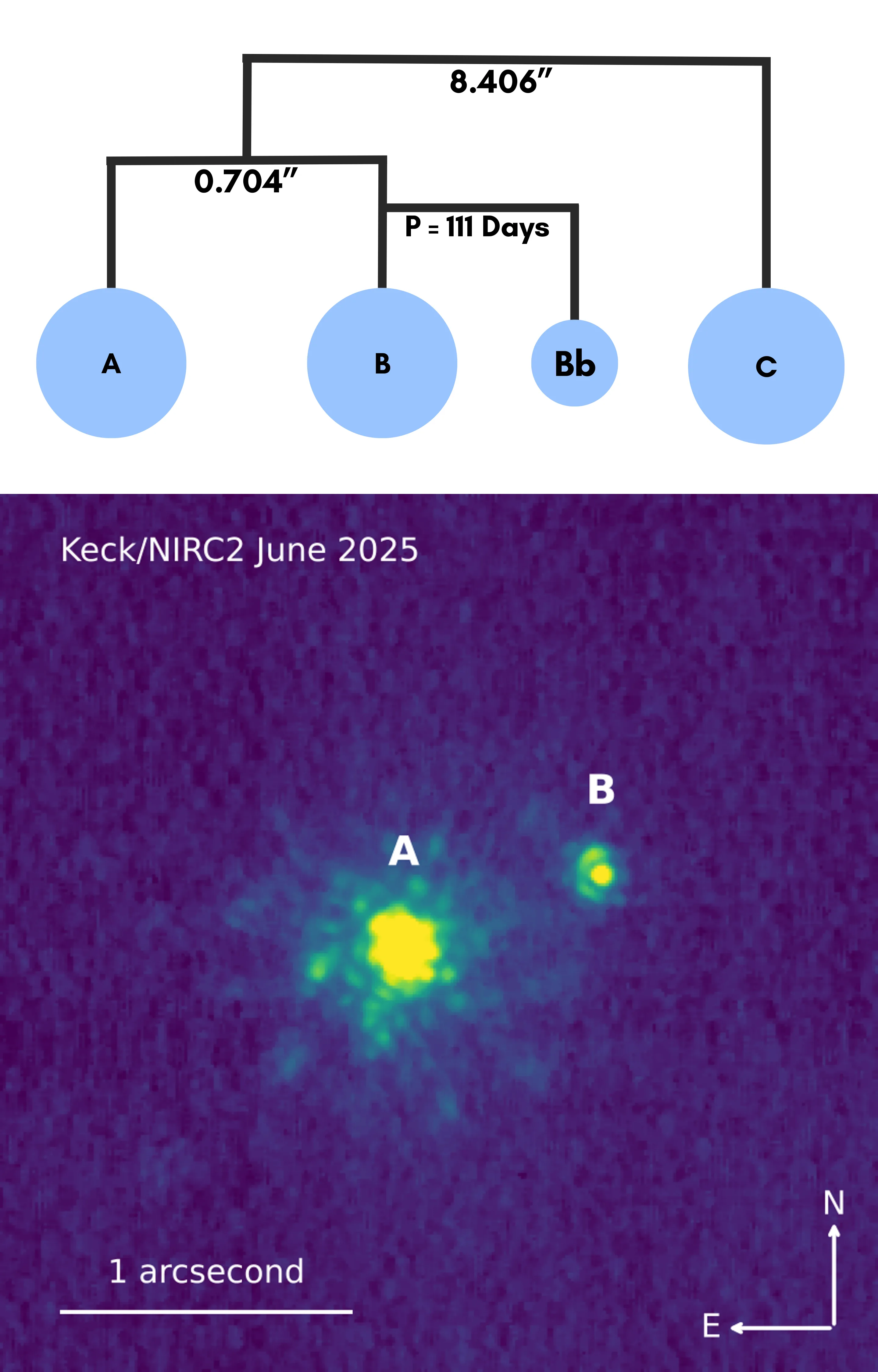
The authors took the old Kepler data and recalculated the shifts using precise coordinates from the Gaia satellite. Then they pointed the Keck telescope at KOI-1623, using adaptive optics to cancel out atmospheric blur, and saw that the system is not binary but triple. Two stars circle each other closely, while the third sits far away. A pixel-level analysis showed that the eclipse occurs at the secondary star, not the primary. If this is a planet, its radius is about ten Earth radii, like Jupiter's, and an orbit of 110.9 days places it in the habitable zone, where liquid water is possible.
A statistical check gave a false-positive probability of about one in a million. But without a mass measurement, we cannot rule out that this is a brown dwarf, an object larger than a planet but smaller than a star. To find out, we need high-resolution spectra that would reveal how the star wobbles under the pull of its companion.
The most important thing about this work is not the planet itself but the scale of the error. Out of roughly five hundred signals rejected solely because of a shift in the center of brightness, about seventy could be real planets in binary systems. If so, exoplanet catalogs are incomplete, and we are missing an entire class of worlds. A false alarm that turned out to be a real find teaches us to revisit old archives with new tools.
The candidate planet KOI-1623.01 has a radius roughly like Jupiter's, but it orbits a star that is twice as light as the Sun. If it really is a planet, it is one of the few giants found in the habitable zone of a K dwarf.