Galaxy rotation refers to the coherent spinning motion of galaxies, particularly within large-scale structures like cosmic voids. While individual stars orbit a galaxy's center, the term here emphasizes the collective rotation of galaxies themselves, which can produce measurable effects on light passing through or near them. This rotation is a key probe for understanding the distribution of matter, including dark matter, and the dynamics of the universe on large scales.
History
The concept of frame-dragging was predicted by Albert Einstein's general relativity in 1918, and its effect on light polarization was later explored by various physicists. The specific application to galaxy rotation and cosmic voids is a recent development, driven by advances in observational precision.
How it works
The rotation of a galaxy, or a system of galaxies, can induce a rotation in the polarization plane of light passing through it—an effect known as gravitational Faraday rotation or the frame-dragging effect. This occurs because a rotating mass drags spacetime around it, subtly twisting the path and polarization of photons. Measuring this polarization rotation requires extremely precise observations, often using distant quasars or the cosmic microwave background as background sources. The effect is tiny, but with enough photons and careful statistical analysis, it can reveal the angular momentum of large-scale structures.
In practice
This effect is used in cosmology to map the distribution of angular momentum in the universe and to test alternative theories of gravity, as discussed in the article on modified gravity versus dark matter.
Fun fact
The rotation of a galaxy can act like a giant lens, slightly twisting the polarization of light from billions of background galaxies, an effect that is only now becoming measurable with large surveys.
A weather forecaster draws a thick black line across Europe: north of it, frost; south, a thaw. That boundary, the zero isotherm, won't tell you the temperature in Stockholm or Rome, but it honestly marks where winter ends. In recent cosmology, a map has emerged where a similar frontier can be drawn.
For decades astrophysicists painted a neat picture: a galaxy, like a giant carousel, spins in a unified rhythm, and the supermassive black hole at its center inherits that dance.
At the center of the Milky Way, where the supermassive black hole Sagittarius A* reigns supreme (its metric first derived by Karl Schwarzschild), star S4714 makes a dizzying voyage.
The early universe was a restless place. Space trembled with gravitational waves — ripples in the very fabric of reality. In this churning cauldron, dark matter is thought to have been born. But the newborn particles had no mass: it had to come from somewhere.
Usually, the Higgs field is responsible for mass.
Toss a handful of glitter into a river, and some flakes will drift straight while others spin in tiny eddies. Galaxies in the universe do something similar: they don't just recede due to cosmic expansion: they also swirl in giant currents, like wood chips caught in invisible whirlpools.
Previously, astronomers calculated galaxy mass as if they were perfect spheres. But a galaxy is a flat pancake. The new 'Lost and Found' model takes the actual shape into account: it sums up the gravitational pull from all parts of the disk, not just the central bulge. The result is stunning: many galaxies need a third less invisible dark matter than previously thought.
When stars at the edges of galaxies rotate faster than calculations based on visible mass predict, standard cosmology invokes the hypothesis of hidden dark matter — invisible substance that reveals itself only through gravity. A new study offers an alternative that requires no new particles.
Stars on the outskirts of galaxies rotate unexpectedly fast. According to Newton, the farther from the center, the slower the motion should be, like in a round dance, where the outer dancers move more slowly. But in reality, stellar outskirts race along almost as fast as the core, resembling a giant carousel: on it, the outer horses fly faster so as not to fall behind the inner ones.
A galaxy is like a giant merry-go-round: stars and gas whirl around the center, and their speeds reveal how much stuff is on the ride. If we only saw the luminous matter, the outer parts would spin slower than observations show. So there must be invisible mass, dark matter, that holds the galaxy together.
At the center of our Galaxy lies a supermassive black hole, with stars orbiting around it. Their motion resembles a cosmic dance: some race along elongated orbits, others follow nearly circular paths. If invisible dark matter exists near the black hole, it slightly distorts these orbits, like an unseen hand nudging a star off course.
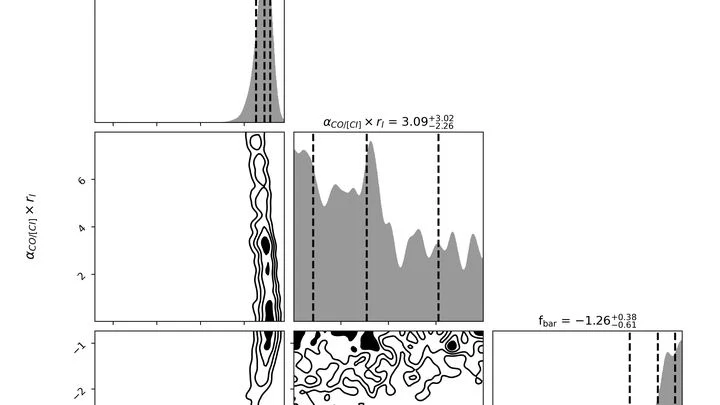
Three distant galaxies spin like giant carousels. Their stars and gas move along spiral arms, and from the speed of this motion you can calculate how much total matter the galaxy contains — visible and invisible.
Astronomers combined two views: radio telescopes revealed cold gas, while the James Webb Space Telescope showed the stars.