Photometric distance D_L relates the observed radiation flux F to the true luminosity L via the formula F = L / (4π D_L²). It includes a correction for the expansion of the universe: photons lose energy due to redshift (wavelength increases), and the time between the arrival of successive photons also stretches. As a result, D_L = (1+z) D_M, where z is the redshift, and D_M is the comoving transverse distance. For nearby objects, D_L ≈ D_M, but for distant galaxies (z ~ 1 and higher) the difference becomes significant. D_L is precisely what is measured using standard candles—objects of known luminosity, like Type Ia supernovae.
History
The concept originates from the work of Edwin Hubble, who in 1929 established the proportionality of redshift to distance. The formula for photometric distance in relativistic cosmology was derived within the framework of the Friedmann–Lemaître–Robertson–Walker metric. The Supernova Cosmology Project (Saul Perlmutter) and the High-Z Supernova Search Team (Brian Schmidt, Adam Riess) in 1998 used Type Ia supernovae as standard candles and discovered a deviation of D_L from the linear law, which indicated accelerated expansion. This became direct observational evidence for the existence of dark energy. Adam Riess and Saul Perlmutter are present in the list of scientists.
How it works
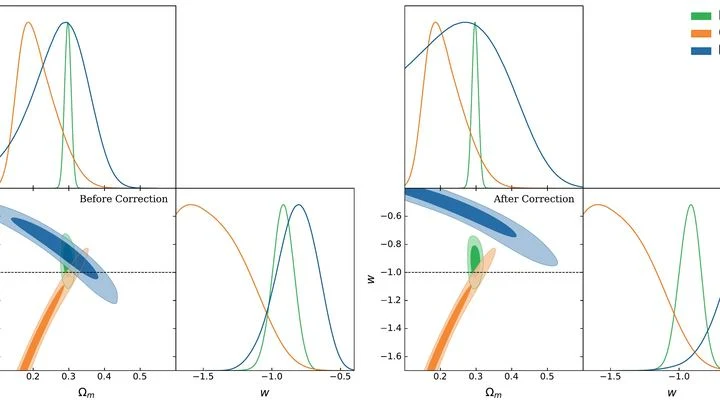
The relationship between apparent magnitude m and absolute magnitude M is given by the distance modulus: m − M = 5 log₁₀(D_L / 10 pc). For an object with known absolute luminosity (standard candle), measuring the peak apparent magnitude yields D_L. Within general relativity, D_L is expressed through solutions to the Friedmann equations, which follow from Einstein's equations for a homogeneous isotropic universe. The value of D_L depends on the densities of matter Ω_m, dark energy Ω_Λ, curvature Ω_k, and the Hubble constant H₀. Therefore, measuring D_L for a set of objects at different z allows placing constraints on cosmological parameters, in particular on the equation of state of dark energy w.
In practice
The method is used to measure distances to Type Ia supernovae, which led to the discovery of the accelerating expansion of the universe. Without it, modern cosmology would lose its ruler.
Fun fact
Looking at a galaxy with redshift z=1, we receive light dimmed by a factor of four just due to the expansion of space—the photometric distance turns out to be twice the comoving distance.
Two electrons that leave a metal needle tip almost simultaneously start to repel each other, like two people trying to squeeze through a narrow door at the same time. The closer they are, the more they get in each other's way.
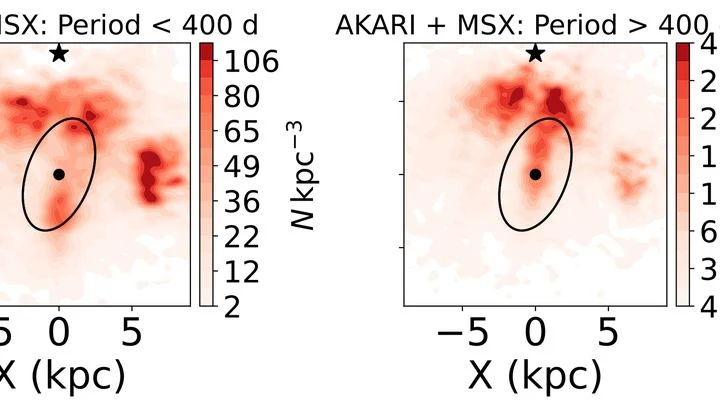
Red giants in the center of the Milky Way resemble distant lighthouses that brighten and dim. Their light pierces through dense dust, but standard distance-measuring methods fail here: the stars are too bright and unstable, and dust distorts the picture.
Astronomers found a workaround.
A passing particle leaves a flash of light in a long transparent bar — a scintillator. Inside the bar, like threads in a rope, thin fibers are stretched to collect this light and channel it to a sensor. Particle detectors have worked this way for decades.
A night river is dotted with tiny sparks. This isn't plankton: it's functional pollen-sensors, millimeter-sized devices that swim on their own and measure the water's chemistry.
Each particle is a tiny lab. Inside, two reagents meet: one triggers a glow upon contact with a pollutant, and the second, a colored filter, blocks out interference.
If you accelerate an observer to near-light speed, the emptiness around them stops being cold. A thermal glow emerges — an effect predicted in 1976 and named after William Unruh. For earthly accelerations, this glow is vanishingly faint, like a whisper at a rock concert.
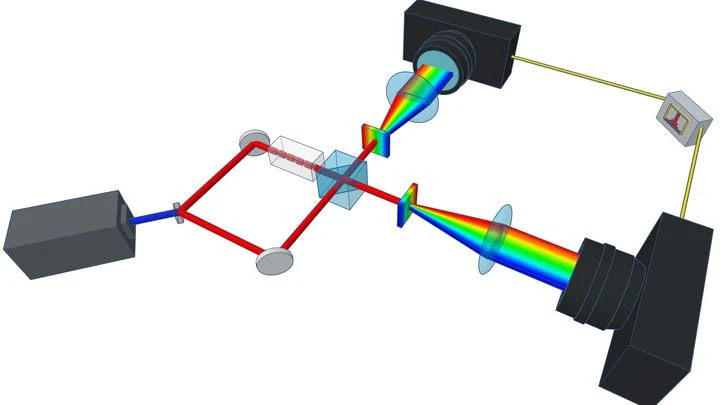
Two photons meet at a half-silvered mirror. If they arrive at exactly the same time, they always leave together — side by side, like twins who refuse to be parted. This effect, discovered in 1987, became the basis of a quantum ruler for measuring tiny delays.
Imagine photographing a statue in dim light. You face a dilemma: take one bright shot or a series of dim frames from different angles. In the first case, quality is limited by photon noise, the graininess that arises from a lack of photons, while in the second, details overlap, making it harder to reconstruct the 3D structure.
The cosmological debate is like two craftsmen measuring the same wall but getting different lengths. One uses a tape measure, applying it to nearby landmarks — Cepheids (pulsating beacon stars) and Type Ia supernovae (flashes of dying stars). He finds the wall is stretching at 73.5 arbitrary units.
The cosmological orchestra doesn't tune to a single tuning fork. There are two groups of instruments: one listens to the hum of the young universe — the cosmic microwave background, while the other reads notes from mature galaxies and supernovae.
Type Ia supernovae are the final, blinding chords in the symphony of stellar evolution: when a white dwarf crosses the limit predicted by Chandrasekhar, it explodes so brightly that for a moment it outshines an entire galaxy.
Galaxies without dark matter are like beads from which the invisible thread has been ripped. Stretching around the elliptical NGC 1052 is a chain of eight ghostly dim dwarfs: they contain almost none of the mysterious mass that makes spiral arms rotate. Vera Rubin first showed that without the invisible framework, stars would fly apart.
Cosmology is experiencing a tectonic rift. Cepheid-calibrated supernovae, measured by Adam Riess’s team, point to a rate of about 73 km/s per megaparsec.
A regular rangefinder sends a single light pulse and waits for it to return — like a person shouting into the void and listening for an echo. But if you use multiple sources that glow in unison, and analyze not the volume but the rhythm of the echo of reflected flashes, the picture becomes sharper.
Imagine a giant inflatable balloon with galaxies painted on it. As it inflates, the pattern stretches and neighboring dots move apart. The rate of that stretching is the Hubble constant. Astronomers usually catch light from distant stars and see how much it has reddened due to the stretching of space.
The cosmic microwave background is the afterglow of the Big Bang, which we see at millimeter wavelengths. But it also has a long-wavelength tail extending into the radio range.
Photographing the vicinity of a black hole is like shooting a fountain: a short exposure freezes the droplets, a long one blends everything into blurry streaks. Light from the superheated gas swirling around the hole reaches us along different paths. Some rays curve around it in an arc, others make multiple loops due to spacetime curvature.
When two dead stars collide in a distant galaxy, two messengers bring us the news: a shiver in space, a gravitational wave, and a flash of light. Both messengers race toward us across the entire Universe, but their paths can differ slightly. Light sometimes gets delayed by cosmic dust, while gravitational waves pass through everything almost without noticing obstacles.
An ordinary rain gauge collects water in a bucket and shows the total volume of precipitation. But the new device is like a sensitive palm that feels every falling drop and keeps count, even when the drops number in the thousands.
That's exactly what physicists have built.
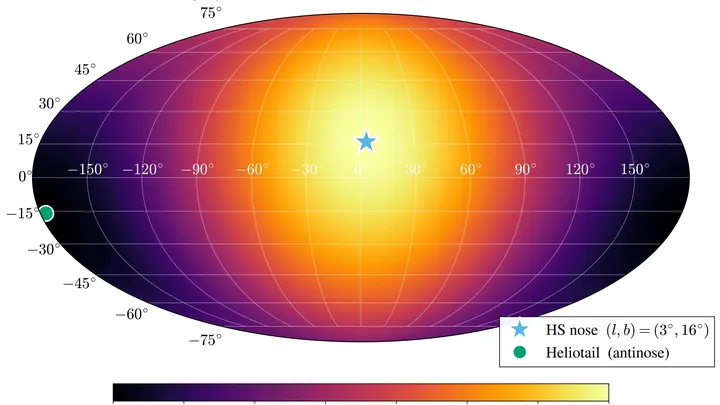
Imagine a dark room with dust floating in the air. A bright flashlight goes off, and the dust particles light up, revealing their positions. Astronomers have applied a similar trick to our Galaxy. The flashlights were gamma-ray bursts, the most powerful explosions in distant galaxies, and the dust particles were interstellar clouds.
In the operating room, the surgeon illuminates the tumor with a special agent that makes it glow. But how do you know whether it glows brightly because there are many cancer cells or simply because it lies close to the surface?
When a massive star explodes, its remnants fly apart like fragments of fireworks. But how do we know how far away such an explosion occurred? Astronomers have found a way: they look at the gas clouds that these remnants collide with.
The idea is simple. Supernova remnants are often surrounded by clouds of cold molecular gas.
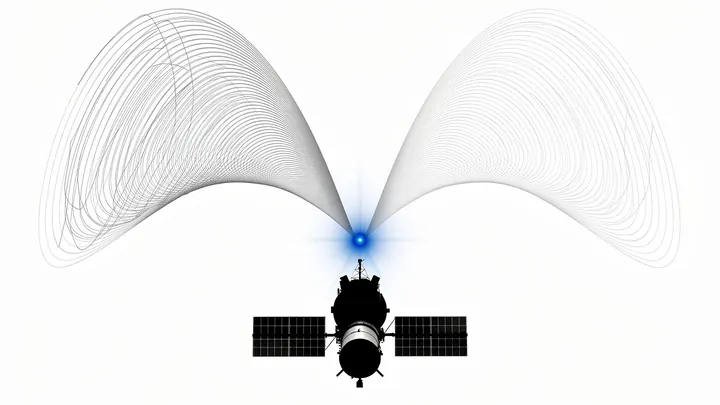
A pebble dropped in a pond creates curved ripples, but from far away they appear as straight lines. Gamma-ray flashes from an evaporating black hole behave the same: a distant burst sends flat waves, while a nearby one arrives curved.
Astronomers measure distances in the universe using explosions of special stars — Type Ia supernovae. These flashes always have nearly the same brightness, like light bulbs of known wattage. Knowing how much light reached us, you can calculate how far away the explosion is.
A standard laser rangefinder works like a stopwatch on a 100-meter dash: it times how long light takes to run to the target and back. But such a stopwatch has a limit: it ticks in steps of tens of picoseconds (trillionths of a second). In that step, light travels about a centimeter, so finer details are invisible.
Two laser beams, like two pencils, draw an invisible scale on the wall. One tip moves slightly faster than the other, and by the way their strokes alternately coincide and diverge, you can calculate the distance to the wall with an accuracy down to the thickness of a spider's thread.
In the new work, physicists made these two beams work continuously, without pauses.
Two spotlights placed side by side: from a distance, their light blends into one patch, and it seems there's a single source. The same happens in space: about 10–20% of faint stars are actually close pairs of identical stars. Individually, they can't be resolved, but together they shine noticeably brighter than a single star with the same parameters.
Light from a distant star travels to us for billions of years, and during that time the universe has time to expand. How can we check that we correctly understand this journey? Astronomers use two 'rulers': supernova explosions, which shine with a known brightness, and fast radio bursts — short, powerful pulses of radio waves from other galaxies.
In distant galaxies, old stars swell and redden. Among them are two groups that act like lighthouses: some have just ignited helium burning, while others are already burning carbon and oxygen.
A flashlight in thick fog is useless: the beam scatters, and the reflected light drowns in noise. But if you tie two photons with an invisible thread, one can pass through the fog and come back, while the other stays safe. This connection is called quantum entanglement — when two particles behave as a single whole, even when far apart.
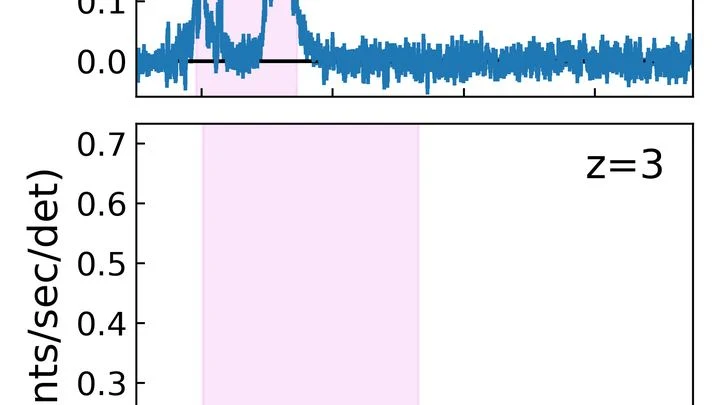
A gamma-ray burst is a short but incredibly powerful explosion in a distant galaxy. In a few seconds, it releases as much energy as the Sun will emit over billions of years. The Neil Gehrels Swift satellite catches such flashes with a special telescope called BAT, which detects gamma rays.
Light from a streetlamp passing through blinds flickers: the stripes shift, and brightness rises and falls. From that rhythm, you can guess how wide the lamp is. The new method for measuring stars works similarly: instead of capturing a sharp image, astronomers monitor the "twinkling" of light collected by two or more telescopes simultaneously.
Light from an ordinary bulb is a stream of individual photons, like drops from a faucet. But there is also light where photons come in pairs, like twins walking together. Such grouped light has long been desired for measuring distances and imaging objects hidden around corners. But sources of this light were either too dim, or their flashes too short for ordinary detectors to catch.
The universe is expanding, but at what rate is a question that has been troubling astronomers for decades. Two methods of measurement give different answers, and this discrepancy is called the Hubble tension. Some look at the early universe through the cosmic microwave background, others at nearby supernovae and Cepheid variables.
In the dark clouds of interstellar gas where stars are born, matter gathers into dense knots — future cradles of stars. Astronomers measure distances between these knots from sky photographs, but a photograph is flat while the cloud is volumetric. Converting from plane to volume is not as simple as it seems.
When a distant star explodes, its light travels toward us for billions of years. Astronomers measure how dim it appears and use that to calculate the distance. Usually, this involves complex models with dark energy and other mysteries.
Light from a single source can be made to 'meet' itself, and then fringes appear on the screen, like ripples from two pebbles dropped into water. Physicists have long known how to do this with two photons, but making four particles of light merge at once was tricky: single-photon sources lost too many particles along the way.
A fluorescence microscope is like a photographer shooting in the dark: the more frames, the better the view, but each frame costs photons. In a living cell, the supply is limited, otherwise the light would simply kill the sample. So scientists proposed not to increase the number of photons, but to choose more wisely when to catch them.
Type Ia supernovae are the 'standard candles' of cosmology: their peak luminosity is nearly identical, allowing distances to be determined from apparent brightness — the fainter the object, the farther away it is.
Astronomers use Type Ia supernovae — thermonuclear explosions of white dwarfs — as 'standard candles': their peak luminosity was long thought to be the same everywhere in the universe.
Astronomers have found an invisible object in the Universe weighing just a million Suns — for cosmic scales, that’s a mere trifle, a hundred times lighter than anything they’ve been able to “weigh” at such distances. The object itself doesn’t shine, but it gave itself away by bending the light from an even more distant galaxy.