A Ruler Made of Light: Measuring Nanometers with a Pair of Photons express
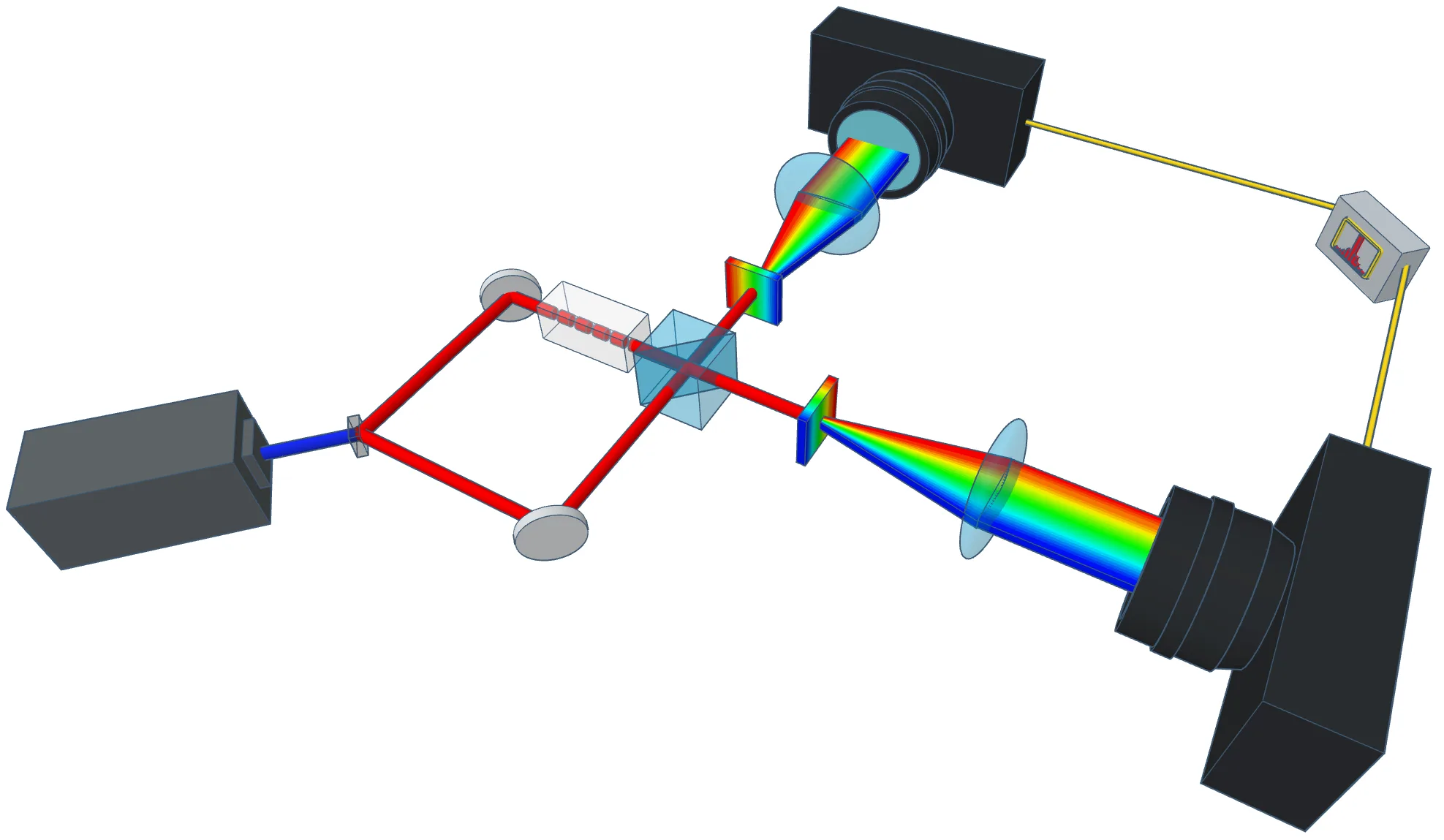
Two photons meet at a half-silvered mirror. If they arrive at exactly the same time, they always leave together — side by side, like twins who refuse to be parted. This effect, discovered in 1987, became the basis of a quantum ruler for measuring tiny delays. But the ruler had a flaw: as soon as the delay exceeded the lifetime of a single photon, all precision vanished like ripples on water. The instrument saw only coincidences, not the reason for their disappearance.
The authors of the new study made the instrument see more. Instead of merely counting coincidences, they split the light by color, and found distinct bands in the spectrum, reminiscent of the rainbow rings in a soap film. The spacing between the bands revealed the delay between the photons with remarkable precision. Thus, the old ruler was transformed into a spectral comb: it now measures not the mere fact of meeting, but its color.
The method proved surprisingly resilient. Photon losses, mirror vibrations, imperfect optics — the spectral bands merely dimmed slightly but did not shift. It's like determining the distance between mountain peaks by counting lunar craters rather than by the Moon's brightness: clouds may obscure the light, but they won't change the count. Thanks to this robustness, the need for constant calibration disappeared — a rarity for quantum devices.
In a test, they measured the thickness of a transparent plate of 300 micrometers with nanometer precision. The light ruler, which previously worked only over distances of a few microns, now spans hundreds of microns, and promises to go even further. Where bulky laser systems were once required, a pair of entangled photons and a spectrometer now suffice.
Original abstract
as written by the authors arXiv:2607.16849
Hong-Ou-Mandel (HOM) interferometry enables delay estimation at the quantum precision limit but is traditionally constrained to path differences within the coherence time of the interfering photons. Here, we demonstrate single-measurement path-delay sensing at the measurement Cramer-Rao bound using spectrally resolved HOM interference, thereby removing the conventional dynamic-range limitation imposed by the photon coherence window, with no scanning required for calibration. By extracting delay information from the spectral interference fringes of spectrally entangled photon pairs, we retain near-optimal sensitivity over an operational range exceeding the photon coherence time by over two orders of magnitude. Using one million detected photon pairs, we achieve a time-delay precision of 20 attosecond (6 nm), while real-time operation (at 1 Hz) yields 330 attosecond (100 nm) precision. Because the estimator relies on fringe periodicity rather than absolute coincidence rates, the method is intrinsically robust to photon losses and variations in interference visibility, eliminating the need for recalibration. As a practical demonstration, we measure the thickness of a 300 um transmissive target with nanometer-scale precision. These results mark a significant step towards deploying quantum-limited measurements in real-world sensing applications using HOM interferometry.
20 attoseconds is the time it takes light to travel just 6 nanometers, comparable to the thickness of a cell membrane.
In Arthur C. Clarke's novel "The Fountains of Paradise," aliens use quantum correlations for instantaneous communication, a similar principle of entanglement underlies this measurement technique.