Kolmogorov modes and linear response of models with jumps and diffusion ✛
Context
Complex systems such as climate are often described by stochastic equations where fast unresolved processes are modeled as noise. Traditionally, Gaussian white noise is used, but in many cases real dynamics include abrupt jumps: sudden wind changes, extreme precipitation, rare events. Linear response theory for systems with Gaussian noise is well developed, but for models with jumps (jump-diffusion) it remained a gap. This work fills that gap by generalizing the Green's function formalism and fluctuation–dissipation relations to Lévy processes. This places it alongside research on stochastic parameterization and response in nonsmooth systems, but with a fundamentally new tool for analyzing nonlocal perturbations.
Methods
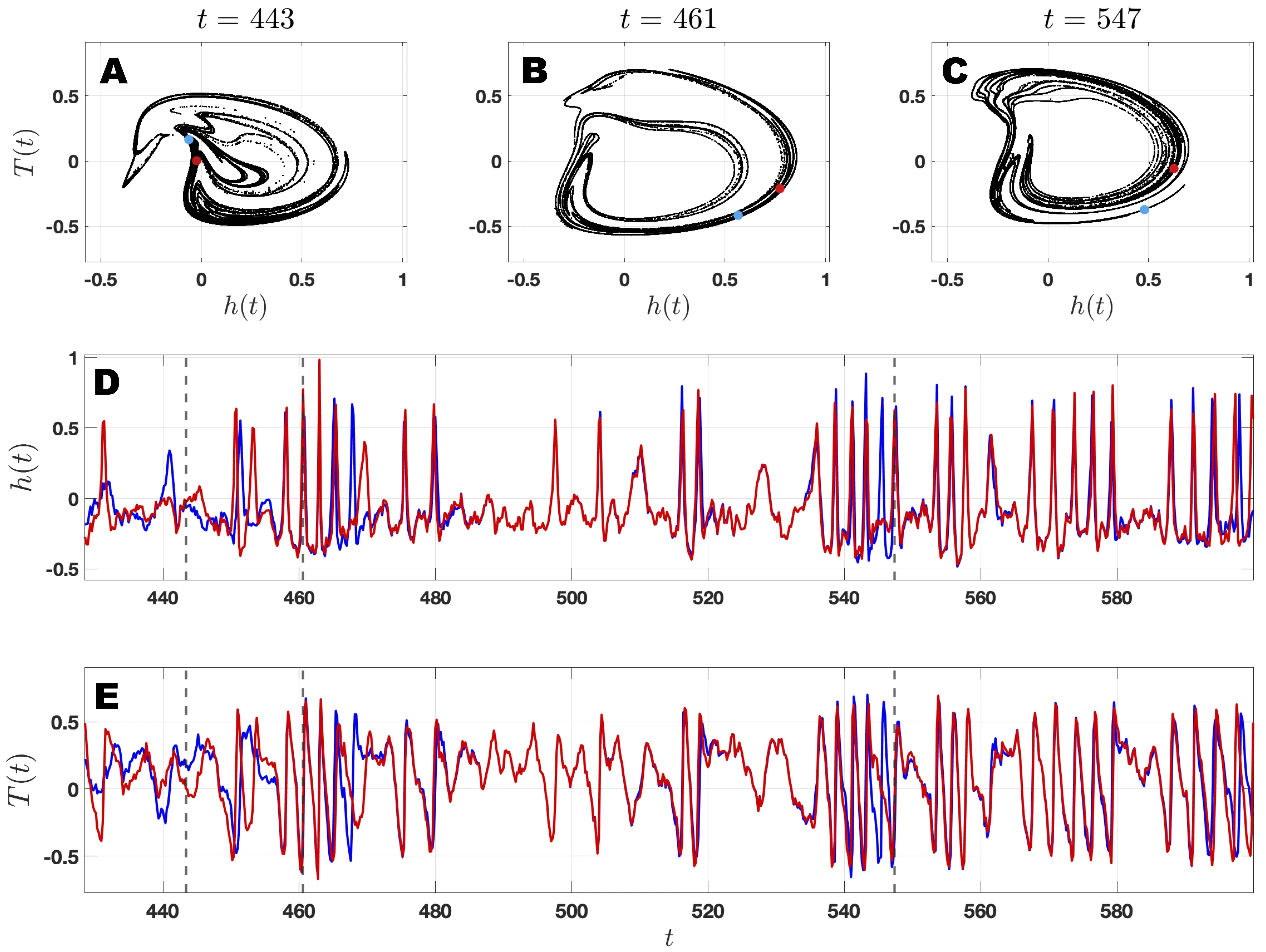
The authors consider stochastic differential equations with drift, diffusion, and a jump Lévy process. They derive a generalized Fokker–Planck equation with an integro-differential Kolmogorov–Lévy operator. Using semigroup theory and spectral decomposition, they obtain first-order response formulas for perturbations to the drift and the jump measure. For numerical verification, they use Ulam's method: they construct a Markov transition matrix from a long time series and estimate Ruelle–Pollicott resonances and Kolmogorov modes. In applications to the El Niño model and the energy balance climate model, they compute Green's functions and compare predictions with direct ensemble simulations.
Results
Explicit linear response formulas for systems with jumps are derived, including a nonlocal term corresponding to perturbations of the jump law. The response is expanded in eigenmodes of the Kolmogorov operator, linking forced variability to natural variability. In the El Niño model with jumps, the theory accurately predicts the response to changes in the ocean–atmosphere coupling parameter up to 10% of its original value. In the Ghil–Sellers energy balance model with α-stable noise, the linear response reproduces climate projections with small bias, although it requires two orders of magnitude more ensemble members than the Gaussian case. Spectral analysis revealed an increase in the spectral gap when jumps are included, indicating faster mixing and decay of correlations.
Implications
This work extends Hasselmann's program by allowing non-Gaussian perturbations in stochastic climate models. A rigorous mathematical framework emerges for assessing sensitivity to parameter changes and for detecting and attributing climate change in the presence of extreme events. Unlike neighboring works that consider either purely diffusive processes or specific applications, here a unified formalism is proposed for arbitrary perturbations of the jump measure, opening the way to analyzing nonlocal impacts. This is the first test of the theory on a spatially distributed model with α-stable noise, demonstrating practical applicability.
Future development
The theory could be extended to higher orders of response and to systems with multiplicative noise. It would be interesting to explore the connection between Kolmogorov modes and rare events, and to use dynamic mode decomposition methods to improve mode estimation at the periphery of the data. In the long run, this could lead to more reliable early warnings of climate transitions and to optimized stochastic parameterizations in weather and climate models.
Impact
The results apply to climatology, epidemiology, biology, finance, and quantitative social sciences, where jump processes occur. They are especially important for detection and attribution of climate change and for risk assessment of climate tipping points.
Next steps
The next step could be applying the formulas to more complex general circulation models of the atmosphere and ocean. It is also necessary to investigate the conditions under which the theory holds for large jump amplitudes and near critical transitions.
Key open problems
In climatology, the question remains open as to how nonsmooth stochastic forcings affect predictability and sensitivity of the climate system. This work provides a tool for quantifying the response to extreme perturbations, bringing closer the solution to the problem of reliable forecasting of rare events.
The knowledge machine's view
This section is addressed to the author of the paper and their colleagues. Neighbouring works were found by meaning-based search across our archive, not by word overlap. We do not review: we show the field around the work.
What the work does
This work generalizes linear response theory to stochastic systems with jumps (Lévy processes), deriving response formulas for perturbations of the drift and the jump measure via the spectral decomposition of the Kolmogorov operator. The framework is tested on two climate models: an El Niño oscillator with state-dependent jumps and the Ghil–Sellers energy balance model with α-stable noise, using Ulam's method for numerical estimation of the modes. The theory accurately predicts the response over a wide range of perturbations, although the α-stable noise case requires considerably more ensemble members.
Where its strength is
A unified linear response formalism is derived for arbitrary perturbations of the jump measure, linking forced variability to natural variability through Kolmogorov modes. This opens the way to analyzing nonlocal impacts and assessing sensitivity in systems with extreme events.
Where it could go next
- It might be interesting to see how methods from the cellular orchestra paper, which studies synchronization and response in noisy systems, could be adapted to analyze collective effects in climate models with many coupled oscillators subject to jumps.based on: The Cellular Orchestra: How Genes Learn to Play in Tune with Chaos arXiv:2607.03545
- Related work on gravitational noise studies decoherence under random perturbations; its approach to analyzing noise effects on quantum systems might suggest new ways to assess the stability of climate attractors in the presence of jumps.based on: Gravitational Noise: How Ripples in Space Erase Quantum Superpositions arXiv:2608.06121v1
- The archive contains a study on noise-induced quantum order; its ideas about the constructive role of noise could be useful for exploring how jumps in climate models might foster new regimes rather than merely perturb existing ones.based on: Noise as the Architect of Quantum Order arXiv:2607.07801
Worth trying
- Test the spectral gap estimation technique from the cellular orchestra paper on jump models to accelerate convergence of ensemble estimates.
- Use the sensitivity analysis approach from the gravitational noise paper to compare responses to Gaussian versus jump perturbations in the same model.
- Investigate whether methods from the noise-induced order paper can identify regimes where jumps enhance predictability of the climate system.
Why this may matter
Extending response theory to systems with jumps is critical for climate science, where extreme events and non-Gaussian perturbations play an increasingly important role. The proposed formalism could underpin more accurate projections and attribution of climate change, as well as insights into the role of rare events in other complex systems.
Nearby works in our archive
- One Neuron, One Memory: Inequalities to Unlock Brain Secretssimilarity 0.50
- Cosmic Vortex: How Void Rotation Reveals the Universe's Compositionsimilarity 0.49
- The Cellular Orchestra: How Genes Learn to Play in Tune with Chaossimilarity 0.49
- Gravitational Noise: How Ripples in Space Erase Quantum Superpositionssimilarity 0.49
- How a Neural Network Speeded Up Molecular Collision Calculationssimilarity 0.48
- No Rudder Needed: This Boat Steers by Shifting Weightsimilarity 0.48
- Noise as the Architect of Quantum Ordersimilarity 0.48
The archive is sparse around this work: the closest review is only 0.50, against a usual 0.64. It looks like few have drilled nearby.
Ulam's method, used to estimate modes, was originally proposed by Stanislaw Ulam in the 1960s to study ergodic properties of dynamical systems, and now it helps analyze climate models with jumps.
Key numbers
- spectral gap: increases when jumps are included
- perturbation amplitude: up to 10% of the original parameter
- ensemble size for α-stable noise: 10 000 members
- ensemble size for Gaussian noise: 100 members
- stability index α: 1.75