The Sculptor of Informativeness: How to Carve a Specimen That Tells Its Own Story ✛
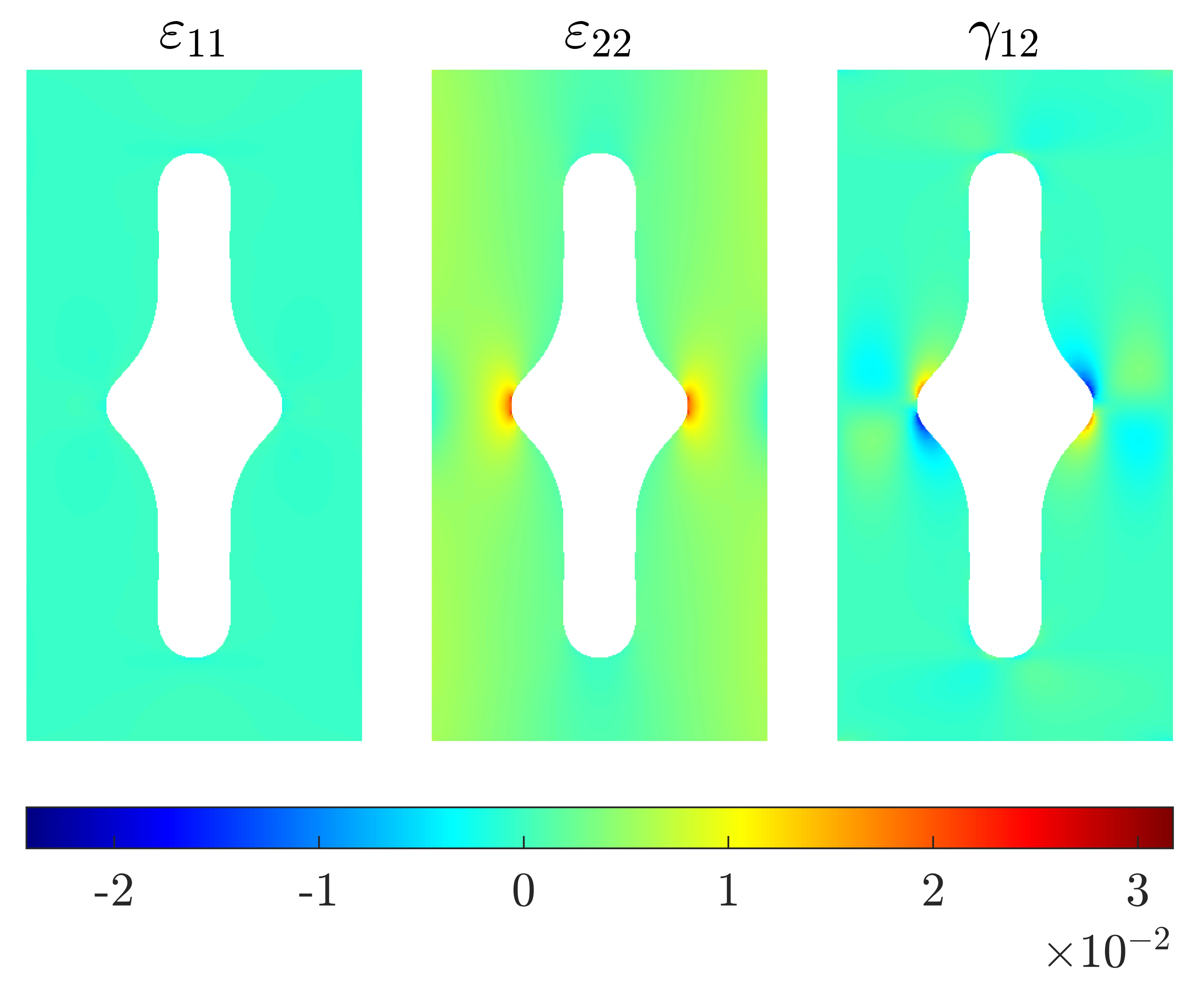
A mechanical testing lab is like a kitchen where a chef tastes a dish to guess the recipe. For an anisotropic material, one that is stiffer along its fibers than across them, a single taste is not enough. You need three or more separate tests, each with its own specimen. Engineers have spent years refining specimen shapes by hand, relying on intuition and experience. Now there is a tool that does this automatically, and better.
The method is like a sculptor who removes excess to reveal the essence. Only here the sculptor is a topology optimization algorithm, and the essence is not form but informativeness. The design domain is divided into thousands of finite elements, each assigned a virtual density from zero (void) to one (material). The algorithm iteratively redistributes material to minimize the condition number of the system matrix. This number is a measure of how sensitive the solution is to data errors: the lower it is, the more robust the identification of material properties to measurement noise. The result is a black-and-white geometry with sharp boundaries, no gray zones.
The result is surprising. For orthotropic materials, those whose stiffness differs in two mutually perpendicular directions, the optimized specimens contain characteristic holes. Their arrangement depends on the anisotropy angle. Compared with reference designs from the literature, the proposed shapes showed lower parameter identification error, especially for intermediate angles. The condition number was reduced to values around 200, ensuring reliability even with noise at 0.1% of the nominal strain. A robust version of the algorithm eliminates thin bridges that could break during manufacturing.
The practical benefits are clear. In labs testing composites, biomaterials, and anisotropic metals, the new approach speeds up characterization: one test instead of three. The method does not depend on the true parameter values, which removes the paradox of "needing to know the material to design the test for its determination." It can be integrated into software packages for automated experimental design. Next steps include extending to nonlinear models: hyperelasticity, plasticity, viscoelasticity. Incorporating metrological characteristics of digital image correlation into the objective function would make the design even more practical. And multi-start optimization with different random initial conditions could help find the global minimum rather than local traps.
The sculptor of informativeness has just begun. Ahead lie three-dimensional problems, multi-material structures, and experimental validation. But already it is clear: smart geometry can replace a series of tests. And there is a certain beauty in that, the beauty of a bone that bears load and a wing that catches the wind.
Optimized specimens often resemble bones or insect wings, where nature also solves the problem of maximum informativeness with minimal mass.