Topologicalspectroscopy is a set of experimental techniques that probe the electronic structure of materials to reveal their topological properties. Topological materials have electronic states that are protected by symmetry — they are robust against disorder and deformation. These states often appear at the surface or edges of a material, even if the bulk is insulating. Topological spectroscopy aims to directly observe these states and map their energy-momentum relationship, which is essential for understanding and exploiting them.
History
The field emerged in the mid-2000s after the theoretical prediction of topological insulators by Kane and Mele (2005) and Bernevig, Hughes, and Zhang (2006). The first experimental confirmations using ARPES came in 2007–2009 for HgTe quantum wells and BiSb alloys.
How it works
The most common methods are angle-resolved photoemission spectroscopy (ARPES) and scanning tunneling microscopy (STM). ARPES shines ultraviolet or X-ray light on a sample and measures the energy and angle of emitted electrons, directly mapping the band structure. STM uses a sharp tip to tunnel electrons into or out of the surface, providing spatial and energy resolution of electronic states. In topological materials, these techniques reveal the characteristic Dirac cones or helical surface states that cross the band gap, confirming the material's topological nature.
In practice
Topologicalspectroscopy is essential for characterizing materials for future quantum computers and spintronic devices, where the robust surface states could be used to carry information without dissipation.
Fun fact
The surface states of a topological insulator are 'spin-locked' — the direction of an electron's spin is tied to its momentum, meaning that backscattering is forbidden, which is why they conduct electricity without resistance to disorder.
Light knocks electrons out of a crystal, and they fly toward the detector like arrows toward a target. From their trajectories, physicists reconstruct how electrons behaved inside the material: with what energy and in which direction they moved. But switch on a magnetic field, and the trajectories bend. The arrows start to curve, the target turns into a warped mirror, and the picture blurs.
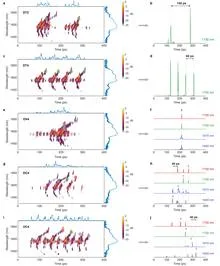
A conductor raises the baton, and the orchestra produces not just sound but a complex score: each note sounds at its own moment, at its own pitch, with the right volume. Light can also be a score, if you control its spectrum and timing. Previously, this required bulky setups that could not be reconfigured after assembly.
The ring was assembled from several different segments. In each segment, particles behave in their own way, like musicians playing different notes. The most interesting part begins at the junctions: here particles often get stuck, like an echo trapped in a narrow corridor. This phenomenon is called the skin effect — particles pile up at the boundary, like a crowd at an exit.
But the authors noticed something new.
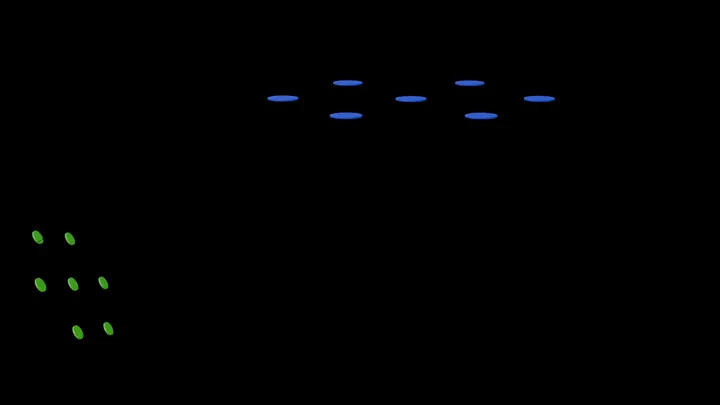
Light flows like an invisible river. If you place an obstacle in the stream, the water whirls into eddies. Likewise, specially designed surfaces create light 'whirlpools' that catch nanoparticles like wood chips.
A neat stack of atomic layers lies on a substrate. An invisible beam of terahertz light shines down on it, with a magnetic field applied from the side. After reflection, the beam's polarization rotates slightly.
A drop of water in your palm holds roughly $$10^{21}$$ molecules, each made of three atoms surrounded by a swarm of electrons. To understand how matter behaves, physicists solve equations for these electrons. The trouble is that the number of equations grows like an avalanche: for N electrons, you need to store $$N^2$$ numbers.
In a strong magnetic field, electrons in a thin metal film move along circular orbits. When the film thickness is comparable to the size of such an orbit, the resistance starts to oscillate: these are Sondheimer oscillations, known since the mid-20th century as a purely geometric effect.
On the surface of a thin film of bismuth iron oxide, you can see neat stripes, like furrows in a plowed field. What lies beneath them has remained a mystery until now.
Two quantum dots are like two tiny pockets in a piece of silicon where an electron can sit, like a ball in a cup. When the pockets are far apart, each electron lives on its own, and its energy resembles the levels of a solitary atom.
An ordinary sheet of paper looks white because it scatters all light rays chaotically. But a butterfly's wing shimmers blue and green without a drop of paint: its surface is covered with microscopic grooves that dampen some light waves and amplify others. Engineers have long dreamed of replicating this trick: creating a material that colors itself simply by trapping light in the right places.
A tiny needle glides over the surface like a finger over a page written in Braille. That's how a scanning tunneling microscope works: it feels the atomic landscape and turns bumps into a picture. But when you need to add a magnetic field, the design hits a wall.
A fingernail-sized piece of ceramic is squeezed in a vise, and its internal structure rearranges like clay under your fingers. Inside, orderly rows of tiny domains line up where they were once randomly oriented. After this 'massage,' the crystal lets light through almost like glass and, at the same time, generates a strong electric charge when bent or pressed.
Graphs are considered identical if their 'terrain' matches. Imagine two maps with mountains and valleys: even if drawn differently, the heights and steepness of slopes can be the same.
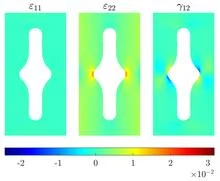
A mechanical testing lab is like a kitchen where a chef tastes a dish to guess the recipe. For an anisotropic material, one that is stiffer along its fibers than across them, a single taste is not enough. You need three or more separate tests, each with its own specimen. Engineers have spent years refining specimen shapes by hand, relying on intuition and experience.