Designing a Specimen That Reveals a Material in a Single Test ✛
Context
This work sits at the intersection of experimental mechanics and computational design. Related studies in the archive apply machine learning to analyze elastic properties of rocks, optical traps for nanoparticles, and materials with controllable vibrations. However, this paper stands out for its focus on automatic specimen geometry design via topology optimization, which is closer to material model identification than to analyzing existing structures.
Methods
Density-based topology optimization is used: the design domain is discretized into finite elements, each assigned a fictitious density from 0 (void) to 1 (material). The objective function is the reciprocal of the determinant of $A^T$ A, where A relates unknown material parameters to measured displacements. Minimizing this functional makes the system of equations maximally well-conditioned, meaning less sensitive to noise. To obtain crisp boundaries, a projection filter with gradually increasing strength is applied, and to prevent thin hinges, a robust formulation with three projection thresholds is used.
Results
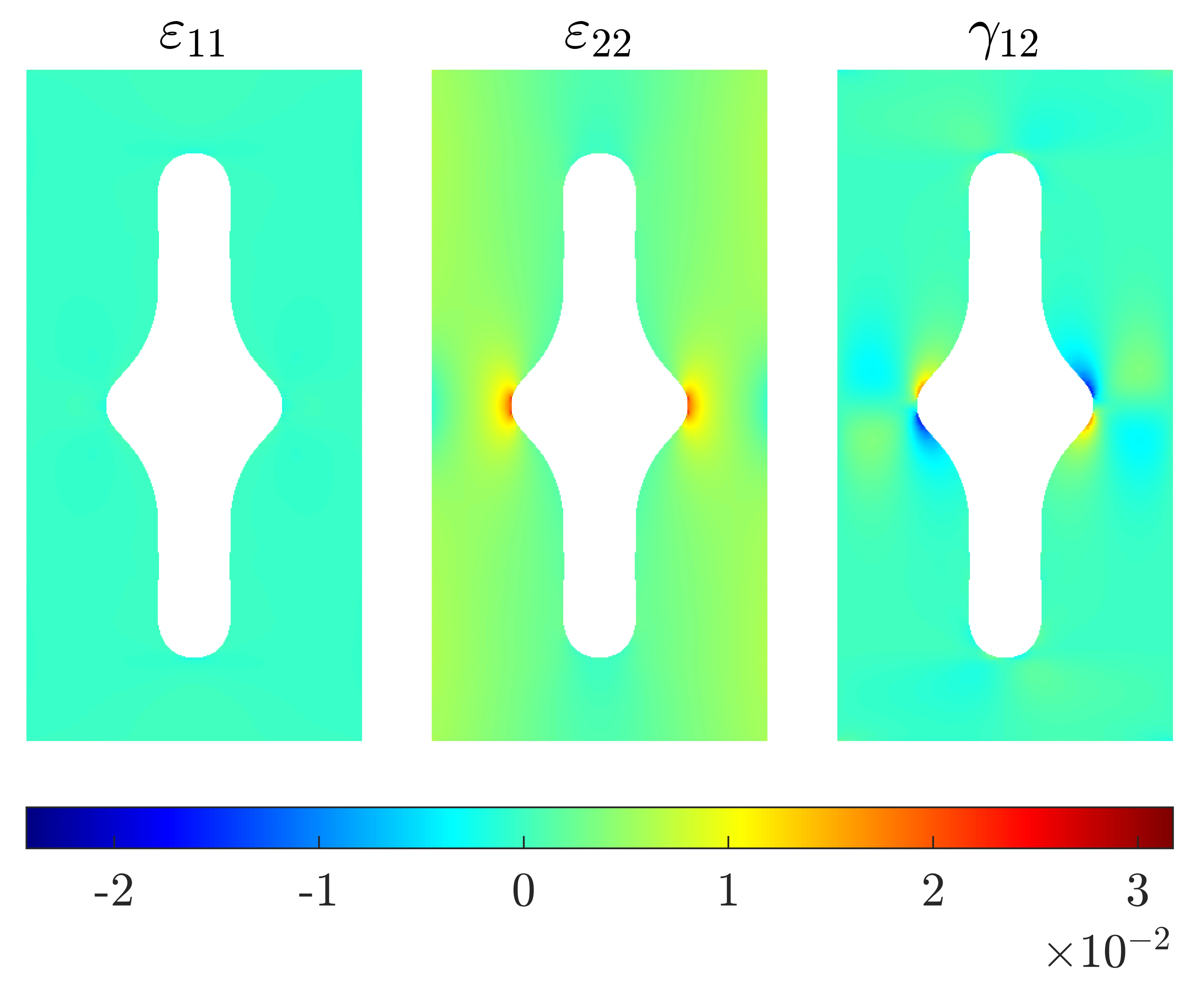
Optimized topologies for orthotropic materials feature characteristic holes whose arrangement depends on the anisotropy angle. Compared to reference specimens from the literature, the proposed designs showed lower parameter identification error, especially for intermediate angles. The key parameter, the condition number of the matrix, dropped to values around 200, ensuring robustness to noise with an amplitude of 0.1% of the nominal strain. The robust version of the algorithm eliminates thin hinges, improving practical usability.
Implications
Unlike related work that uses fixed geometries or simple shape optimization, this is the first application of high-resolution topology optimization with analytical gradients and proven mesh convergence. This allows automatic generation of specimens that previously required manual tuning and expert intuition. The approach does not depend on the true parameter values, resolving the paradox of needing to know the material to design a test for its identification.
Future development
The method can be extended to nonlinear material models such as hyperelasticity, plasticity, and viscoelasticity. Including metrological characteristics of digital image correlation (resolution, noise) in the objective function would make the design even more practical. Multi-start optimization with different random initial conditions is also promising for finding global minima.
Impact
The results are directly applicable to mechanical testing of composites, biomaterials, and anisotropic metals. The method can be integrated into software packages for automated experimental design.
Next steps
Experimental validation of optimized specimens using digital image correlation. Extension to three-dimensional problems and multi-material structures.
Key open problems
In mechanics of materials, identifying models with many parameters and strong nonlinearity remains an open problem. This approach addresses the geometry selection issue but does not guarantee uniqueness for complex constitutive laws. The connection to the non-uniqueness problem of inverse problems remains unexplored.
The knowledge machine's view
This section is addressed to the author of the paper and their colleagues. Neighbouring works were found by meaning-based search across our archive, not by word overlap. We do not review: we show the field around the work.
What the work does
The authors have developed a method for the automatic design of complex-shaped specimens to identify all elastic parameters of an anisotropic material in a single mechanical test. Using topology optimization with a cost function based on the conditioning of the system matrix, they obtain binary geometries that are robust to measurement noise. The results show that the optimized specimens are comparable to or better than known designs in terms of identification accuracy.
Where its strength is
The strength of the work lies in applying topology optimization with analytical gradients and a robust formulation to automatically generate specimens that do not depend on the true material parameters, thereby resolving the paradox of needing to know the material to design the test.
Where it could go next
- It might be interesting to see how the specimen design approach can be linked to active learning for selecting the most informative tests, similar to methods used for training material models.based on: How Clever Sampling Teaches Metal to Predict Strength arXiv:2606.08148
- A related line of work uses geometry optimization to control the vibrational properties of materials; perhaps similar ideas could be useful for designing specimens with improved dynamic identification.based on: Whisper in the Hall: How to Build a Material That Silences Sound at Two Frequencies at Once arXiv:2408.08428
- There is a study in the archive where topological invariants are determined from the system response; perhaps such mathematical constructs could help in choosing the cost function for conditioning.based on: Topology by Aroma: How One Spin Gives Away the Quantum Phase arXiv:2607.10656
Worth trying
- Test the use of Bayesian optimization to select the initial topology before running gradient-based optimization.
- Investigate how adding constraints on the minimum feature size affects the practical manufacturability of the specimens.
- Compare the matrix conditioning with other criteria, such as mutual information, to assess the informativeness of the experiment.
Why this may matter
The proposed approach could greatly simplify and accelerate the characterization of anisotropic materials, making it accessible to a wide range of laboratories and reducing the need for expert intuition in test design.
Nearby works in our archive
- Whisper in the Hall: How to Build a Material That Silences Sound at Two Frequencies at Oncesimilarity 0.54
- Light Trap for Nanoparticlessimilarity 0.54
- How Clever Sampling Teaches Metal to Predict Strengthsimilarity 0.52
- Material Reveals Its Secretssimilarity 0.51
- Topology by Aroma: How One Spin Gives Away the Quantum Phasesimilarity 0.51
- An Electron Beam as Fine as a Pencilsimilarity 0.51
The archive is sparse around this work: the closest review is only 0.54, against a usual 0.64. It looks like few have drilled nearby.
Optimized specimens often resemble bones or insect wings, where nature also solves the problem of maximum information content with minimal mass.
Key numbers
- condition number: around 200
- material volume fraction: 80%
- noise amplitude: 0.1% of nominal strain
- number of design variables: up to 160,000