How a Part's Shape Deciphers Material Properties ✛
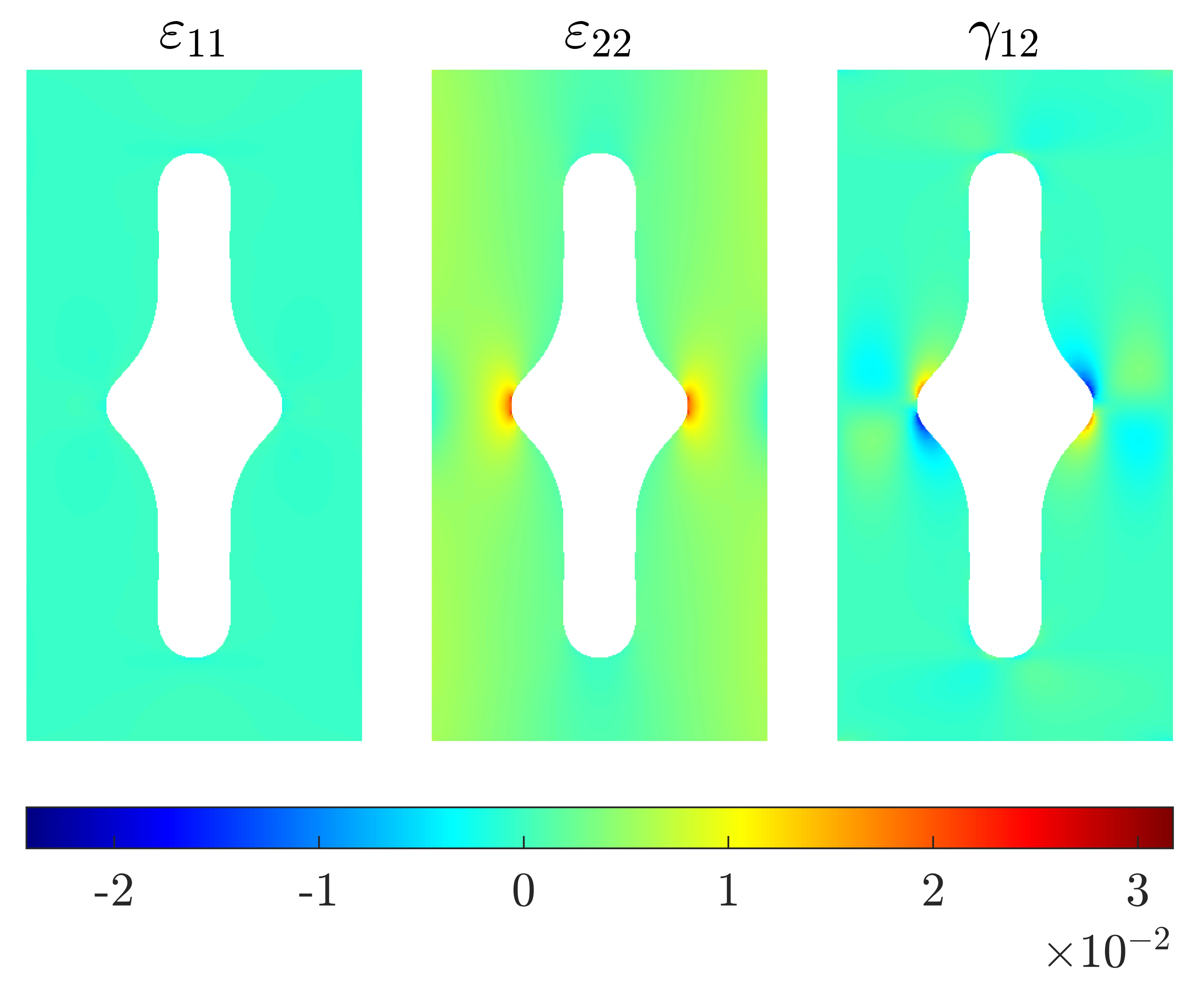
The bends of a specially designed part are like inscriptions that encode all the elastic properties of the material. Previously, these properties were determined by testing many rectangular pieces to calibrate the standard model of elasticity — almost like learning a language word by word. Now, a single part with protrusions and notches, loaded in a specific way, deforms so that the entire 'text' of the material becomes visible at once. This resembles spectroscopy in astronomy: by the pattern of deformations we read hidden characteristics, just as from a spectrum we read a star’s composition.
The optimal shape is computed by an algorithm, adjusting geometry to the material’s properties — especially if it’s not uniform in different directions, like wood or carbon fiber. Robert Hooke first described elasticity, but the modern approach turns his legacy on its head: instead of a set of tests, one precise question.
It’s surprising that such a 'one-shot' experiment often yields more accurate parameters than a classic series of hundreds of measurements. The complex shape works like a filter: it suppresses noise and highlights what matters.
With just one such sample, you can calculate the material’s stiffness more accurately than after hundreds of conventional tests. Fewer measurements — less noise.
A similar method in science fiction could be imagined as a universal 'matter tester' that, with a single touch, learns everything about the composition of an unknown substance — like the tricorder from Star Trek.