The Vortex That Links Quantum Memory and Processor ✛ ✦
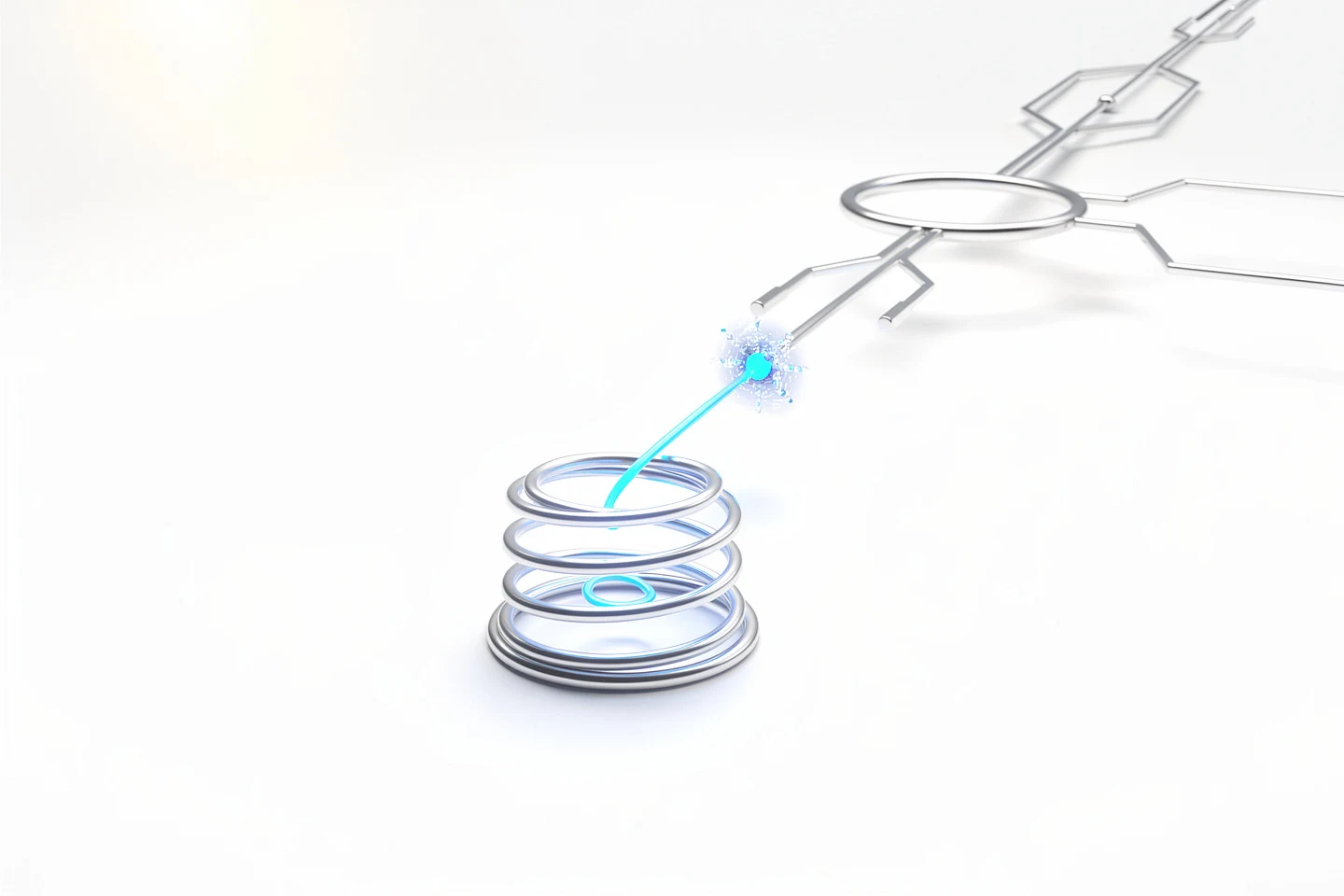
A powerful quantum computer needs a blazing-fast processor and a memory with a firm grip. The trouble is, their physical 'languages' don't match: superconducting currents barely converse with the magnetic properties of individual atoms. Enter the magnetic skyrmion as the translator — a microscopic vortex. Vibrating at high frequencies, it sensitively responds to both the state of an atomic defect in diamond (which stores quantum information) and the electromagnetic field of a superconducting circuit. This way, two qubits that were once deaf to each other start exchanging data. The vortex 'translator' wastes almost no energy on friction, helping preserve superposition and entanglement. What's more, its topological nature acts like an unbreakable knot: tiny defects and noise aren't a threat. That leads to a sharp suppression of quantum decoherence and the ability to perform precise quantum measurements. The ideas of David Deutsch about a universal quantum computer and the experiments of Alain Aspect on quantum correlations find real-world engineering embodiment: memory and logic now coexist on a single chip. Unexpected bonus: these same vortices can serve as ultra-dense memory, storing a bit in a cluster of just a few dozen atoms — thousands of times more compact than today's storage media.
The skyrmion is named after British physicist Tony Skyrme, who predicted similar particles in nuclear physics. Today, their magnetic counterparts promise a revolution in data storage.