Hadrons are a class of subatomic particles that participate in the strong interaction. They are not fundamental but consist of quarks held together by gluons (carriers of the strong interaction). The name comes from the Greek 'hadros' meaning massive, reflecting their relatively large mass compared to leptons (e.g., electrons). Hadrons include protons and neutrons (baryons, fermions with half-integer spin), as well as mesons (bosons with integer spin). Inside a hadron, quarks are bound so tightly that free quarks are not observed—this is the property of confinement.
History
The concept of hadrons became established by the mid-20th century as the number of discovered particles grew rapidly. In 1961, Murray Gell-Mann and Yuval Ne'eman proposed a classification of hadrons based on the SU(3) group, leading to the prediction of the Ω⁻ baryon. In 1964, Gell-Mann and, independently, George Zweig introduced the quark hypothesis. Experimental confirmation of quarks was obtained in the late 1960s in electron-proton scattering experiments at SLAC. The development of QCD in the 1970s (Gross, Wilczek, Politzer) explained the dynamics of the strong interaction.
How it works
Hadrons arise due to confinement: the color charges of quarks are attracted by gluons so strongly that the potential energy grows linearly with distance. When attempting to separate quarks, the gluon field string breaks, producing a quark-antiquark pair from the vacuum, leading to hadronization—the formation of jets of hadrons. This is described by the laws of QCD, in which asymptotic freedom and infrared slavery are important. Hadron masses are calculated using lattice QCD. The Pauli principle explains why baryons have an antisymmetric color wave function: the three quarks must be of different colors.
In practice
Understanding hadrons explains the structure of matter and allows studying the forces inside atomic nuclei, which is applied in nuclear energy and medical imaging (PET scanning).
Fun fact
Although the proton appears stable, some theories predict that it could decay over an unimaginably long time—more than 10³⁴ years. Such decay has not yet been observed.
Neutrinos are nearly elusive particles that pass through Earth without noticing it. But sometimes one slams into an atomic nucleus in water, and a whole shower of particles is born: muons, protons, pions. Catching that moment is like photographing a bullet hitting an apple from a kilometer away.
Inside an atomic nucleus, protons and neutrons don't sit still like peas in a pod. Each particle occupies its own orbit — a region of space where it can be found. The larger the orbit, the more 'smeared out' the particle is.
A neutron star is the remnant of an exploded star, compressed so tightly that a teaspoon of its material would weigh as much as a mountain. Inside such an object, protons and neutrons are packed tightly together, and under enormous pressure, hyperons, particles containing a strange quark, can appear.
When a proton is smashed apart in an accelerator, quarks and gluons fly out. But you never see them free: almost immediately they stick together into new particles, like droplets of mercury merging into spheres.
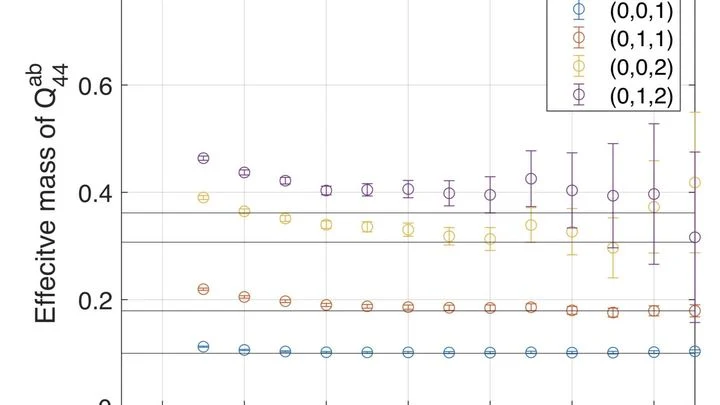
Quarks, the building blocks of protons and neutrons, usually pair up or form trios. But sometimes they assemble into larger, unstable combinations that live for mere fractions of a second. Two such particles, Bs0* and Bs1, have long been a puzzle: calculations hinted they should be bound, but the precision wasn't enough to say so with confidence.
At the Jefferson Lab accelerator, a beam of light strikes protons, and the collisions give birth to short-lived particles — omega mesons. They live for less than a billionth of a second, but they still manage to tell us about the forces inside the atomic nucleus.
In a tight row of atoms, spaced closer than the wavelength of light, a remarkable state hides. The excitation is distributed among all particles so that their radiation cancels itself out. This quantum 'silence' is an ideal vault for a photon: it can be stored there hundreds of times longer than usual.
Inside the atomic nucleus, protons and neutrons are packed so tightly that the forces between them resemble tightly coiled springs. Some springs compress and expand equally in all directions: these are the familiar central forces.
The proton is not a solid ball but a tiny prison. Inside it, three quarks are locked up, and the gluon field keeps them from escaping — something like invisible threads that only grow stronger if the quarks try to move apart.
The proton is not a monolithic ball. It is a seething cloud of quarks and gluons that constantly appear and vanish. Parton distribution functions help describe this picture: they show the probability of encountering a quark or gluon with a certain energy inside the proton.
A handful of sand in your fist: the grains press against each other, and your hand can't squeeze any further. Ordinary matter behaves similarly. But in a neutron star, compression is billions of times stronger — atoms are crushed, electrons are squeezed into protons, and nearly all space is filled with neutrons.
Water in a glass looks continuous, but it's made of molecules. Similarly, physicists have long described the matter inside a neutron star as a uniform soup of protons and neutrons. But real neutron stars are not soup. They are a dense crowd of particles where each neutron feels its neighbors.
The authors of the new work abandoned the uniform picture.
In June 2024, the CHIME radio telescope recorded over 700 radio bursts per hour from source FRB 20240114A. Such a hyperactive repeater releases in one hour nearly all the magnetic energy of a typical magnetar (a neutron star with an ultra-strong field).
A neutron star is a city squeezed to the size of a metropolis, where matter is packed to the limit. At the very center of such a city, a redevelopment may begin: familiar neutrons and protons give way to quark plasma — free quarks, the building blocks of almost everything around us.
In the microscopic world of the strong interaction, nature's most powerful glue, quarks never wander alone. Over large distances, they stick together into the protons and neutrons we know. But under extreme compression, like in the depths of a neutron star, this glue creates far more exotic forms of matter.
At accelerators, by smashing heavy nuclei, physicists briefly create a quark-gluon plasma — a state of matter where quarks and gluons are not confined inside particles but are free. For a long time, it was imagined as a gas, but experiments showed it's an almost perfect liquid.
Inside a neutron star, matter is squeezed so hard that atomic nuclei stop being separate clumps. Neutrons and protons get closer together, and their innards, quarks, begin to feel their neighbors through the walls of their 'bags'.
A neutron star is a sphere about the size of a small city but with a mass of one and a half Suns.
On one side of the scale lies all the matter in the Universe; on the other, all the antimatter. According to the laws of physics, at the moment of the Universe's birth, the pans should have been balanced. But we see one pan tipping: around us are stars, planets, people, and almost no antimatter. This imbalance is one of the greatest mysteries.
Hot gas settles on a substrate, building up a transparent film layer by layer. But instead of a perfect mirror, the surface sometimes gets covered with tiny bumps, like frost patterns on glass in severe cold. Usually, people try to remove them because they get in the way of making smooth components. Physicists from Oxford and their colleagues did the opposite: they looked inside the bumps.
Tiny invisible bullets pass straight through the Sun, barely noticing its matter. These are axions — hypothetical particles so light and elusive that they are often compared to ghosts.
In the world of elementary particles, there's a long-standing puzzle: why are the masses of the electron, muon, and tau particle so vastly different? And why are quarks, the building blocks of protons and neutrons, also split into three generations with sharp jumps in mass?
Two neutron stars (the remnants of dead stars, compressed to the size of a city but weighing as much as the Sun) spiral around each other and eventually collide. At that moment, something between a black hole and a super-powered magnet is born: a field billions of times stronger than that of the most powerful MRI machine.
A drop of cream in a glass of milk. Shake it, and the fat doesn't spread evenly: it clumps into denser blobs that move differently from the rest of the liquid. Quarks inside mesons, tiny particles that live for mere fractions of a second, behave in much the same way.
A meson consists of a quark and an antiquark, and they are rarely equals.
At first glance, the atomic nucleus is a cramped communal apartment where protons and neutrons (together called nucleons) live by strict rules. Each occupies its own orbit, like electrons in an atom, and on average everything looks orderly.
A pool of the purest water, into which tiny, almost invisible droplets occasionally fall. Each leaves a barely perceptible ripple, and capturing it requires years of patience. That is what the hunt for solar neutrinos looks like in the DEAP-3600 detector — a huge vat of liquid argon hidden deep underground.
Hydrogen is the most common element. Its atoms are like antennas: they emit and absorb light at very specific frequencies. Einstein predicted that spacetime can ripple: these are gravitational waves.
A pinch of salt falls into water, and sodium and chlorine ions scatter, surrounded by water molecules. Now, instead of an ion, a positron (an antiparticle, the electron's twin but with a plus instead of a minus) joins the molecular crowd.
A juggler tosses clubs while sitting on a spinning chair. If he starts spinning the clubs all in one direction, the chair will rotate the opposite way — otherwise, the conservation of angular momentum would be violated.
The atomic nucleus is not a billiard ball but rather a hazy cloud that constantly changes its contours. Protons and neutrons inside are in continuous motion, and the nucleus can take on many different shapes: elongated, flattened, or pear-like. To describe this quivering diversity, physicists usually picked a few most probable shapes and mixed them, like an artist mixing paints on a palette.
The atomic nucleus is not a solid ball but a dense swarm of tiny particles called quarks, glued together by a special glue (the strong force). In light nuclei, such as calcium, this swarm is simply arranged: the numbers of the two quark types, up and down, are almost equal, like the white and black keys in an octave.
If you try to break a proton apart and pull out a quark, you're in for a surprise. Ordinary forces, like the electric force, weaken as particles fly apart. Here, it's the opposite. The farther a quark gets from its neighbors, the harder it's pulled back.
In the CMS detector at the Large Hadron Collider, protons accelerated to nearly the speed of light collided. Among billions of such collisions, physicists searched for a rare signature: the production of a single heavy particle that immediately decays into a W boson and a b quark.
Two streams of cars collide at an intersection. In the first moments after the impact, the debris scatters not randomly, but as if briefly enveloped by a common cloud. This is roughly what physicists saw at the Large Hadron Collider when protons smashed into each other at tremendous speed.
In a giant particle accelerator, particles smash into each other, and sometimes after the collision only two photons, particles of light, remain. Physicists can predict how often this happens, but their calculations have long disagreed with what detectors see. Each refinement of the theory changed the answer, and there was no consensus.
Heavy particles, which physicists call baryons, are like tiny families of three quarks. The common baryons are protons and neutrons, which make up everything around us. But there are also exotic relatives: instead of light quarks, they harbor charm or bottom quarks — heavy and short-lived.
Quarks are the tiny building blocks that make up protons and neutrons. Usually, they stick together in pairs: a particle and its mirror-image antiparticle. But sometimes quarks form more exotic combinations, which physicists call exotic states.
The proton looks like a solid ball, but inside it's a hive of activity: quarks exchange gluons — the particles that bind them together. Gluons pop in and out of existence, and their distribution within the proton is not just a curious detail but a key to predictions at the Large Hadron Collider.
When particles collide at enormous speeds, they produce a shower of new particles. Among them are antiprotons — twins of ordinary protons but with the opposite charge. Each of these particles has its own spin, like a tennis ball sent with a twist. But whether antiprotons are actually spun up at birth has never been checked.
If you place a kaon in an electric field, it stretches slightly, like a balloon rubbed on wool. This response, the electric polarizability, shows how rigidly the particle is built inside. For the charged kaon, it has been measured for the first time, and the number is about one ten-thousandth of the volume occupied by a proton.
If an atomic nucleus is a family, then in an ordinary helium house live two protons and two neutrons, holding hands tightly. Now imagine that one family member is an oddball who loves to wander far from home.