Diamond quantum memory refers to the use of nitrogen-vacancy (NV) centers in diamond crystals to store quantum information. An NV center is a defect where a nitrogen atom replaces a carbon atom and an adjacent lattice site is empty. This defect has an electron spin that can be manipulated and read out with light, making it a promising qubit. The diamond lattice provides a stable, solid-state environment that protects the quantum state from decoherence, allowing for relatively long storage times compared to other solid-state qubits.
History
NV centers in diamond were first studied in the 1990s, but their use as a quantum memory was demonstrated in the 2000s, with significant advances by groups such as those at Harvard and Delft. The field has grown rapidly since.
How it works
Information is encoded in the spin state of the NV center's electron, which can be in a superposition of up and down states. Microwave pulses manipulate the spin, while laser pulses initialize and read out the state. The diamond crystal shields the spin from magnetic noise, and at low temperatures coherence times can reach milliseconds or even seconds. For memory applications, the NV center can absorb a photon, transfer its quantum state to the spin, store it, and later emit a photon with the same state, enabling quantum repeaters and interfaces between light and matter.
In practice
Diamond quantum memories are used in quantum repeaters for long-distance quantum communication, in quantum computing prototypes, and in high-sensitivity magnetometry and sensing.
Fun fact
A single NV center can be used as a thermometer that measures temperature changes of just a few millikelvin in living cells, thanks to its spin-dependent fluorescence.
Imagine a carousel carrying not children but tiny magnetic needles inside diamond dust. Usually these needles point randomly, and their signal is lost in noise. But if you tilt the carousel at a special angle and shine a green laser on it, the needles start aligning in one direction. That is exactly what physicists did with diamond particles, spinning them at 54.74° to the magnetic field.
An X-ray flash tears through matter in billionths of a second. To remember it, physicists make atoms briefly absorb the light and then release it back. But pulling out a photon on command is like grabbing the right book from a shelf when the shelves move on their own.
The usual approach is to move several absorbers with extreme precision, like a well-coordinated orchestra.
An extra electron in a molecule is like a passenger barely hanging onto the step of a departing train. Such a 'passenger' turns the particle into an anion — a negative ion. Studying it is tough: the bond is weak, the electron cloud is diffuse, and any jolt can knock the electron off.
Building a quantum network node is like teaching a dancer to balance on a carbon thread over an abyss. One leg must spring lightly from the wire, hurling photon-messengers into the external world. The other must grip the rope tightly, guarding precious quantum information.
Diamond is a symbol of perfection, but its true magic is revealed through flaws. Perfect lattice purity gives transparency and hardness, while defects, such as color centers, open a portal to the quantum world, becoming the foundation for quantum computers and quantum sensors.
In diamond, as in any crystal, defects are common — empty sites or foreign atoms. When they capture an electron, they can glow or become magnetic, which is valuable for quantum devices. But the electron is easily lost, and to keep it, boron has to be added to the diamond — sort of like constantly warming up an engine so it runs in the cold.
In diamond quantum devices, there's a tiny defect — the nitrogen-vacancy center (a nitrogen atom plus a vacancy where a carbon atom should be). It acts as a switch that spontaneously flips back and forth: it can carry an extra electron or not, and this determines whether it emits light or not.
A tiny diamond with a defect — a nitrogen atom next to a vacancy in the crystal lattice. This defect, the NV center, acts like a magnetic needle: under green light, it glows red, and the brightness of that glow depends on the direction of its magnetic field.
A spinning top, set in motion on a perfect surface, topples from the slightest tremor. Likewise, a quantum bit, created at a defect in a diamond, has its state destroyed by magnetic disorder from impurities and external interference.
Lasers usually heat things up. But in some crystals, light can carry heat away, like a teapot cooling under a bright lamp. In diamond, this job falls to defects: spots where a nitrogen atom replaces carbon, with a vacancy nearby.
In the crystal lattice of diamond, defects occasionally appear: a nitrogen atom grabs a foreign spot, and next to it gapes a void. Such a flaw turns into a supersensitive diamond compass: its magnetic needle quivers at the slightest external field. Paradoxically, a blemish that lowers a stone's value has become a coveted tool for physicists.
A crystal that inside resembles a sponge with a labyrinth of pores turns out to be capable of performing computations. The material, named DUT-8, consists of metal nodes and organic linkers forming an intricate lattice. Under the influence of different gases, this lattice slightly changes shape, like a house of cards that rearranges with a gentle breath.
Three charged ytterbium atoms are arranged in a triangle inside an electromagnetic trap. Normally, they all communicate with each other, like three people at a table constantly exchanging remarks. But if one of them steps into the next room, the conversation continues between the remaining two.
A ring the size of a dinner plate made an electron beam run in circles. Its diameter is 22 centimeters, and a full turn takes just 4.7 nanoseconds. To put that in perspective: in one second, such an electron would complete more than two hundred million laps.
A magnetic field is invisible, but you can make it 'glow' using tiny defects in diamond — nitrogen-vacancy centers. Each such defect acts as a miniature compass, telling you which way the field points. The problem is that there are many of these compasses, and reading them all in sequence is like transcribing every letter in a thick book by hand.
A diamond speck smaller than a hundredth of a millimeter glows red. Inside it is a crystal defect: two neighboring carbon atoms, where one is missing and a nitrogen atom sits nearby. Such a pair captures light and re-emits it, like a tiny beacon that doesn't fade at room temperature.
This speck was brought near a pathway on the chip's surface.
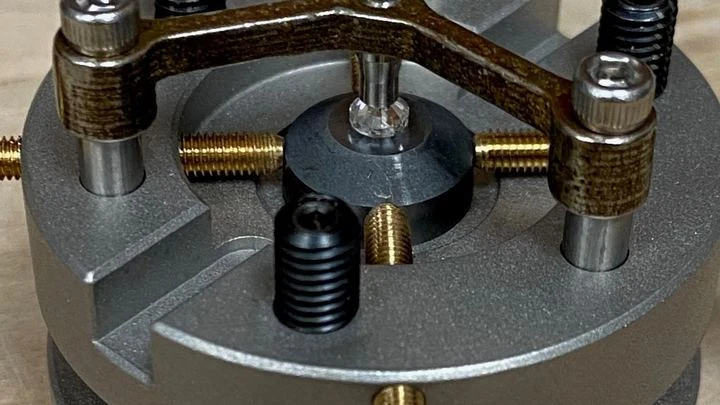
In a diamond anvil cell, pressure squeezes a material as if it were buried hundreds of kilometers deep inside the Earth. Inside this chamber, tiny diamond sensors, color centers, respond to microwaves and report on the magnetic fields and temperatures around them.
A tiny diamond, smaller than a dust speck, hovers inside a magnetic trap made of microchips. Inside the crystal is a single defect acting as a beacon. Scientists coax the diamond into being in two places at once, like a magician’s ball that honestly rests under two cups.
This isn't just a trick.
Heat an ordinary quartz watch by ten degrees, and it will start losing seconds each day. Atomic clocks are more precise, but they take up an entire cabinet. Diamond with a tiny defect, a nitrogen vacancy, promises atomic-clock accuracy in the volume of a grain of sand.
Every cell is a miniature tuning fork. A sharp magnetic pulse makes it 'ring', and the decay of that sound depends on what's inside: viscosity, density, composition. A tiny diamond with a structural defect acts like a hypersensitive microphone, picking up magnetic echoes from individual cells.
In diamond, you can embed a “spy.” Simply replace a carbon atom with nitrogen: you get a defect that responds to magnetic fields and sends a light signal.
Quantum computers demand reliable memory. In a diamond crystal — carbon — information is stored as the orientation of microscopic magnetic needles (spins) at special defects. Reading these arrows with light was inconvenient: optics are bulky for chips. The new method works like developing photographic film.
A crowd of thirty-one quantum sensors whispers within a diamond slab. Previously, this whisper was drowned out by the roar of floodlights: the random photon bursts used to read out the spin states masked the ensemble's own quantum noise. Now physicists have learned to switch off the floodlights and listen to the crowd itself.
On a two-by-two-millimeter diamond plate, an entire orchestra of forty-nine violins fits. Each string is tuned to its own note, its own DNA fragment. When the right melody enters the hall, the string responds, and the conductor hears a clean sound. That conductor is a quantum sensor hidden within the diamond itself.
Inside a diamond anvil cell, a device where two diamonds squeeze a sample to hundreds of gigapascals, pressure is distributed unevenly. Some regions are compressed more, others less. This affects experimental results: the material may behave differently than under perfectly uniform compression.
A quantum computer is like an orchestra where strings and brass play in different languages. Superconducting processors operate with microwave photons in centimeter-scale circuits, while spin qubits, such as nitrogen-vacancy centers, store…
Inside a diamond, you sometimes find tiny flaws — a spot where a carbon atom is replaced by nitrogen, with a vacancy right next to it. Physicists call this an NV center (a nitrogen-vacancy defect). Such a defect acts like a magnetic needle that can store information in its spin.
A tuning fork sounds when you strike it. Its prongs vibrate, and you hear the sound until the vibration dies out. The quantum world has its own "tuning forks"—for example, a defect in diamond that responds to magnetic fields, and a carbon tube that can tremble at frequencies billions of times higher than the note A.
A tiny diamond with defects, nitrogen atoms that replaced carbon, hides an unusual feature. Around each defect, an extra electron spins like a top that can be tilted by radio pulses. On its own, this top is too quiet to reach a superconducting qubit — an artificial atom operating at temperatures colder than outer space.
Hidden within the bulk of a diamond are tiny flaws — places where a carbon atom is replaced by nitrogen, with a vacancy gaping nearby. These defects, like beacons, can store and transmit quantum information. But around them rages a magnetic storm: the nuclei of atoms in the crystal jostle, creating interference.
A superconducting qubit, a tiny loop with zero resistance, crunches problems faster than you can blink. But cut the power, and everything it has calculated vanishes. Like a chef who cooks without writing down the recipe: as long as he's at the stove, he remembers every step, but an hour later — nothing.
The authors of the study propose writing the result into diamond.