The Quantum Translator: Bridging Superconductors and Light ✛ ✦
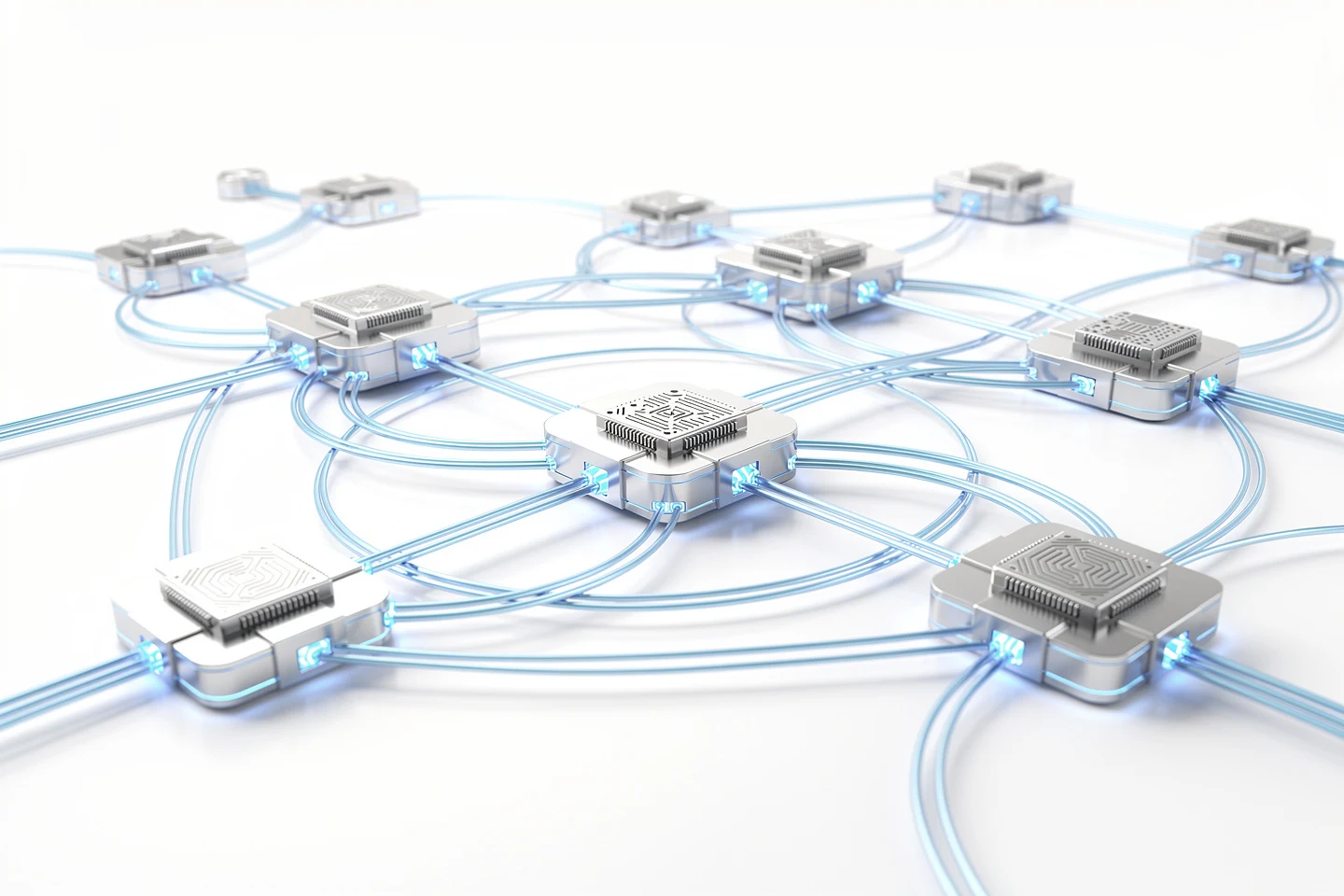
Today’s best quantum computers use superconducting circuits that operate with microwaves. For long-distance communication, you need optical photons (light particles) in fiber optics. To make these waves get along, a quantum translator based on the electro-optic effect is used: a laser inside a microscopic cavity links microwaves and light, transferring quantum information without reading it. But a qubit holds a superposition of states, and any measurement triggers a collapse — an irreversible destruction, like a popping soap bubble.
The bridge is entanglement — a weird connection where two particles behave as one, no matter how far apart. Once you create it between nodes, you can teleport data with much less demanding hardware. What matters are conversion efficiency and entropy (the purity of the state). A surprising twist: even mediocre efficiency yields usable entanglement, whereas direct transmission requires near-perfect devices that suffer from decoherence — the destruction of quantum properties by noise. The concept of teleportation was developed by Charles Bennett, and groundbreaking entanglement experiments were carried out by Alain Aspect and Anton Zeilinger.
The frequency gap between microwaves and light is about a hundred thousand times. It’s as if the same guitar were playing the lowest bass note and an inaudible ultrasound at the same time.
In the series 'Star Trek,' teleportation is routine. The quantum bridge, of course, doesn’t move people, but it already 'teleports' the properties of particles, bringing a global quantum network closer.