Quantum Transduction: How to Combine Superconducting Qubits and Optical Photons in a Quantum Network ✛ ✦
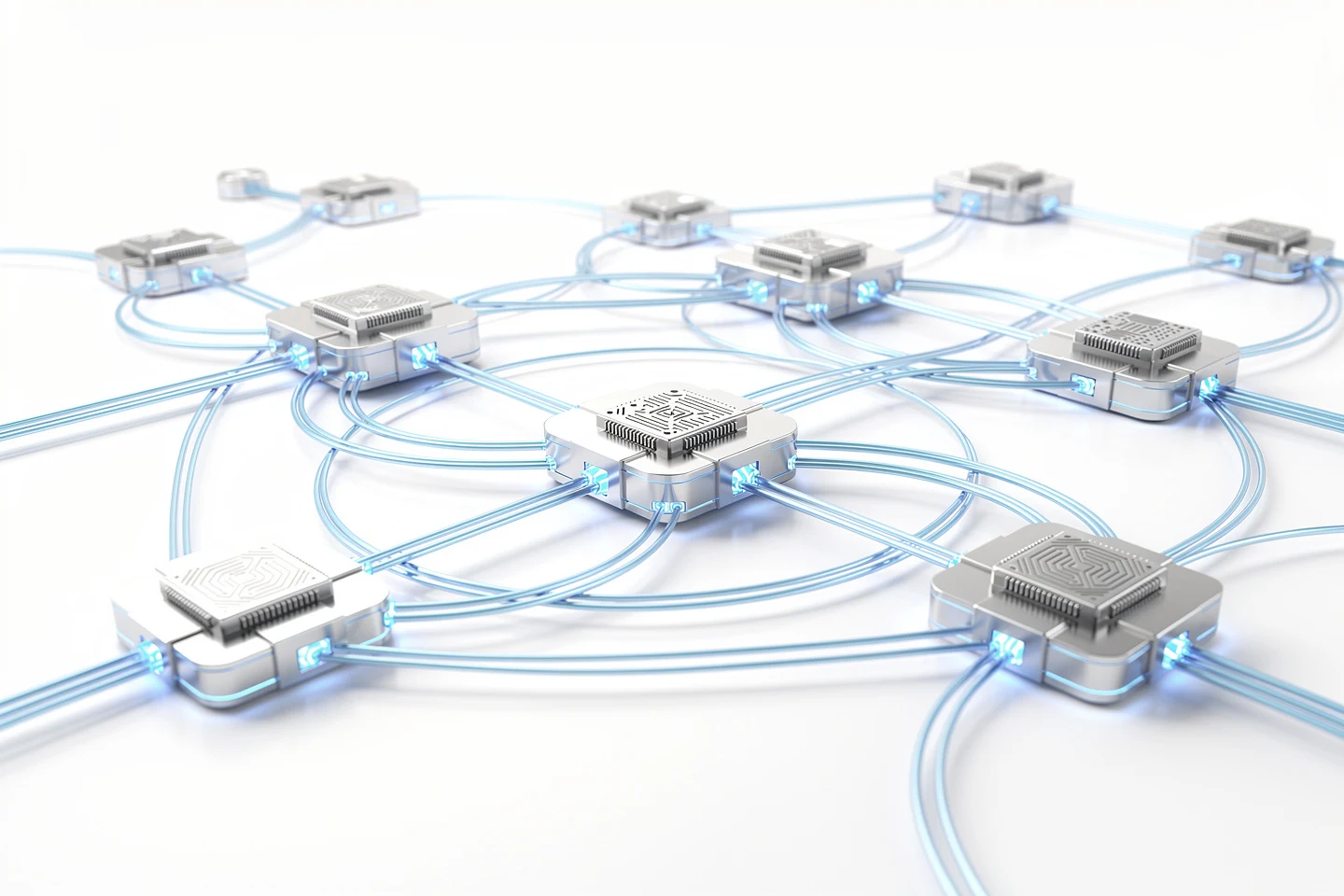
Context
Creating a quantum internet requires merging different hardware platforms: superconducting qubits excel at computation thanks to fast gates and technological maturity, while optical photons are indispensable for long-distance transmission due to their weak interaction with the environment. However, they operate in vastly different frequency ranges: microwave (GHz) and optical (hundreds of THz). Direct interaction is impossible, and this is where quantum transduction comes in—a process that converts a qubit's state from one physical implementation to another without violating the fundamental prohibitions of quantum mechanics, most notably the no-cloning theorem and the measurement postulate.
Methods
The physical implementation of a quantum transducer is based on the electro-optic Pockels effect in resonators, where a laser pump couples microwave and optical modes via a nonlinear interaction described as a beam splitter. A qubit in a superposition of logical states is transferred to a new carrier without destruction. The key parameter is the conversion efficiency η, expressed through cooperativity C and extraction ratios ζ. Cooperativity, in turn, depends on the single-photon coupling rate g₀ and the number of pump photons nₚ. Experimental setups include bulk optomechanical and integrated electro-optic devices, and network aspects are analyzed using models of quantum channels and capacity theory.
Results
It is shown that direct transduction of information qubits requires η↑η↓ > 0.5 for non-zero quantum capacity—values not yet achievable. Meanwhile, transduction of entanglement (ebits) relaxes the requirements: the condition η↑η↓ > 0 becomes sufficient thanks to resource regeneration. The most promising approach is 'Entanglement Generation by Transduction' (EGT), where the transducer itself creates hybrid entangled pairs. An analysis of connection archetypes using von Neumann entropy to assess state purity showed that EGT combined with entanglement swapping can distribute ebits even at moderate cooperativity C ≈ 0.17, bypassing direct conversions at the receiver side. The probability of successful EPR pair distribution critically depends on C and optical fiber length.
Implications
The developed concept shifts the focus from direct conversion of information qubits to management of entanglement distribution, radically changing the architecture of quantum networks. This resembles the transition from circuit switching to packet switching in the classical Internet: instead of transmitting a fragile quantum state directly, it's more advantageous to first create shared entanglement as a resource and then use it for data teleportation. Pioneers of these ideas, who laid the foundations of quantum teleportation and entanglement distribution, include Charles Bennett, Alain Aspect, and Anton Zeilinger.
Future development
Near-term tasks include increasing cooperativity C through new materials and resonator designs, as well as suppressing thermal noise and pump photon scattering. Additionally, the problem of intraband transduction (between different optical bands, e.g., from visible to telecom) must be solved, which is necessary for integrating ion-trap and quantum-dot processors. Network aspects will require protocols for synchronization and heralding (confirmation) of successful entanglement distribution, accounting for the effects of decoherence.
Impact
The practical realization of efficient quantum transducers will impact distributed quantum computing and quantum data centers, enabling the scaling of quantum processors to useful sizes. Furthermore, it will accelerate the creation of a quantum internet capable of uniting disparate qubit platforms into a single network.
Next steps
Next steps include experimentally achieving cooperativity C ≈ 1 while maintaining low added noise (less than one photon), and testing entanglement heralding schemes based on photon-number-resolving single-photon detectors.
Key open problems
Quantum transduction is directly linked to the fundamental problems of quantum decoherence and scaling of quantum systems. Success in this area will bring closer the realization of a universal quantum computer with error correction and fault-tolerant quantum communication.
The knowledge machine's view
This section is addressed to the author of the paper and their colleagues. Neighbouring works were found by meaning-based search across our archive, not by word overlap. We do not review: we show the field around the work.
What the work does
The paper examines quantum transduction as a way to interface superconducting qubits with optical photons. The authors analyze conversion efficiency, the conditions for achieving nonzero quantum capacity, and propose the 'Entanglement Generation by Transduction' (EGT) approach, where the transducer itself creates hybrid entangled pairs. They show that EGT allows for the distribution of ebits at moderate cooperativity, without the need for direct conversions.
Where its strength is
Shifting the focus from direct conversion of information qubits to managing the distribution of entanglement is a strong architectural move that relaxes the requirements on conversion efficiency.
Where it could go next
- There is a nearby work on imperfect transducers in a cryostat, which examines the impact of non-idealities on building quantum links. It might be interesting to see how their model of imperfections could be applied to your EGT approach.based on: Light in a Cryostat: How Imperfect Converters Build Quantum Bridges arXiv:2505.00542v1
- A paper on quantum networks with optical switches discusses the architecture for connecting processors. Perhaps your entanglement generation by transduction scheme could be integrated into such networks to reduce the demands on individual nodes.based on: Quantum Networks: How Optical Switches Link Processors arXiv:2501.05598
- The archive contains an analysis of a quantum transducer from an atomic language to an optical fiber one. It would be curious to compare how they address the challenge of interfacing different platforms and possibly transfer some techniques to superconducting qubits.based on: Quantum Translator: From Atomic Language to Fiber-Optic arXiv:2607.29609v1
Worth trying
- Investigate how imperfections in transducers from 2505.00542v1 affect the success probability of EGT.
- Evaluate whether optical switches can be used to route the entangled pairs generated by your transducer.
- Compare the cooperativity requirements in your scheme with those in an atom-optical transducer.
Why this may matter
Such a paradigm shift could simplify the implementation of quantum networks, making them more resilient to component imperfections and bringing the practical creation of a quantum internet closer.
Nearby works in our archive
- Light in a Cryostat: How Imperfect Converters Build Quantum Bridgessimilarity 0.68
- Quantum Networks: How Optical Switches Link Processorssimilarity 0.68
- Quantum Translator: From Atomic Language to Fiber-Opticsimilarity 0.67
- A Quantum Bridge of Diamond and Lightsimilarity 0.67
- Quantum Data Centers: The Future of the Internetsimilarity 0.66
- Quantum Cold: How Wires Don't Get in the Way of Computingsimilarity 0.65
The closest work in the archive sits at 0.68 by meaning — the usual level for our corpus.
Original abstract
as written by the authors arXiv:2505.02057v4
The complementary features of different qubit platforms for computing and communicating impose an intrinsic hardware heterogeneity in any quantum network, where nodes, while processing and storing quantum information, must also communicate through quantum links. Indeed, one of the most promising hardware platforms at quantum node scale for scalable and fast quantum computing is the superconducting technology, which operates at microwave frequencies. Whereas, for communicating at distances of practical interest beyond few meters, quantum links should operate at optical frequencies. Therefore, to allow the interaction between superconducting and photonic technologies, a quantum interface, known as quantum transducer, able to convert one type of qubit to another is required. This paper aims to provide a tutorial treatise on the fundamental research challenges of quantum transduction. The tutorial is structured around a communications engineering framework, thereby shedding light on its fundamental role in quantum network design and deployment -- a perspective often overlooked in existing literature. This framework allows us to categorize different transduction modalities and to reveal an unorthodox one where the transducer itself can act as an entanglement source. From this standpoint, it is possible to conceive different source-destination link archetypes, where transduction plays a crucial role in the communication performances. The analysis also translates the quantum transduction process into a proper functional block within a new communication system model for a quantum network.
The frequency gap between microwave and optical domains spans five orders of magnitude: it's like trying to connect radio waves several meters long with infrared radiation using a single device the size of a dime.
In the famous series 'Star Trek', teleportation happens instantly and without visible technical difficulties. Modern science, alas, is far from moving people, but quantum transduction implements the first step, transferring quantum states between network nodes, inspiring science fiction writers to new plots about quantum journeys.
Key numbers
- frequency gap: 5 orders of magnitude
- achieved efficiency (electro-optics): ~15% (C≈0.3)
- threshold for direct qubit transduction: η↑η↓ > 0.5
- threshold for ebits: η↑η↓ > 0
- attenuation in telecom fiber (1550 nm): 0.2 dB/km