Tunnel Resonance: How Diodes Learn to See ✛
In 1974, physicists first described a device in which electrons pass through an energy barrier thanks to quantum tunneling. Today, that device, the resonant tunneling diode, is becoming the heart of an unusual computing architecture. Instead of thousands of lines of code and a powerful processor, an array of 28 diodes reads an image and converts it into a set of features sufficient for recognizing digits and fruits.
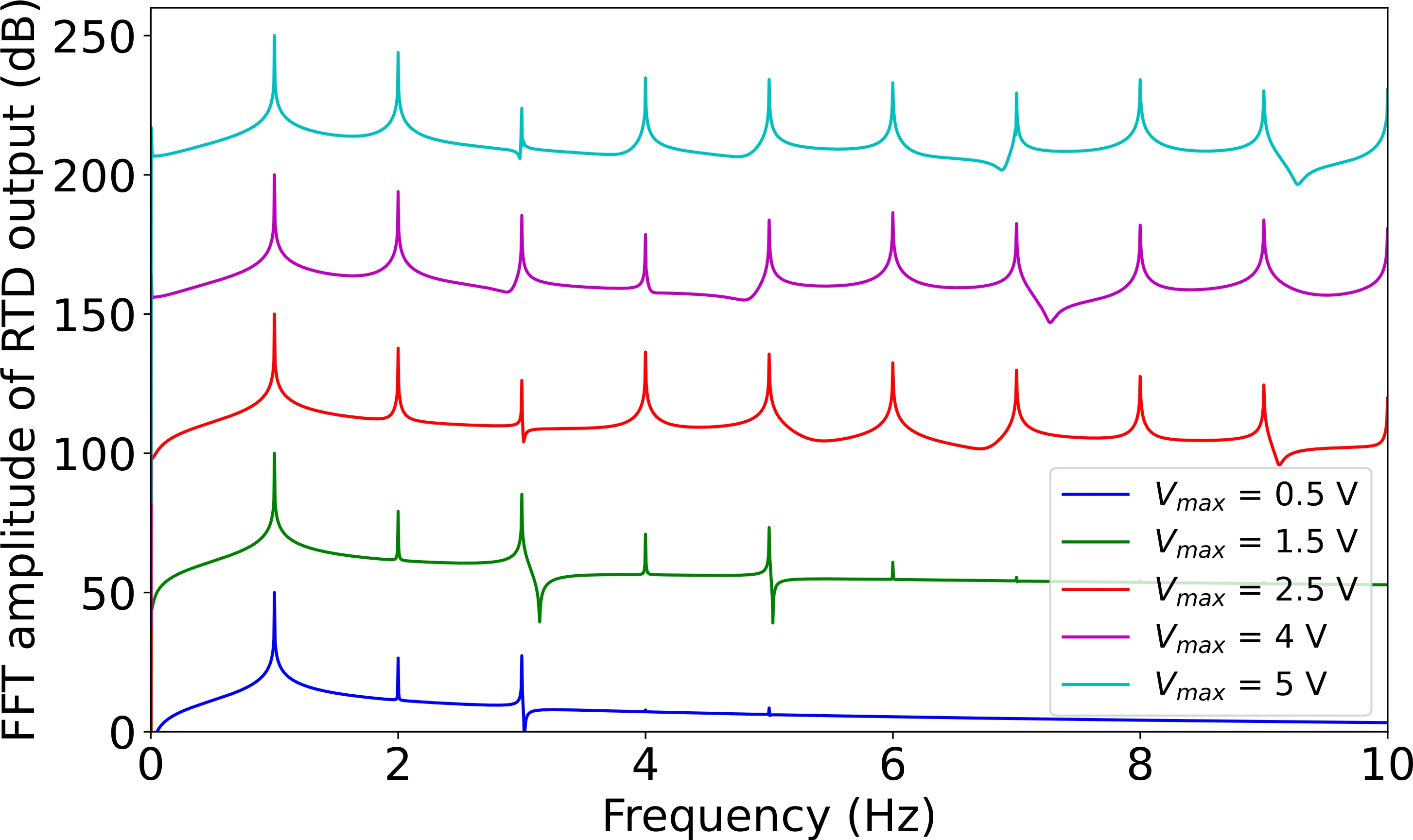
Reservoir computing is a machine learning method with a fixed nonlinear network. The classic scheme uses random connection matrices, but the new generation abandons randomness in favor of a deterministic nonlinear transformation. Here, the resonant tunneling diode acts as an interpreter that does not merely repeat the signal but adds new overtones to it. Each row of pixels is fed to the diode as voltage pulses, and the nonlinear current-voltage characteristic, the dependence of current on voltage, generates higher harmonics. These overtones carry information about the shape of a digit or the contour of an apple.
Numerical simulations in Python showed that on the MNIST dataset (handwritten digits) accuracy reached 92.5%, and on Fruit-360 (fruits and vegetables) it was 99.1%. Errors occurred mostly between similar digits, for example 4 and 9. The classes 'apple', 'avocado', and 'strawberry' were recognized almost without error. The output currents of the diodes form the reservoir state matrix, and the output weights are computed using ridge regression, a linear regression with regularization. No random masks, delay lines, or virtual nodes: only the physics of tunneling.
This work fits into the trend of next-generation reservoir computing, where randomness is replaced by a deterministic nonlinear transformation of the input signal. Previously, it was unclear whether resonant tunneling diodes could serve as a physical reservoir for image recognition without random matrices. Now it has been shown that an array of RTDs with a deterministic nonlinear characteristic achieves accuracy up to 99.1% on Fruit-360 and 92.5% on MNIST. This was achieved thanks to a numerical model where nonlinearity is set by the diode current-voltage characteristic, not by random connections. Such an approach could be used to create energy-efficient hardware accelerators for pattern recognition in autonomous devices.
The next step is the experimental implementation of the diode array and integration with temporal coding. It may be combined with quantum tunneling and spiking neurons. The technological compatibility of RTDs with silicon electronics opens the way to hybrid chips where the reservoir operates in analog mode and readout in digital mode. A drone that recognizes obstacles without cloud computing, or a wearable device that recognizes gestures, is no longer science fiction but an engineering task for the coming decade.
The resonant tunneling diode was first described in 1974, but its application in neuromorphic computing has only begun recently.