Resonant Tunneling Diodes as a Reservoir for Pattern Recognition ✛
Context
Image recognition on edge devices is constrained by limitations in energy and computational power. Software neural networks require powerful processors that are unsuitable for drones and autonomous systems. Reservoir computing (RC) offers a workaround: instead of training the entire network, only the linear output layer is trained. However, traditional RC relies on random connection matrices that need to be tuned. Around this problem, the field of "next-generation RC" has emerged, where randomness is replaced by deterministic nonlinear transformation of the input signal. This work fits into that vein, proposing a physical implementation of nonlinearity using resonant tunneling diodes.
Methods
The authors built a numerical model of a reservoir consisting of a parallel array of RTDs. Each image is converted into a sequence of voltage pulses corresponding to pixel rows. For a 28×28 pixel image, 28 diodes are used, each receiving 28 pulses. The diode's current-voltage characteristic, described by a formula with parameters from the literature, defines the nonlinear transformation. The output currents of the diodes form the reservoir state matrix. Output weights are computed using ridge regression. The model is implemented in Python and tested on the MNIST (digits) and Fruit-360 (fruits) datasets, split into 70% training and 30% test data.
Results
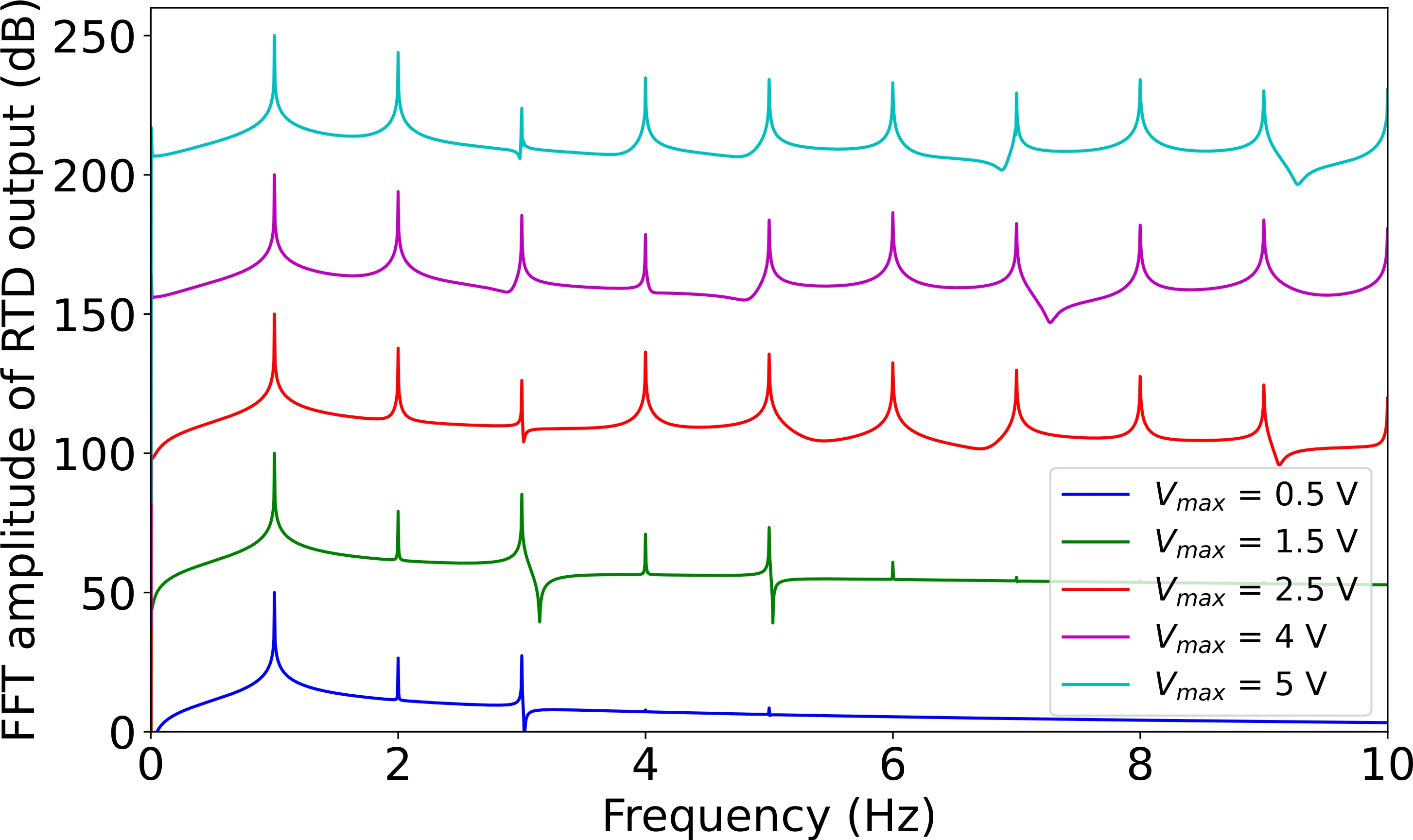
On MNIST, the system achieved an accuracy of 92.5% after 30 training epochs, with errors mainly between similar digits, such as 4 and 9. On Fruit-360, the accuracy was 99.1%, with classes like "apple," "avocado," and "strawberry" recognized almost without error. The key result is the dependence of accuracy on the input voltage amplitude Vmax. At Vmax = 0.5 V, the reservoir operates in a linear regime and accuracy drops to 80%. When Vmax is increased to 4–5 V, nonlinearity grows and accuracy exceeds 95%. Spectral analysis showed that at large amplitudes, the output signal contains higher harmonics up to the tenth, which is equivalent to retaining many nonlinear terms in the algorithmic version of next-generation RC.
Implications
This work demonstrates that the physical nonlinearity of RTDs can replace software activation functions and random matrices in reservoir computing. This differs from neighboring works where the reservoir is an optical system or a software emulation: here, a specific electronic component with a deterministic characteristic is proposed. The approach eliminates the need for masks, delay lines, and virtual nodes, simplifying hardware implementation. It is shown that increasing the nonlinearity of the response directly improves classification quality, giving engineers a simple tuning knob.
Future development
The next step will be the experimental implementation of an RTD array and integration with temporal coding. It may be combined with quantum tunneling and spiking neurons. The technological compatibility of RTDs with silicon electronics paves the way for hybrid chips where the reservoir operates in analog mode and readout in digital mode.
Impact
The method could influence the development of compact and energy-efficient machine vision systems for drones, wearable devices, and edge AI.
Next steps
Planned experimental verification on real diodes, investigation of temporal coding schemes, and hybrid architectures with quantum effects.
Key open problems
In the field of reservoir computing, an open question is: which physical systems provide the best balance between computational power and energy consumption. This work shows that RTDs with controllable nonlinearity could be a competitive candidate, but it remains unclear how to scale the array and maintain stability under variations in diode parameters.
The knowledge machine's view
This section is addressed to the author of the paper and their colleagues. Neighbouring works were found by meaning-based search across our archive, not by word overlap. We do not review: we show the field around the work.
What the work does
This work proposes a reservoir computing architecture built on an array of resonant tunneling diodes (RTDs), where the diodes' nonlinear current-voltage characteristic transforms images into features without any random connectivity. The model was tested on MNIST and Fruit-360, achieving accuracies of 92.5% and 99.1%, respectively, and it was shown that increasing the input voltage amplitude enhances nonlinearity and classification performance.
Where its strength is
The strength lies in the concrete physical implementation of the nonlinear transformation using RTDs, which eliminates the need for random matrices and virtual nodes, simplifying the hardware realization and providing a direct tuning knob via the amplitude.
Where it could go next
- It might be interesting to see how this physical nonlinearity approach compares with work where the reservoir is an optical system: there, light is used for signal processing, and one could compare how much the electronic RTD array wins in energy efficiency and compactness.based on: Dense Connections vs. Residual Paths: How DenseNet-121 Outperforms ResNet-50 in Brain Cancer Detection arXiv:2505.11735
- In our archive, there is work on how chaotic dynamics in a crystal are used for computing; perhaps it is worth considering how introducing controlled chaos into the RTD response could expand feature diversity and improve class separability.based on: Chaos in a Crystal Learns to Think arXiv:2602.18335
- Nearby lies a study where a neural network is trained on the algebraic skeleton of data; it might be useful to see how structured mathematical features can combine with the RTD nonlinear transformation to improve accuracy on complex datasets.based on: Tropical Blueprint: A Neural Network Learns from an Algebraic Skeleton arXiv:2607.00237
Worth trying
- Test adding a small random component to the input voltage to check robustness and possibly expand the reservoir's dynamic range.
- Investigate how changing the pulse shape (not just amplitude) affects the harmonic content and classification accuracy.
- Explore parallel connections of diodes with different current-voltage characteristics as a way to create a heterogeneous reservoir without complicating the circuit.
Why this may matter
If the approach scales to real chips, it could lead to ultra-low-power pattern recognition on edge devices, which is critical for autonomous systems.
Nearby works in our archive
- Neural Network by Ear: How to Capture a Particle's Energysimilarity 0.52
- Chaos in a Crystal Learns to Thinksimilarity 0.52
- Dense Connections vs. Residual Paths: How DenseNet-121 Outperforms ResNet-50 in Brain Cancer Detectionsimilarity 0.52
- The Cosmic Tuning Fork: Einstein Telescope Will Catch Neutron Star Resonancessimilarity 0.51
- Tropical Blueprint: A Neural Network Learns from an Algebraic Skeletonsimilarity 0.51
The archive is sparse around this work: the closest review is only 0.54, against a usual 0.64. It looks like few have drilled nearby.
The resonant tunneling diode was first described in 1974, but its application in neuromorphic computing has only begun recently.
Key numbers
- accuracy on MNIST: 92.5%
- accuracy on Fruit-360: 99.1%
- number of diodes in reservoir: 28
- voltage amplitude for maximum accuracy: 4-5 V
- simulation temperature: 300 K