A Photon That Was an Hour Late: The Mystery of Gamma-Ray Burst GRB 221009A ✛
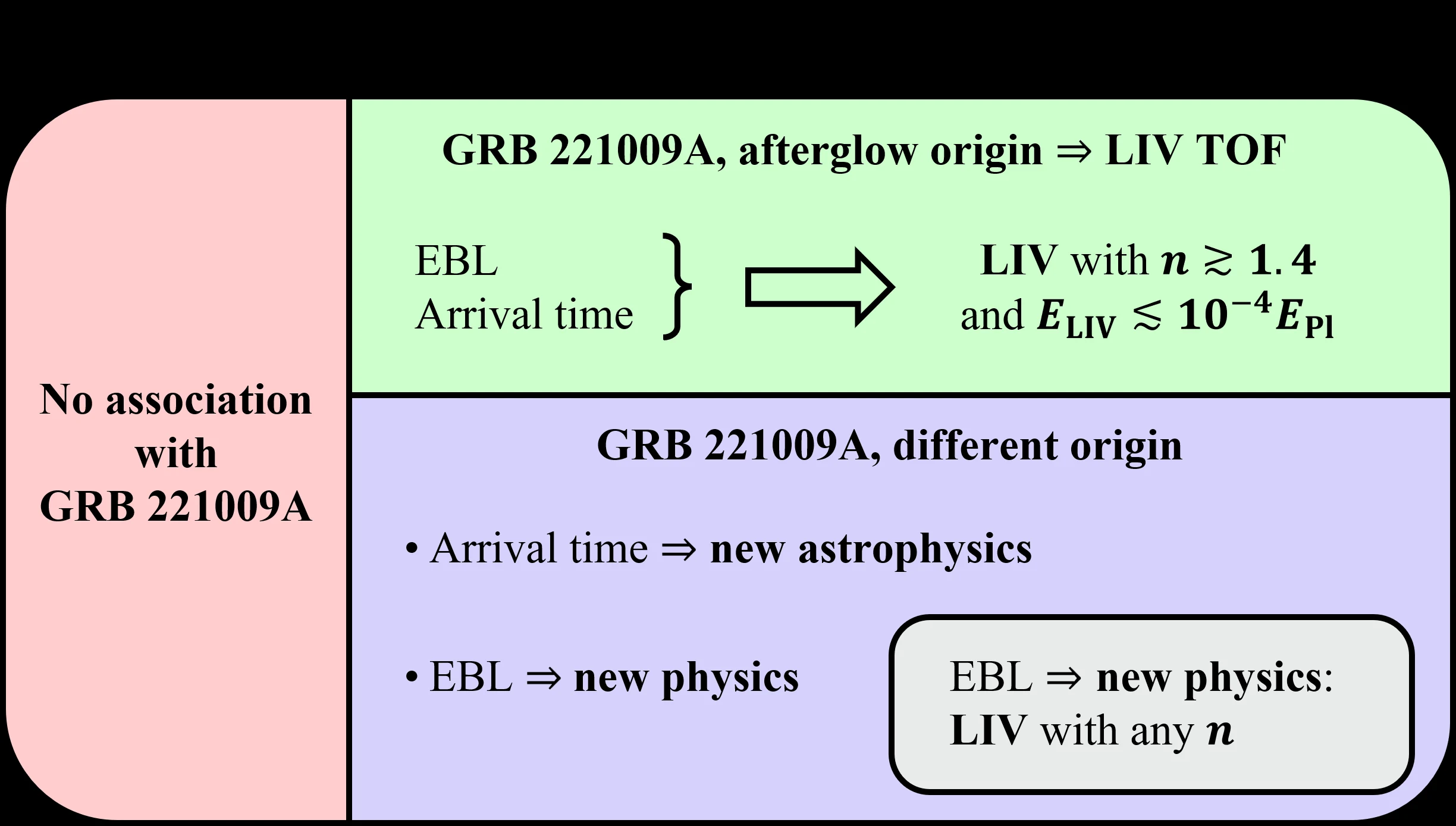
On October 9, 2022, the cosmos put on a show unlike anything astronomers had seen in the history of observations. Gamma-ray burst GRB 221009A, the most powerful cosmic explosion that produces a flash of gamma radiation, blinded detectors in orbit and on Earth. It was dubbed the “brightest of all time.” But hidden in the data stream was a peculiarity: one photon, caught by the Carpet-3 detector in the Caucasus, arrived with an energy of about 300 TeV and was delayed by 4536 seconds, more than an hour. For a particle traveling at nearly the speed of light, that is an eternity.
Standard physics struggles here. First, a photon of this energy should have been absorbed along the way: intergalactic background light, the faint radiation from all galaxies in the universe, acts like a fog that scatters high-energy particles. Second, no one knows why it was so delayed. Astrophysical mechanisms offer no answer. So the authors of the new study propose a bold hypothesis: perhaps the vacuum itself is not the same for all photons. If the speed of light depends slightly on energy, then a more energetic photon travels a bit slower. It is like a runner who eases off slightly on the track, and so not only arrives late but also manages to slip through obstacles that would be deadly for faster runners.
This idea is Lorentz invariance violation, the principle that the laws of physics are the same for all observers. In Einstein’s ordinary theory of relativity, the speed of light is an iron constant. But some quantum gravity theories, attempts to unify quantum mechanics and gravity, predict that at extremely small scales, comparable to the Planck length, this constant may “breathe” slightly. The effect is tiny, but over billions of years of travel it accumulates. The authors calculated what violation could explain both the delay and the photon’s survival. It turned out that a linear dependence does not fit: the probability of matching the data is only 0.1%, less than the random background of 0.9%. But a quadratic model with an energy scale $E_{LIV2}$ = 1.30 (+0.56/-0.35) × $10^{-7}$ of the Planck energy agrees with all observations.
This is the first time that a single hypothesis explains two anomalies at once. Previously, Lorentz invariance violation was invoked either to explain how ultra-high-energy particles reach Earth or to describe their delay. Now both puzzles are solved together. If future gamma-ray bursts produce similarly delayed photons, the model will gain strong support. For now, we return to the runner image: a lone photon, slightly slowed at the very start of its journey, crossed the finish line later than all the others, and told us that spacetime might be more intricate than we thought.
The energy of the detected photon is about 50 times greater than the maximum energy of protons in the Large Hadron Collider, and its delay relative to the main signal is comparable to the time it takes light to travel from Earth to the Moon and back.
In Greg Egan’s novel “Schild’s Ladder,” universes with different laws of physics are explored, where the speed of light may depend on energy, leading to unusual cosmological effects. The idea that fundamental constants might change resonates with the hypothesis of Lorentz invariance violation.