The Mystery of the Gamma-Ray Burst: When the Speed of Light Is Not Constant ✛
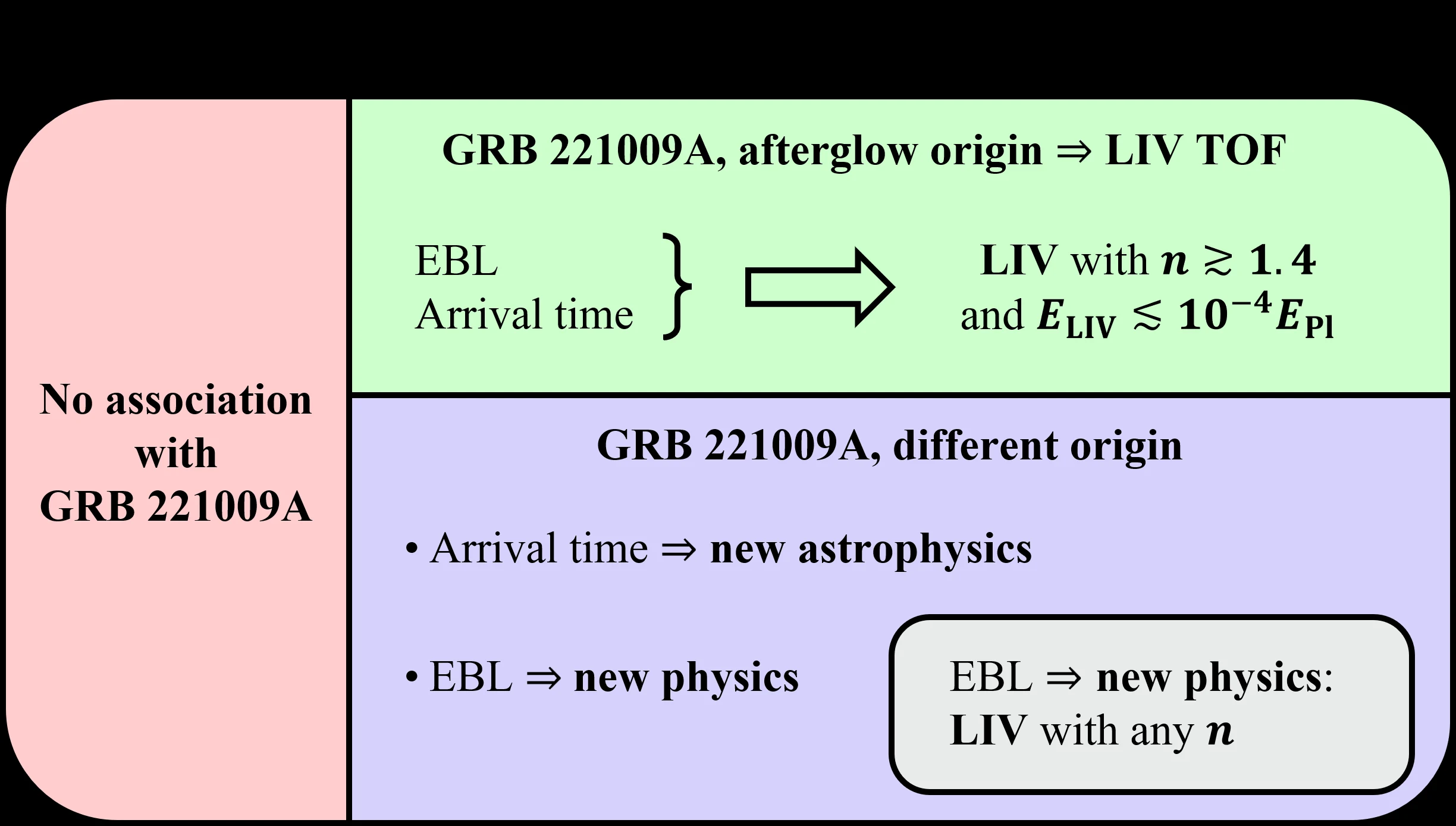
In October 2022, the gamma-ray burst GRB 221009A, born from a star's collapse into a black hole, became the brightest in history. An hour later, a detector caught a single photon with an energy of 300 TeV: like a mosquito's worth of energy squeezed into a subatomic particle. According to the Standard Model, such a photon should scatter on the background light of the expanding Universe, but it flew for billions of years unscathed and, on top of that, arrived late.
An explanation is sought in the violation of the constancy of the speed of light. It's like with trains: for a super-high-speed express, the rails bend ever so slightly, changing the travel time. In quantum gravity, which reconciles the ideas of Einstein and quantum mechanics, such a thing is allowed: at colossal energy, the speed of light fluctuates barely noticeably. This would explain both the photon's 'invincibility' and the delay. The effect is tiny and noticeable only at Planck scales, where, according to Hawking, spacetime froths.
Irony of fate: the burst was nicknamed BOAT (Brightest Of All Time, or 'boat'), but the captured photon is just a drop of the energy that burst from the black hole. A changeable speed of light promises new physics and unthinkable technologies.
The gamma-ray burst was nicknamed BOAT (Brightest Of All Time, meaning 'boat'), but the captured photon is just a drop in the bucket of its total energy.
The idea of a changing speed of light has been explored by science fiction writers, for example in the novel 'Spin' by Robert Charles Wilson.