Relativity, developed by Albert Einstein in the early 20th century, is a framework of physics that describes how space, time, and gravity are intertwined. It consists of two theories: special relativity, which deals with objects moving at constant high speeds, and general relativity, which describes gravity as the curvature of spacetime caused by mass and energy. Relativity is essential for understanding phenomena like black holes, gravitational waves, and the expansion of the universe.
History
Albert Einstein published special relativity in 1905 and general relativity in 1915. The theory was confirmed by Arthur Eddington's observation of starlight bending during a solar eclipse in 1919, which made Einstein a global celebrity.
How it works
Special relativity is based on two postulates: the laws of physics are the same for all observers in uniform motion, and the speed of light is constant for all observers. This leads to effects like time dilation and length contraction at high speeds. General relativity extends this by stating that mass and energy warp the fabric of spacetime, and objects move along the curved paths created by this warp, which we perceive as gravity.
In practice
Relativity is used in GPS satellites, which must account for time dilation due to their speed and altitude to provide accurate positioning data. It is also fundamental to astrophysics, particle physics, and cosmology.
Fun fact
The Global Positioning System (GPS) would drift by about 10 kilometers per day if it did not account for relativistic effects.
Light freezes at the edge of the abyss: that's what the event horizon of an ordinary black hole looks like. But at the center of this abyss lurks a singularity, a point where the laws of physics break down. What if, instead of a point, there were a hard shell?
A gravastar is not a black hole.
At the center of the Milky Way, shrouded in dust and glare, lurks a supermassive black hole — Sagittarius A*. Around it, like moths around a flame, swarm dozens of guide stars. Two of them, S2 and S38, with eccentric orbits and periods of just a few years, have become the protagonists in testing the fundamental laws of the cosmos.
A black hole is not just a dark spot. It rotates, drags space along with it, and can carry imprints of the quantum world. To describe such a hole, one must solve gravitational field equations.
According to Einstein's general theory of relativity Albert Einstein, a massive rotating body drags the fabric of spacetime along with it, much like a spoon twirled in a jar sets thick honey flowing.
The void is never truly empty. In curved spacetime (for instance, in an expanding universe or near a black hole) the vacuum heats up. This is reminiscent of how acceleration makes particles appear seemingly out of nowhere: a phenomenon known as thermal vacuum radiation.
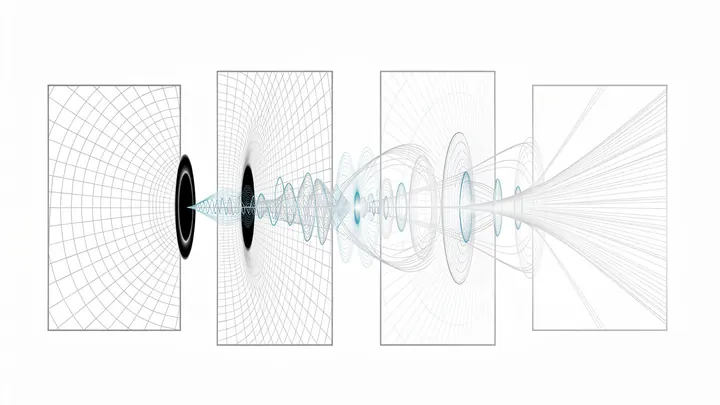
At the centers of many galaxies lurk black holes — regions with gravity so strong that even light cannot escape. Stars often orbit them, and sometimes one of those stars is a pulsar, a cosmic lighthouse sending out strictly periodic radio pulses. When such a pulsar moves behind a black hole, its signals reach us with a delay.
Gravity is usually explained through the curvature of spacetime. Massive bodies press it down like a bowling ball on a stretched rubber sheet. But this approach has two lesser-known twins. In one, gravity arises from torsion (twisting) of spacetime; in the other, from its non-metricity (when lengths and angles change during transport).
Time in physics is like a conductor setting the tempo for the whole orchestra. But in the quantum world, there's no single baton: each particle can live by its own clock. Usually, we simplify the picture and assume time flows the same for everyone.
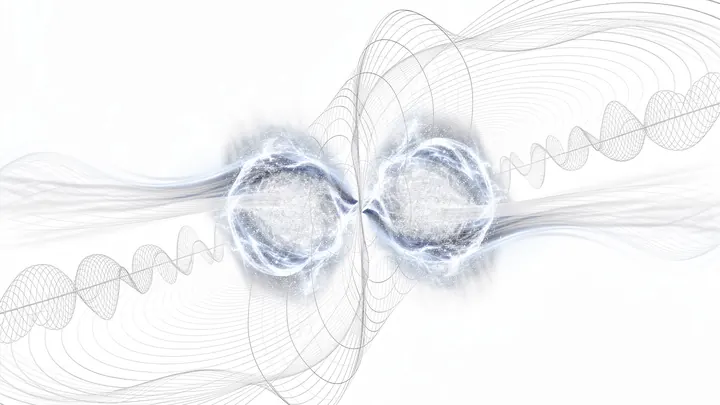
Gravitational waves are not vibrations of matter, but tremors of spacetime itself, predicted by Albert Einstein. They travel at the speed of light and pass through objects, stretching and squeezing them.
An old mechanical alarm clock ticks on the shelf. You hear the steady sound, see the hands moving, and you're certain time is passing. But if you take the clock apart, you won't find a single part labeled "time." Only springs and gears.
The event horizon of a black hole is often depicted as a one-way membrane: everything falls in, nothing comes out. But what if it's not an empty boundary but a cloud of the tiniest 'bits' of spacetime itself?
A massive nanodiamond inside a quantum interferometer splits in two, pulling itself into two realities. Its gravity — tiny, almost imperceptible — stirs the quantum field of the vacuum, giving rise to coherent clouds of gravitons. These are the gravitational shadows cast by each position of the mass.
A warp drive creates a bubble around the ship, compressing space in front and stretching it behind. This is a clever way to bypass the speed-of-light limit without violating Einstein's theory.
Classical general relativity predicts: a singularity hides inside every black hole. In this region, spacetime curvature skyrockets to infinity, and Einstein's equations lose meaning.
Astronomers, including Vera Rubin, noticed that stars on the outskirts of galaxies rotate faster than visible mass allows. To explain this, they invented dark matter — an invisible ballast. But there's another possibility: gravity isn't always the same.
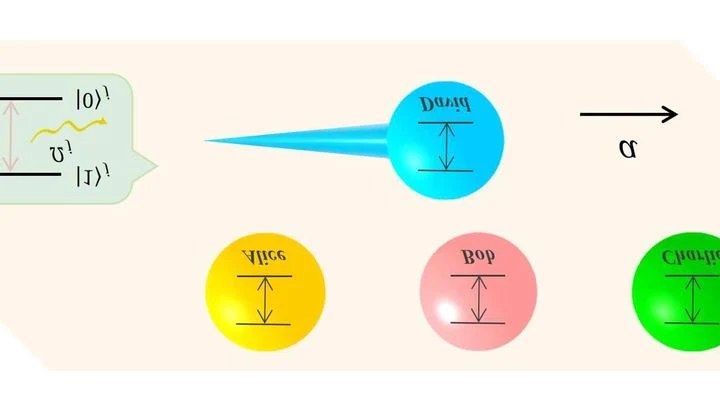
Quantum entanglement is a special connection between particles: they affect each other instantly, even across light-years. For a long time, it was believed that strong acceleration destroys this bond.
A single photon passes through two slits and leaves an interference pattern on a screen. Quantum mechanics describes this process with a wave function, but what happens to the particle itself?