A 300 TeV Photon from a Gamma-Ray Burst: A Hint of Nonlinear Lorentz Invariance Violation? ✛
Context
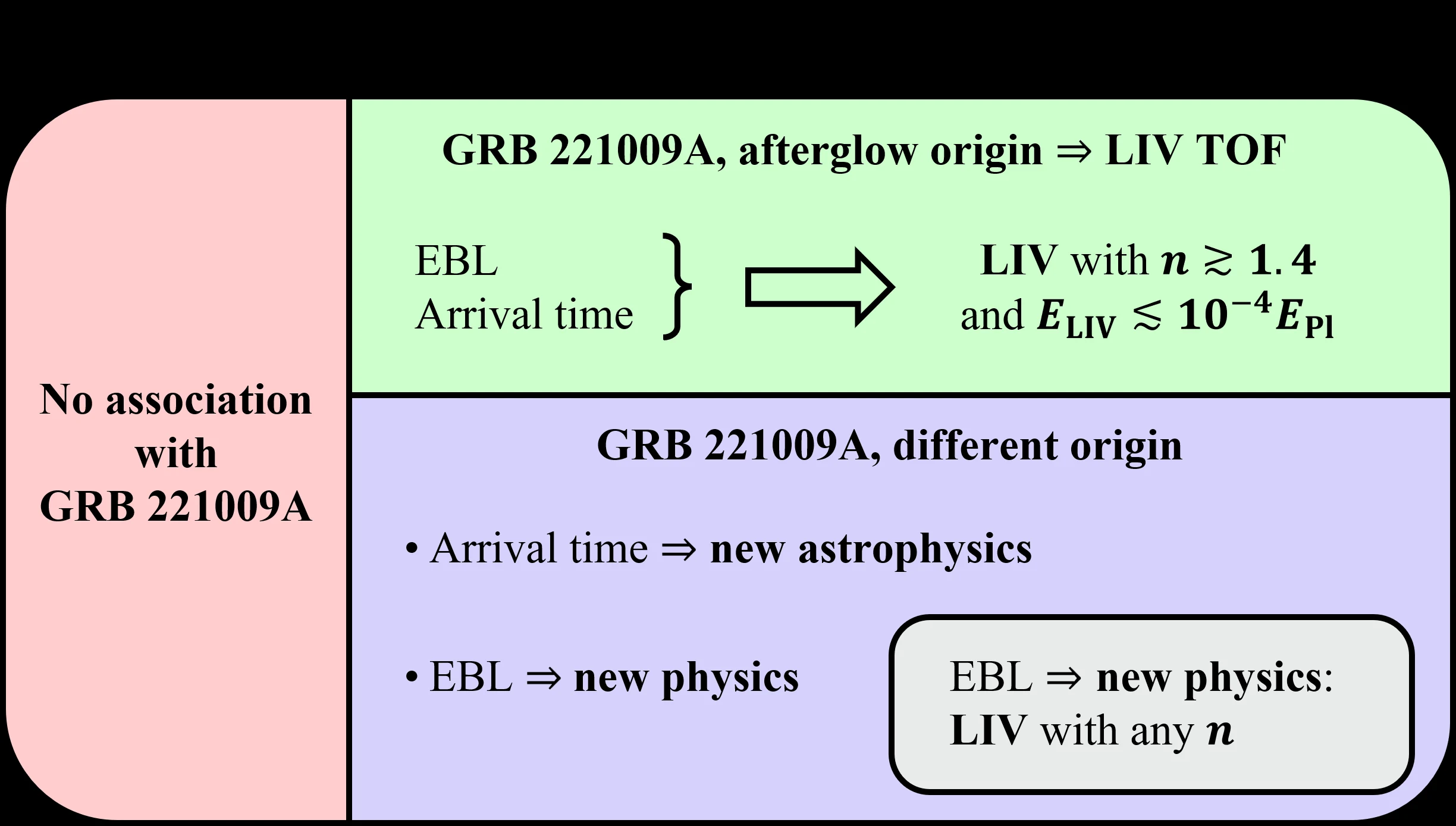
Gamma-ray burst GRB 221009A was the brightest ever observed, and its afterglow in the teraelectronvolt range provided a rare opportunity to test fundamental properties of spacetime. Previous analysis of LHAASO data set stringent limits on possible Lorentz invariance violation, but the 300 TeV photon from Carpet-3 raises new questions. It lies in an energy range where standard physics predicts complete absorption by the extragalactic background light, and its delay of more than an hour relative to the afterglow peak is not explained by known astrophysical mechanisms. This work joins a series of studies using gamma-ray bursts as a natural laboratory to search for quantum gravity effects.
Methods
The authors consider the hypothesis that the 300 TeV photon was emitted simultaneously with the teraelectronvolt afterglow but traveled slower due to Lorentz invariance violation. They use the LHAASO light curve as a probability distribution for the emission time and calculate what time-of-flight delay would be needed to match the Carpet-3 observation. They then impose constraints: an upper limit from the LHAASO time-of-flight analysis, a lower limit from the condition that the delay does not exceed 4310 seconds, and a condition for suppression of absorption by the extragalactic background. All constraints are expressed in terms of two model parameters, the power-law index n and the energy scale $E_{LIV}$, and they search for the region where they are simultaneously satisfied.
Results
Linear Lorentz invariance violation (n=1) is incompatible with the data: the required delay is too small, and the probability of consistency with the LHAASO light curve is only 0.1%, lower than the chance coincidence probability of 0.9%. For n=3/2, consistency is marginal (about 1%). Acceptable solutions appear for n≥2. For the quadratic model (n=2), the authors obtain an energy scale $E_{LIV2}$ = 1.30 (+0.56/-0.35) × $10^{-7}$ $E_{Pl}$ at 95.4% confidence level, where $E_{Pl}$ is the Planck energy. For cubic and quartic models, the values are 8.5 (+2.9/-2.2) × $10^{-10}$ $E_{Pl}$ and 6.7 (+2.1/-1.8) × $10^{-11}$ $E_{Pl}$, respectively. These results are consistent with existing limits on subluminal nonlinear Lorentz invariance violation.
Implications
This work shows for the first time that a single mechanism, Lorentz invariance violation, can simultaneously explain both the photon's passage through the extragalactic background and its delay. Unlike previous studies that considered only the threshold shift or only the time of flight, here both puzzles are solved together. This narrows the allowed parameter space and makes the hypothesis testable: if future events show similar delays, the model will receive strong support.
Future development
If the hypothesis is correct, future gamma-ray bursts with detection of ultra-high-energy photons will allow refinement of the parameters of Lorentz invariance violation. Events with a known teraelectronvolt light curve and simultaneous detection of photons above 100 TeV will be especially valuable. Accumulating statistics will allow testing predictions of specific quantum gravity models, such as loop quantum gravity or string theory.
Impact
The results may affect the interpretation of data from gamma-ray observatories such as LHAASO, CTA, and future ultra-high-energy particle detectors. They also provide guidance for theorists developing quantum gravity models with low-energy manifestations.
Next steps
It is necessary to search for similar events in archival data and in future observations, especially from nearby gamma-ray bursts. It is also important to improve models of the extragalactic background light to reduce uncertainties in the constraints.
Key open problems
In high-energy astrophysics, the origin of particles with energies above 100 TeV from gamma-ray bursts remains an open question. This work connects this problem to fundamental physics, offering a testable mechanism that can be confirmed or refuted by future observations.
The knowledge machine's view
This section is addressed to the author of the paper and their colleagues. Neighbouring works were found by meaning-based search across our archive, not by word overlap. We do not review: we show the field around the work.
What the work does
The authors analyze a photon with an energy of about 300 TeV detected by Carpet-3 4536 seconds after GRB 221009A. They show that its delay and the lack of absorption by the intergalactic background can be explained by Lorentz invariance violation. For the quadratic model, they obtain an energy scale of E_LIV2 = 1.30 (+0.56/-0.35) × 10^-7 E_Pl.
Where its strength is
The work unifies two independent puzzles, the delay and the suppression of absorption, within a single model, which yields tighter constraints on the parameters of Lorentz invariance violation.
Where it could go next
- It might be interesting to consider neutrons catching up with light as an additional channel to probe Lorentz invariance violation in the same event.based on: Echo of a Gamma-Ray Burst: Neutrons Chase the Light arXiv:2604.10378
- A related work on the record-breaking flare could provide context for comparing constraints from other gamma-ray bursts.based on: Record-Bright Flare from a Gamma-Ray Burst arXiv:2601.07688
- There is an analysis that combines gamma-ray bursts into a single picture, which might help assess how typical such delayed photons are.based on: Gamma-ray bursts pieced together into one picture arXiv:2603.09179
Worth trying
- Check whether the model with n=2 provides a consistent description of all afterglow photons, not just a single event.
- Assess how the allowed parameter region changes when accounting for the uncertainty in the LHAASO light curve.
- Compare the obtained constraints with results from the analysis of neutron fluxes from the same gamma-ray burst.
Why this may matter
If the photon is indeed associated with GRB 221009A, this could be the first hint of nonlinear Lorentz invariance violation and open a new avenue for testing quantum gravity.
Nearby works in our archive
- Echo of a Gamma-Ray Burst: Neutrons Chase the Lightsimilarity 0.62
- When the Speed of Light Stops Being the Limitsimilarity 0.62
- Record-Bright Flare from a Gamma-Ray Burstsimilarity 0.60
- Hunting Cosmic Explosionssimilarity 0.56
- A Two-Hour Flaresimilarity 0.55
- Distant Quasar Sets Gamma-Ray Recordsimilarity 0.54
- Gamma-ray bursts pieced together into one picturesimilarity 0.52
The closest work in the archive sits at 0.62 by meaning — the usual level for our corpus.
The energy of the detected photon is roughly 50 times greater than the maximum energy of protons in the Large Hadron Collider, and its delay relative to the main signal is comparable to the time it takes light to travel from Earth to the Moon and back.
In Greg Egan's novel 'Schild's Ladder', universes with different laws of physics are explored, where the speed of light may depend on energy, leading to unusual cosmological effects. The idea that fundamental constants might change resonates with the hypothesis of Lorentz invariance violation.
Key numbers
- Carpet-3 photon energy: 300 TeV
- photon delay: 4536 seconds
- chance coincidence probability: 0.9%
- energy scale for n=2: 1.30 × 10⁻⁷ E_Pl
- gamma-ray burst redshift: 0.151