The Planck length sets the ultimate limit of our ability to probe nature with any conceivable experiment. To see anything smaller, you would need to concentrate so much energy in such a tiny region that you would create a black hole, hiding the very detail you seek. It is the scale at which spacetime itself is expected to be quantized, perhaps made of discrete 'atoms' of space, though no experiment has come close to testing this directly. The Planck length is a cornerstone of quantum gravity research, guiding theories like string theory and loop quantum gravity.
History
The concept was introduced by Max Planck in 1899, who noticed that combining these constants produced natural units of length, time, and mass, long before quantum mechanics was fully developed. He did not anticipate its role in quantum gravity, but the idea was later revived in the 1950s and 1960s as physicists began to grapple with the problem of quantizing gravity.
How it works
The Planck length is constructed by combining three fundamental constants: the speed of light (c), Newton's gravitational constant (G), and the reduced Planck constant (ħ). The formula is ℓ_P = √(ħG/c³). This combination yields a length that is independent of any particular particle or force, representing a universal scale where quantum effects and gravitational effects are equally strong. In practice, it is the scale at which the Compton wavelength of a particle (a quantum property) becomes comparable to its Schwarzschild radius (a gravitational property), meaning quantum uncertainty and gravitational collapse become intertwined.
In practice
The Planck length is not directly used in any current technology, but it sets the ultimate resolution limit for any future probe of spacetime and serves as a benchmark for theoretical models of quantumgravity.
Fun fact
If you scaled a Planck length up to the size of a grain of sand, a single proton would be larger than the entire observable universe.
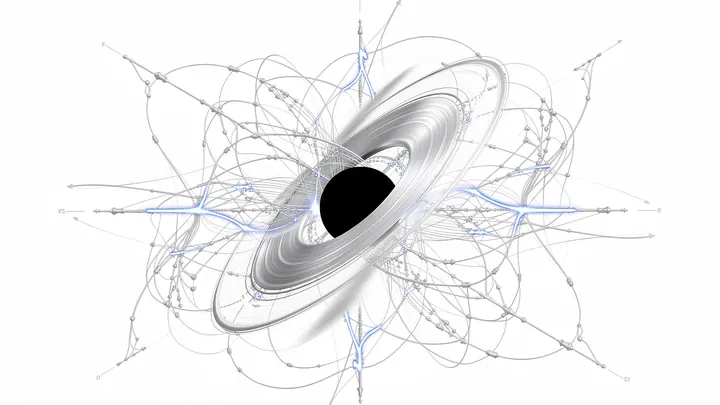
A black hole devours everything, even light. Yet it obeys the laws of physics: it possesses entropy — a measure of the hidden information an object 'remembers.' In the 1970s, Jacob Bekenstein and Stephen Hawking discovered a strange pattern: a black hole's entropy grows not with its volume, but…
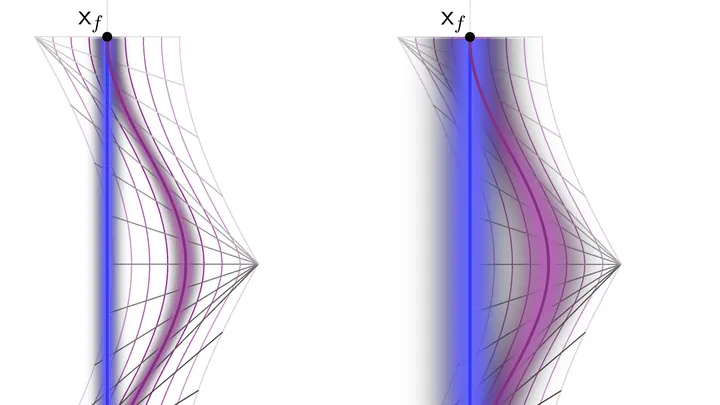
In a two-dimensional universe, a black hole looks like a funnel in spacetime. But the authors of the new work went further: they proposed that the space where particle momenta 'live' is also curved, like a saddle.
At the center of the Milky Way, shrouded in dust and glare, lurks a supermassive black hole — Sagittarius A*. Around it, like moths around a flame, swarm dozens of guide stars. Two of them, S2 and S38, with eccentric orbits and periods of just a few years, have become the protagonists in testing the fundamental laws of the cosmos.
A textbook black hole resembles a perfectly smooth sphere: everything outside it calmly flies off to infinity. However, quantum gravity paints a different picture. Recently, within loop quantum gravity, a solution was found — a 'Kruskal' black hole where spacetime beyond the horizon behaves differently.
A black hole horizon is like a soap film stretched over an abyss. From a distance it looks perfectly smooth, but up close it trembles. This ripple arises from quantum fluctuations — the continuous birth and death of particles in the vacuum.
Space is like a sheet of paper: gravity bends it, making lines converge toward the center. But if you bend too hard, the paper tears, just as space, under monstrous curvature, doesn't collapse into a point but forms a torn edge. That edge is the quantum boundary.
The universe is filled with invisible dark matter. Just as a drop of water, as it evaporates, leaves behind a tiny salt crystal, so too can a black hole evaporate, leaving behind a minuscule stable remnant.
You can zoom into a high-resolution photo for a long time — until suddenly a smooth face dissolves into individual pixels. Something similar, according to a new study, happens to spacetime itself. The authors propose that tiny intervals of length are not pre-existing 'parts' of the universe but results of measurements.
A research probe is planned for the nearest black hole — a region of spacetime whose gravity traps even light. After a hundred years of flight, the spacecraft will enter orbit around the mysterious object to answer a key question: are we looking at a black hole or a neutron star — the ultra-dense remnant of a massive star, compressed to nuclear…
A single graviton, a quantum of spacetime, is incredibly weak. For detectors like LIGO, built by Rainer Weiss and colleagues, quantum effects are suppressed by a factor of 10⁻³⁸: it's like trying to hear a grain of sand changing the wind's direction in a hurricane.
Spacetime sometimes resembles a sheet of paper in which you can punch a hole and connect the edges with a short tube: you get a wormhole. In the simplest mathematical models of such wormholes, massless scalar fields appear — something like an invisible fog filling everything around.
Black holes are not eternal: they slowly lose energy, emitting entropy — a measure of hidden information — as heat. This process was predicted by Stephen Hawking. But until now, it remained a mystery what happens at the very end, when the hole has almost disappeared and must return the captured data.
The biggest puzzle in physics is how to reconcile spacetime curvature with quantum mechanics. At the Planck length, billions of billions times smaller than an atom, the rules break down. This frontier was discovered by Max Planck.
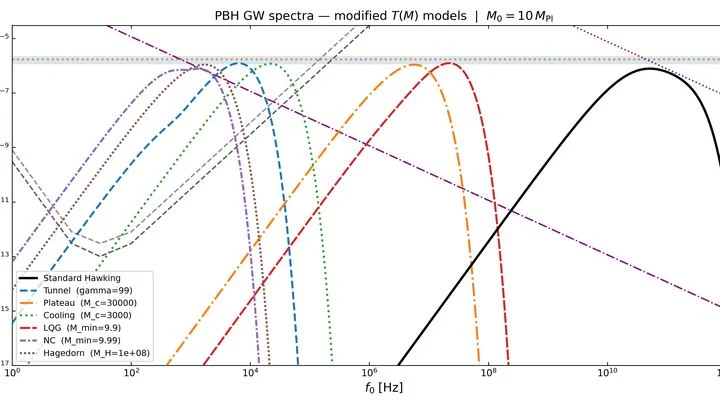
Primordial black holes behave like boiling kettles: as they evaporate, they whistle gravitational waves. The character of the whistle, its spectrum, depends on how the hole's temperature relates to its mass.
Spacetime at ultra-short distances resembles a digital screen: it's not smooth but made of tiny 'pixels.' This minimum length was calculated by Max Planck, and Heisenberg's uncertainty principle explains why the world cannot be continuous: precise measurement always…
Time is like a highway: from afar it looks flawlessly paved, but zoom in and every pothole appears. These bumps are the quantum fluctuations of the vacuum, making it impossible to measure the journey exactly. Physicists built a clock model whose operation relies on spontaneous particle creation from the void.