A Whisper Through a Warm Pipe ✛ ✎
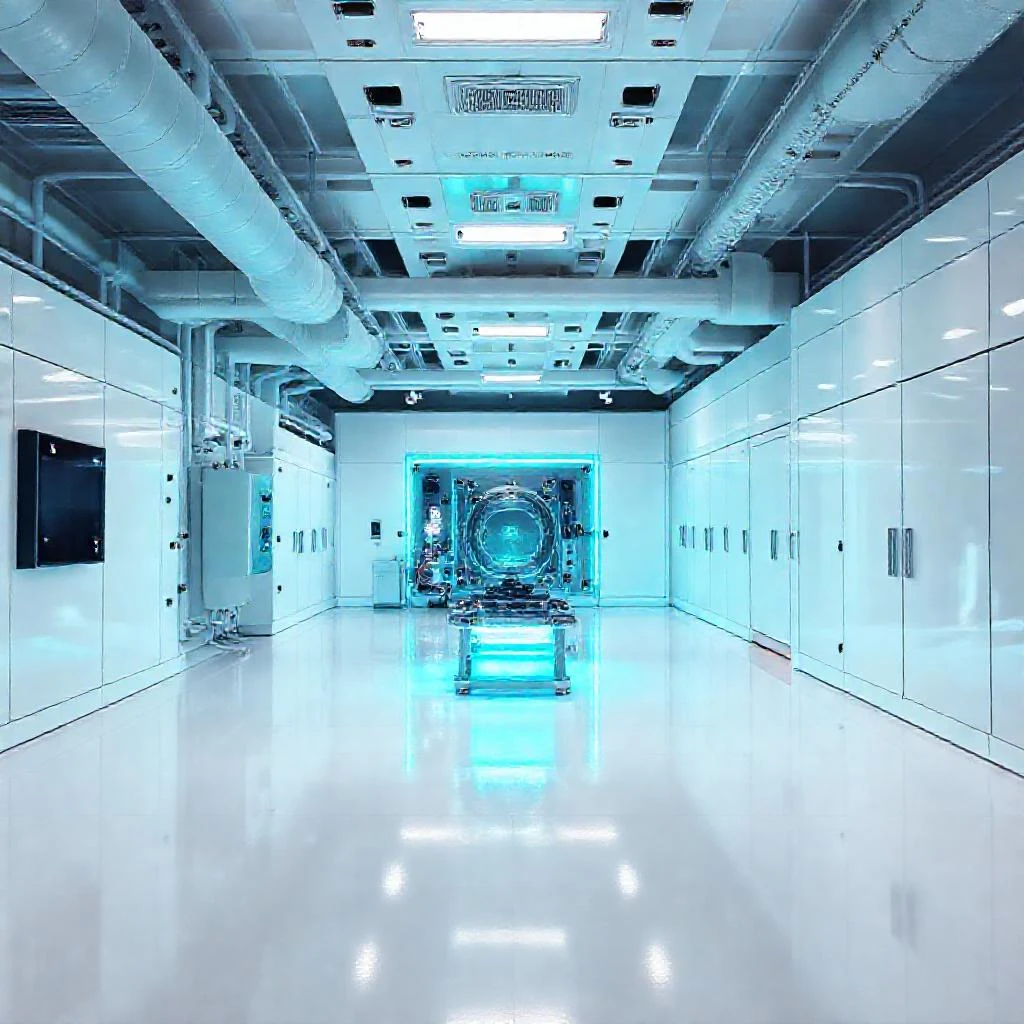
In a dilution refrigerator cooled to 170 millikelvin, a coherent state of the microwave field is born. This is laser light with minimal uncertainty: its amplitude and phase are defined as precisely as quantum mechanics allows. The challenge is to transfer this state to another cryostat located six and a half meters away without sending a single photon there. That is how quantum teleportation works: transferring a quantum state without transferring the particle.
The communication channel is a superconducting cable made of niobium-titanium. Below 10 K, it loses only 1 dB per kilometer, meaning the signal barely attenuates. But the experiment's real surprise is a heater installed in the middle of the cable. When switched on, it raises the temperature to 4 K. By quantum standards, that is a veritable oven: thermal fluctuations can tear apart fragile entanglement. Yet teleportation still works.
The secret is that the channel's losses are so low that thermal noise cannot destroy the quantum correlation before it does its job. Entanglement, measured by negativity, remains positive even at 4 K. Teleportation fidelity drops from 72.6% to 59.9%, but still exceeds the classical limit of 1/2. This means no classical strategy could achieve such a result: the quantum nature of the process is preserved.
Previously, it was thought that for distributed quantum computing, every communication channel needed to be cooled to millikelvin temperatures. Now it turns out that individual parts of the network can be warmer if their losses are low enough. This relaxes some of the stringent requirements on cryogenic infrastructure and makes distributed superconducting architectures more realistic. Instead of building one giant refrigerator for a million qubits, you can connect many small cryostats with warm superconducting bridges.
The experiment is like a whisper through a warm pipe: the voice is slightly distorted, but the words are still discernible. Quantum information passes through thermal noise, relying on entanglement as an invisible thread. And that thread, as the physicists have shown, can withstand far more than expected.
The niobium-titanium cable has a critical temperature of about 10 K, so at 4 K it remains superconducting and introduces almost no losses, even though the environment is already "hot" by quantum standards.
The idea of teleporting states over an unreliable channel resembles "Star Trek", where information is transmitted through space, but here, instead of dismantling matter, it is the transfer of quantum information via entanglement.