Inclusive Flavour Tagging of B Mesons: How LHCb Reads All Tracks at Once ✛
Context
Determining the flavour of neutral B mesons at production is a key task for measuring oscillations and CP violation. The LHCb experiment traditionally uses two types of taggers: opposite-side (OS), based on the decays of the second b-hadron, and same-side (SS), which use particles produced alongside the signal meson. Each relies on specific physical processes and is limited to its own track category. Existing methods improve individual aspects of tagging but do not exploit all available information in an event. This paper proposes a fundamentally different approach: process all tracks at once, without separating them into categories.
Methods
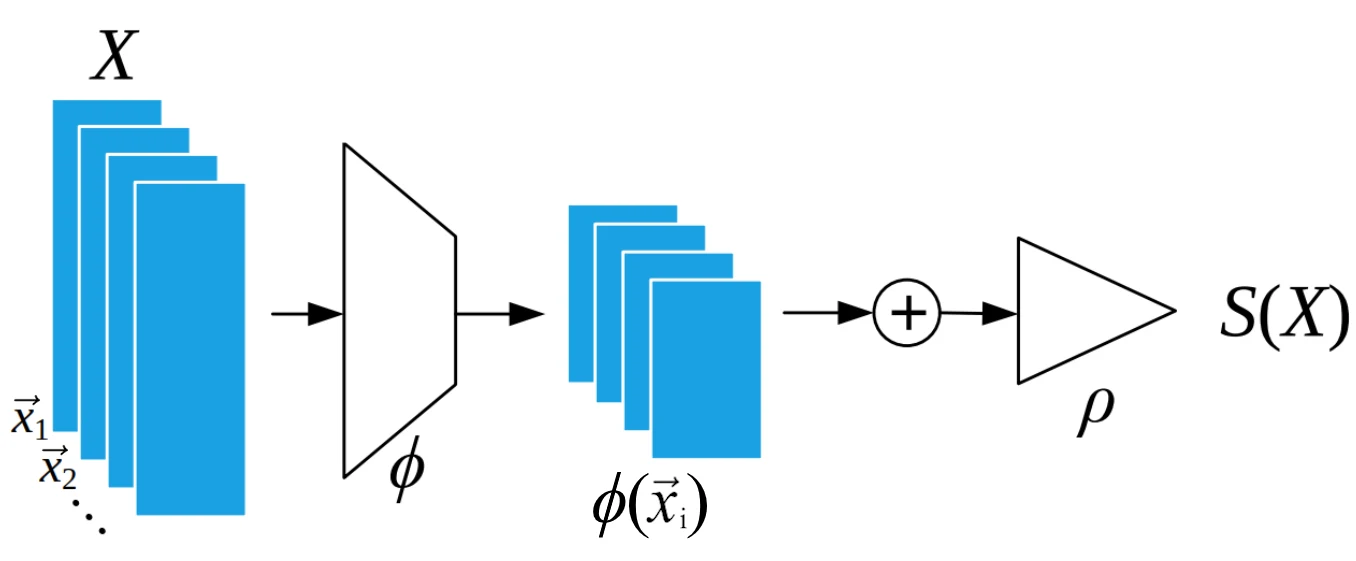
The IFT algorithm is built on the DeepSets neural network architecture, which accepts a variable number of tracks and is invariant to their order. For each track, 23 features are computed, including momentum, charge, particle identification, impact parameters, and the output of an additional classifier based on boosted decision trees (BDT) that estimates the probability of the track belonging to one of four categories: SSF, OSD, OSF, or background. The network was trained on simulated B0 → J/ψK*0 and B0s → J/ψφ events, and the mistag probability calibration was performed on data from B0 → J/ψK+π− and B0s → Ds−π+ decays collected by LHCb in 2016–2018.
Results
After calibration, the tagging power (εeff = εtag⟨D2⟩) for B0 mesons was 5.58–5.87% depending on the year, which is 35% higher than the combination of SS and OS taggers (4.05–4.32%). For B0s mesons, the tagging power was 7.23–7.76%, an improvement of 20% over 5.99–6.47%. The improvement is mainly achieved in events already tagged by SS or OS taggers, where IFT extracts additional information. Applying IFT to the analysis of the CP-violating phase φs reduces its statistical uncertainty by about 10%.
Implications
This work stands out from related studies because it is the first to apply an inclusive approach to all tracks in an event at LHCb, rather than only to specially selected categories. While previous methods improved individual taggers or their combinations, IFT combines information at a global level, yielding a substantial gain in precision. This paves the way for more sensitive measurements of CP violation and oscillations, especially under future high-luminosity conditions.
Future development
The method can be extended to other B meson types and adapted to Run 3 and future LHCb upgrades, where a larger number of primary vertices and tracks is expected. The DeepSets architecture allows easy inclusion of new features, such as time-of-flight information or improved particle identification. It is also possible to apply a similar approach to D meson flavour tagging or in other experiments.
Impact
Improved flavour tagging directly enhances the precision of CP-violation and B meson oscillation measurements, which is important for testing the Standard Model and searching for new physics.
Next steps
The plan is to use IFT in ongoing LHCb analyses, such as the measurement of sin(2β) and φs, and to adapt the algorithm for Run 3 data.
Key open problems
In B meson physics, the question of possible sources of CP violation beyond the Standard Model remains open. Improved flavour tagging directly increases sensitivity to such effects, allowing more precise measurements of CP-violating phases and oscillation frequencies.
The knowledge machine's view
This section is addressed to the author of the paper and their colleagues. Neighbouring works were found by meaning-based search across our archive, not by word overlap. We do not review: we show the field around the work.
What the work does
The paper presents a new inclusive flavor tagging (IFT) algorithm for neutral B mesons at LHCb. The algorithm uses a DeepSets neural network to process all charged tracks in an event, is calibrated on 13 TeV data, and improves tagging power by 35% for B0 and 20% for B0s relative to the combination of existing taggers. This is expected to reduce the statistical uncertainty on CP-violation parameters by roughly 15% and 10%, respectively.
Where its strength is
The strength of the work lies in its inclusive approach: processing all tracks without splitting them into categories allows extracting additional information from events already tagged by traditional taggers, yielding a substantial gain in precision.
Where it could go next
- It might be interesting to see how a similar inclusive approach could be applied to the analysis of asymmetries in decays where the production history of particles matters.based on: Asymmetry in Decays: How Particles Reveal Their History arXiv:2603.13223
- Closely related is the work on tuning the silicon detector for precise particle counting; its optimization methods could be useful for improving the input features of IFT.based on: How to Tune a Silicon Detector for Accurate Particle Counting arXiv:2603.20080
Worth trying
- Test the use of additional track features, such as ionization loss, to improve tagging quality.
- Check how IFT performs on events with many primary vertices, typical of high luminosity.
- Consider applying the DeepSets architecture to other identification tasks at LHCb, for example, determining the type of b-hadron.
Why this may matter
Inclusive flavor tagging could become a standard tool for future measurements of CP violation and oscillations, especially in high-luminosity conditions where traditional methods are limited.
Nearby works in our archive
- A Lunar Detector Will Hear What Dark Energy Sounds Likesimilarity 0.47
- Asymmetry in Decays: How Particles Reveal Their Historysimilarity 0.46
- Wind from Cygnus: First Directional Limits from MIMACsimilarity 0.45
- How to Tune a Silicon Detector for Accurate Particle Countingsimilarity 0.45
The archive is sparse around this work: the closest review is only 0.50, against a usual 0.64. It looks like few have drilled nearby.
The DeepSets neural network treats an event as an unordered set of tracks, much like a person assessing a crowd without thinking about the order of people.
Key numbers
- improvement in tagging power for B0: 35%
- improvement in tagging power for B0s: 20%
- reduction in φs uncertainty: 10%
- number of neural network parameters: 3890
- collision energy: 13 TeV