C. Lin

14 articles · 30 co-authors · latest: 2026-07-28
80 citations · h-index 5 · 28 papersData: Semantic Scholar

We have retold 14 papers by this author. 3 of them with a full read. most often about: brain cancer detection, flavour_tagging, squeezed state. 30 co-authors across our retellings.

Links in the knowledge graph
All tracks at once: how LHCb reads the birth of B mesons in full
In 2016, the LHCb detector at the Large Hadron Collider recorded millions of proton-proton collisions. Among the debris of these collisions, neutral B mesons were born—particles that can spontaneously transform into their antiparticles and back.
Superconductivity2026-01-041 minarXiv:2601.01643express
Pressure Separates Superconductivity and Charge Order
In the crystal La₂₋ₓSrₓCuO₄, at a certain composition, two states coexist: superconductivity, where electrons move without loss, and a charge-density wave — a periodic bunching of electron density. These states compete for the same electron clouds, which resemble cross-shaped petals.
HEP Experiment2026-01-221 minarXiv:2601.15646express
How Mesons Revealed the Difference Between Matter and Antimatter
In the LHCb detector at the Large Hadron Collider, protons collide, and for a fleeting moment, particles that don't exist in ordinary matter are born. One of them is the neutral B meson. It lives for less than a billionth of a second and decays into two other particles: the narrow resonance J/ψ and the broader ρ(770).
HEP Experiment2026-02-191 minarXiv:2602.17184express
How Scientists Measured the 'Character' of Charmed Particles
In a giant particle accelerator, where protons traveling at nearly the speed of light smash into a neon target, charmed baryons are born — particles that live for less than a billionth of a second.
HEP Experiment2026-03-091 minarXiv:2603.08621express
Particle Collisions Reveal New Decays
Proton collisions at the Large Hadron Collider produce particles that live for less than a billionth of a second. One of them is the Bs meson, made of a strange quark and a bottom antiquark.
HEP Experiment2026-03-131 minarXiv:2603.13223express
Asymmetry in Decays: How Particles Reveal Their History
In the LHCb detector, like in a giant camera with billions of 'snapshots,' rare events are captured: how short-lived particles, B mesons, fall apart into lighter ones. One such decay, where a B meson turns into a kaon and a pair of muons, is particularly interesting. In it, as in a mirror, the difference between matter and antimatter may show up.
HEP Experiment2026-03-212 minarXiv:2603.20960express
Hunting an Invisible Particle in Kaon Decays
The kaon is a long-lived particle by microcosm standards: it lives for billionths of a second before breaking apart into lighter particles. In the KOTO experiment in Japan, physicists catch the rarest variants of such decays. One of them is when a kaon transforms into two neutral pions plus another particle X, which immediately decays into two photons (particles of light).
HEP Experiment2026-04-072 minarXiv:2604.05701express
The Gamma Angle: How Physicists Catch the Difference Between Matter and Antimatter
Every second, billions of decays happen inside our bodies, and nobody notices. But physicists do: they smash particles in accelerators and watch what fragments they fly into. Hidden in those fragments is the answer to why we exist at all. Right after the Universe was born, there were equal amounts of particles and antiparticles, but today all we see around us is particles.
HEP Experiment2026-04-071 minarXiv:2604.05712express
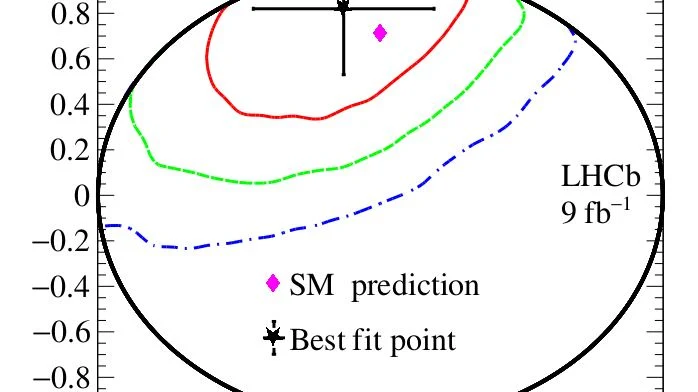
A 71-degree angle: how physicists catch the asymmetry of matter
Imagine a balance scale with identical weights, yet one pan always tips lower. In the world of elementary particles, this imbalance is called CP violation: particles and their mirror twins (antiparticles) behave slightly differently.
HEP Experiment2026-04-231 minarXiv:2604.21257express
A New Charmed Meson
In the LHCb detector, where protons collide, one unusual track was found among billions of decays. The particle, named $$D_{s1}$$(2933)^+, appears for a moment and immediately decays into other particles. Its lifetime is so short that it cannot be observed directly — only through its decay products can its existence be reconstructed.
HEP Experiment2026-04-291 minarXiv:2604.26784express
Rare decay spotted for the first time
A coin landing on its edge is about as rare as a heavy B meson decaying into a light pion and an electron-positron pair. Over a decade of collider operation, only a handful of such events have accumulated, but physicists have finally managed to spot them. The decay probability is about 2.4×10⁻⁸.
The Earth’s Neutrino Confession: IceCube Reads the Planet in the Language of Weak Interactions
Earth is a closed book for those accustomed to leafing through pages with light. But to neutrinos, the invisible particles born in cosmic rays and barely remembering the prediction of Pauli, our planet is a braille script: each kilometer of depth presses its relief into their…
High Energy2026-07-282 minarXiv:2607.25966express
The Milky Way Speaks the Language of Neutrinos
Deep beneath the ice of the South Pole, nearly two and a half kilometers down, an unusual telescope is at work. It is not pointed at the sky but through the Earth. Its quarry: neutrinos, nearly elusive particles that pass through planets and stars without interacting with anything.