J. Li

14 articles · 30 co-authors · latest: 2026-08-21
25 citations · h-index 3 · 59 papersData: Semantic Scholar

We have retold 14 papers by this author. 1 of them with a full read. most often about: brain cancer detection, flavour_tagging, plasma. 30 co-authors across our retellings.

Links in the knowledge graph
All tracks at once: how LHCb reads the birth of B mesons in full
In 2016, the LHCb detector at the Large Hadron Collider recorded millions of proton-proton collisions. Among the debris of these collisions, neutral B mesons were born—particles that can spontaneously transform into their antiparticles and back.
Strongly Correlated2026-01-171 minarXiv:2601.12160express
Plasmons in Nickelates: The Electron Cloud Behaves Differently
Electrons in a metal are like a crowd in a subway: each on their own, but at the slightest push, everyone moves at once. Physicists call this collective oscillation of the electron gas a plasmon. In superconductors, these oscillations are especially important because they reveal how electrons interact with each other.
Plasma Physics2026-01-181 minarXiv:2601.12378express
Real-Time Plasma: How Machine Learning Controls a Tokamak
Inside a tokamak, a giant magnetic donut, plasma is heated to hundreds of millions of degrees. It doesn't touch the walls; it floats in a vacuum, held by invisible magnetic fields. But plasma is finicky: a slight change in current or pressure and its shape starts to wobble like jelly on a plate.
HEP Experiment2026-01-221 minarXiv:2601.15646express
How Mesons Revealed the Difference Between Matter and Antimatter
In the LHCb detector at the Large Hadron Collider, protons collide, and for a fleeting moment, particles that don't exist in ordinary matter are born. One of them is the neutral B meson. It lives for less than a billionth of a second and decays into two other particles: the narrow resonance J/ψ and the broader ρ(770).
HEP Experiment2026-02-191 minarXiv:2602.17184express
How Scientists Measured the 'Character' of Charmed Particles
In a giant particle accelerator, where protons traveling at nearly the speed of light smash into a neon target, charmed baryons are born — particles that live for less than a billionth of a second.
HEP Experiment2026-03-131 minarXiv:2603.13223express
Asymmetry in Decays: How Particles Reveal Their History
In the LHCb detector, like in a giant camera with billions of 'snapshots,' rare events are captured: how short-lived particles, B mesons, fall apart into lighter ones. One such decay, where a B meson turns into a kaon and a pair of muons, is particularly interesting. In it, as in a mirror, the difference between matter and antimatter may show up.
HEP Experiment2026-03-301 minarXiv:2603.28456express
Two-Charm Baryon Caught for the First Time
In proton collisions at the Large Hadron Collider, physicists have for the first time caught a particle with two charm quarks. It is called Ξcc+ (pronounced "ksi-ksi-plus") and resembles a bead with not one but two heavy nuclei.
HEP Experiment2026-04-072 minarXiv:2604.05701express
The Gamma Angle: How Physicists Catch the Difference Between Matter and Antimatter
Every second, billions of decays happen inside our bodies, and nobody notices. But physicists do: they smash particles in accelerators and watch what fragments they fly into. Hidden in those fragments is the answer to why we exist at all. Right after the Universe was born, there were equal amounts of particles and antiparticles, but today all we see around us is particles.
HEP Experiment2026-04-071 minarXiv:2604.05712express
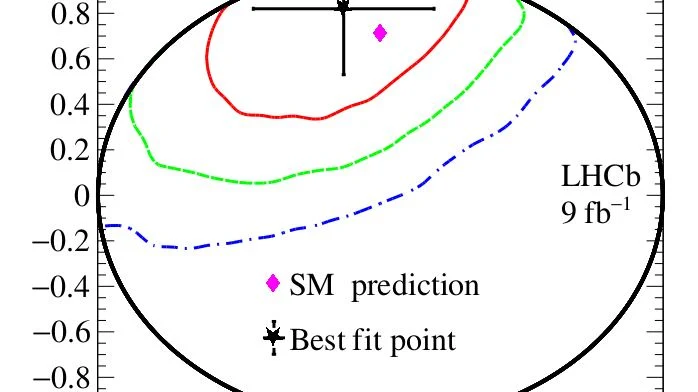
A 71-degree angle: how physicists catch the asymmetry of matter
Imagine a balance scale with identical weights, yet one pan always tips lower. In the world of elementary particles, this imbalance is called CP violation: particles and their mirror twins (antiparticles) behave slightly differently.
HEP Experiment2026-04-231 minarXiv:2604.21257express
A New Charmed Meson
In the LHCb detector, where protons collide, one unusual track was found among billions of decays. The particle, named $$D_{s1}$$(2933)^+, appears for a moment and immediately decays into other particles. Its lifetime is so short that it cannot be observed directly — only through its decay products can its existence be reconstructed.
HEP Experiment2026-04-291 minarXiv:2604.26784express
Rare decay spotted for the first time
A coin landing on its edge is about as rare as a heavy B meson decaying into a light pion and an electron-positron pair. Over a decade of collider operation, only a handful of such events have accumulated, but physicists have finally managed to spot them. The decay probability is about 2.4×10⁻⁸.
Galaxies2026-06-092 minarXiv:2606.10271express
The Wind That Snuffs Out Stars
A vast city lights new streetlamps every night. But then a hurricane sweeps in, rips all the fuel from the warehouses, and the lamps go out one by one. Something similar has been spotted by astronomers in a galaxy whose light has traveled 12.5 billion years to reach us.
Exoplanets2026-08-051 minarXiv:2608.05054express
Martian Weather, Earthly Playbook
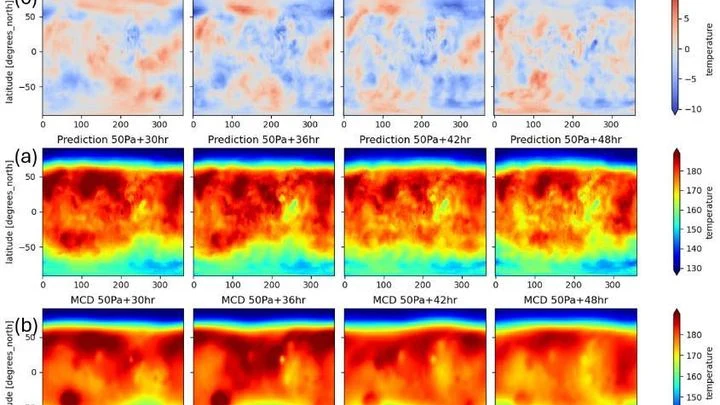
Meteorologists have grown used to trusting neural networks: the GraphCast model predicts Earth's weather days ahead by drawing on global snapshots of the atmosphere. But this 'brain' can be transplanted to another planet — where the air is thin and the Sun warms differently.
HEP Experiment2026-08-211 minarXiv:2608.21082express
How a Heavyweight Particle Decays
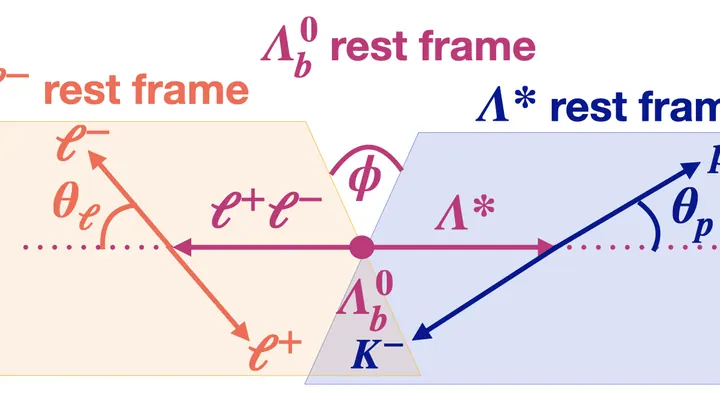
At the Large Hadron Collider, protons are smashed together, and among the debris, a heavyweight particle, the lambda baryon, sometimes appears. It lives for a tiny fraction of a second before decaying into other particles.