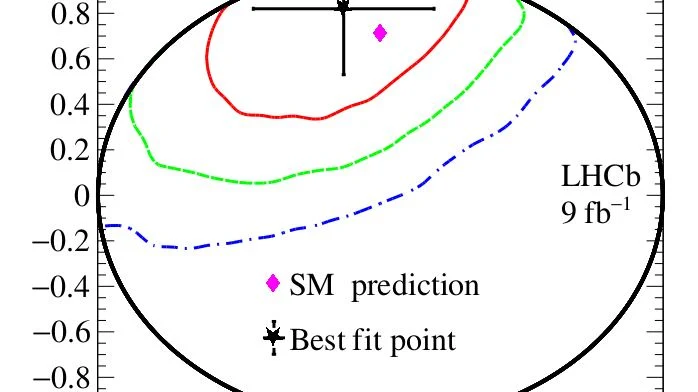
LHCb is one of the four major experiments at the Large Hadron Collider (LHC) at CERN, designed to study the subtle differences between matter and antimatter. Its primary focus is on particles containing the bottom (beauty) quark, particularly B mesons. By measuring how these particles and their antiparticles decay, LHCb probes the violation of CP symmetry—the asymmetry that helps explain why the universe is made of matter rather than antimatter. The experiment's forward geometry, covering a specific angular range, allows it to capture a large sample of B mesons produced in proton-proton collisions.
History
LHCb was proposed in the late 1990s and began taking data in 2010 at the LHC. It was built on the legacy of earlier B-factory experiments (BaBar and Belle) but extends their reach to higher energies and different production mechanisms.
How it works
LHCb uses a series of subdetectors arranged along the beamline to track charged particles and identify their types. When a B meson decays, its products are detected, and the decay vertex is reconstructed with high precision. By comparing the decay rates of particles and antiparticles, LHCb measures CP-violating parameters. The experiment also excels at detecting rare decays, such as those involving muons, which are sensitive to new physics beyond the Standard Model. Its trigger system selects events with high transverse momentum or displaced vertices, efficiently filtering the desired decays from the enormous collision background.
In practice
LHCb's measurements of CP violation and rare decays provide stringent tests of the Standard Model and guide searches for new particles, influencing theoretical models of particle physics.
Fun fact
LHCb has observed the rarest decay of the B_s meson into two muons, a process that occurs only about three times in every billion decays, matching Standard Model predictions with remarkable precision.
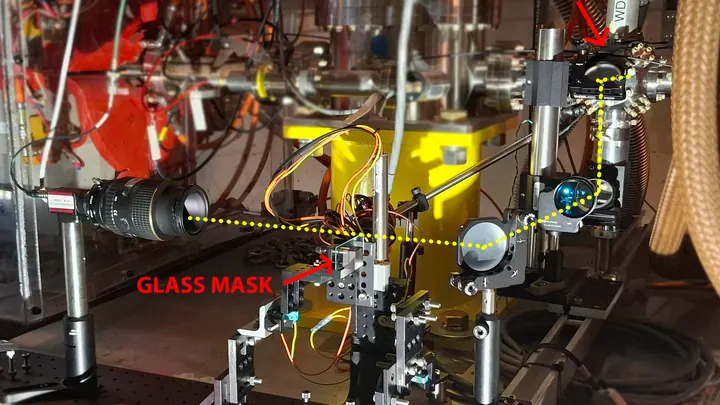
The antiproton beam hits the plate, and each impact bursts into a shower of charged particles. In the GBAR experiment at CERN, this picture is captured not by a sophisticated detector but by an ordinary industrial camera without a lens, pressed against the vacuum window from the outside.
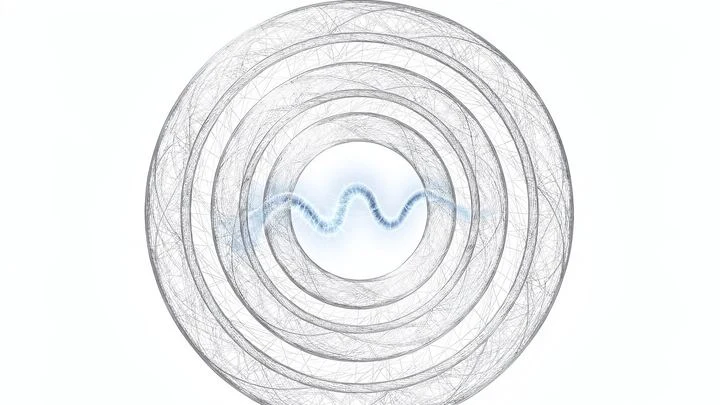
Two dancers on the same stage mirror each other's moves even when a curtain separates them. In the quantum world, such pairs are called entangled, and physicists have spent half a century probing how far this connection reaches. Until now, all tests with massive particles concerned their internal properties, such as spin, but not their motion itself.
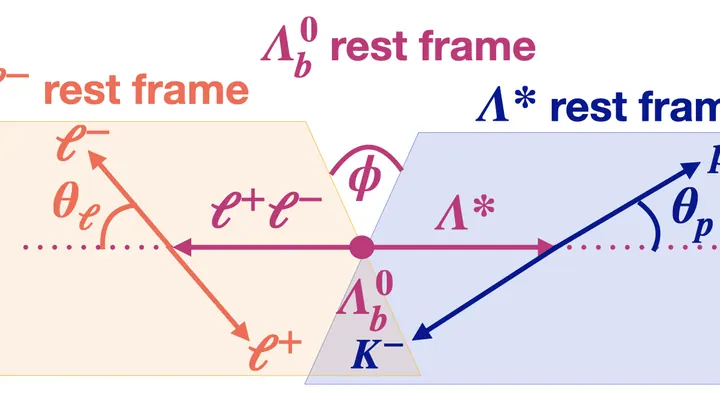
At the Large Hadron Collider, protons are smashed together, and among the debris, a heavyweight particle, the lambda baryon, sometimes appears. It lives for a tiny fraction of a second before decaying into other particles.
The cosmic microwave background is the petrified light of the first moments. Shortly after the Big Bang, microscopic quantum fluctuations were stretched by inflation to the scales of galactic superclusters.
In the late 1990s, the night sky delivered a surprise: Saul Perlmutter and Adam Riess found that the expansion of the Universe is accelerating. Ever since, the greatest riddle has been dark energy — a substance making up nearly 70% of the cosmos, yet evading laboratory study.
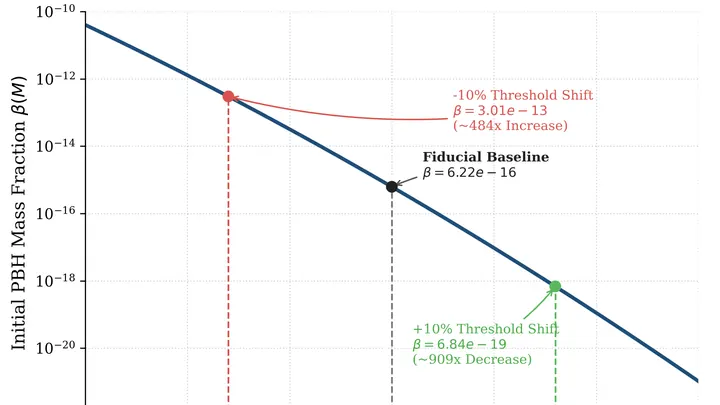
It all began not with emptiness, but with a boiling ocean of plasma. In that primordial broth, sound waves raced through the fiery matter, colliding and compressing it. Sometimes a clump grew so dense that light could no longer escape, and right out of the scorching gas, a primordial black hole was born.
Deep inside the detector at the Large Hadron Collider, protons collide, and for a fleeting moment something heavy is born. It instantly shatters into two Higgs bosons — particles that, like nesting dolls, each hide two pairs of b-quarks.
On one side of the scale lies all the matter in the Universe; on the other, all the antimatter. According to the laws of physics, at the moment of the Universe's birth, the pans should have been balanced. But we see one pan tipping: around us are stars, planets, people, and almost no antimatter. This imbalance is one of the greatest mysteries.
A stone thrown into water leaves ripples. A satellite orbiting Earth also leaves a trace — not on water, but in the laws of physics. Its orbit is not a frozen line: it slowly rotates, like the hand of a giant clock.
Black holes come in lightweights, born from dying stars, and supermassive ones at galactic cores. The missing intermediate link had been hiding. Fast radio bursts, cosmic signals lasting milliseconds but carrying the energy of days of sunlight, helped crack the case. Think of these bursts as cries from the depths of the universe.
In the very beginning, moments after the Big Bang, the universe was ridiculously symmetric: particles and antiparticles in equal measure. But a tiny imbalance occurred, like one extra grain of sugar in a kilogram, and the entire familiar world, stars, planets, people, arose from that surplus. How nature created this imbalance remains a mystery.
The mystery of the missing antimatter has haunted physics since the mid-20th century. The Big Bang should have created equal amounts of matter and antimatter, yet today's world is almost entirely matter. The Standard Model is powerless to explain this baryon asymmetry — we need new particles and mechanisms beyond it.
Two clocks tell different times. One sits on our desk, the other lies far in the past, in the glow left over from the Big Bang. The first, looking at nearby galaxies, ticks off the expansion rate of the universe — about 73 kilometers per second per megaparsec of distance. The second, peering into ancient light, gives a noticeably lower value — roughly 67.
A coin landing on its edge is about as rare as a heavy B meson decaying into a light pion and an electron-positron pair. Over a decade of collider operation, only a handful of such events have accumulated, but physicists have finally managed to spot them.
The decay probability is about 2.4×10⁻⁸.
At the Large Hadron Collider, protons collide billions of times per second, and only once in a trillion collisions does a pair of Standard Model Higgs bosons (the particles responsible for the mass of everything) emerge. In the CMS experiment, physicists hunted for exactly such events.
In the CMS detector at the Large Hadron Collider, protons accelerated to nearly the speed of light collided. Among billions of such collisions, physicists searched for a rare signature: the production of a single heavy particle that immediately decays into a W boson and a b quark.
Every second, billions of decays happen inside our bodies, and nobody notices. But physicists do: they smash particles in accelerators and watch what fragments they fly into. Hidden in those fragments is the answer to why we exist at all. Right after the Universe was born, there were equal amounts of particles and antiparticles, but today all we see around us is particles.
Imagine a balance scale with identical weights, yet one pan always tips lower. In the world of elementary particles, this imbalance is called CP violation: particles and their mirror twins (antiparticles) behave slightly differently.
Cosmologists have measured how fast distant galaxies are receding in different parts of the sky. To do this, they used two kinds of "cosmic rulers": galaxy clusters and a certain type of supernova explosion. Both methods showed the same thing: in one direction, the Universe is expanding slightly faster than in the opposite direction.
A ring road around the Sun, where the traffic is not cars but clumps of matter. The diameter of this road is measured in light-years: it encircles our planetary system at its outer edge, in the Oort Cloud, where the star's weak gravity still holds sway.
In proton collisions at the Large Hadron Collider, physicists have for the first time caught a particle with two charm quarks. It is called Ξcc+ (pronounced "ksi-ksi-plus") and resembles a bead with not one but two heavy nuclei.
In the kitchen, two flashlight beams pass through each other without noticing. Light barely interacts with light. But if you accelerate particles to enormous energies, two photons can collide and give birth to something new.
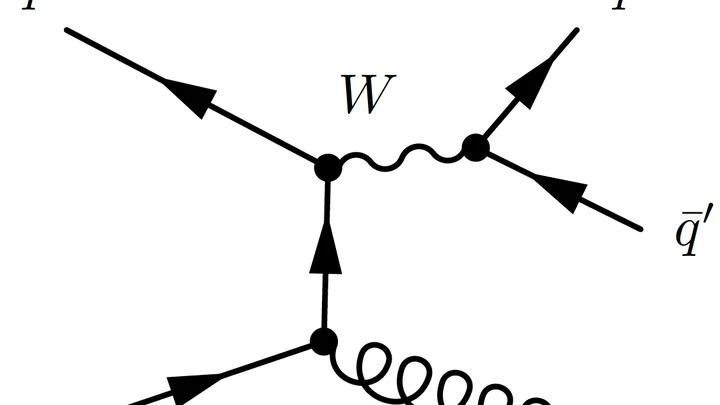
When a W boson, the particle that carries the weak force, decays into a quark and an antiquark, these two fragments fly off in nearly the same direction at the collider's immense speeds.
In the LHCb detector, like in a giant camera with billions of 'snapshots,' rare events are captured: how short-lived particles, B mesons, fall apart into lighter ones. One such decay, where a B meson turns into a kaon and a pair of muons, is particularly interesting. In it, as in a mirror, the difference between matter and antimatter may show up.
In 2017, protons at the Large Hadron Collider collided with an energy of 5.02 TeV. The CMS detector recorded these collisions, and among billions of events, physicists hunted for a rare occurrence: the production of a single top quark without its antiparticle.
A single antiproton, trapped and cooled to near absolute zero, behaves like a tuning fork that needs a very precise strike to produce a clean note. Catching that 'note' directly is nearly impossible — the signal is too weak.
In the first moments after two lead nuclei collide at the Large Hadron Collider, a tiny fireball is born — a quark soup where particles move freely. If a very strong magnetic field arises at that moment, it can separate positive and negative charges, much like a comb parts hair into strands.
Two twins look identical, but one is left-handed and the other right-handed. In the world of elementary particles, there are similar pairs: Ξ- and its antiparticle Ξ+. They are born together in the decay of the J/ψ particle and, like entangled twins, maintain a connection even at a distance.
At the center of our Galaxy lies a supermassive black hole, with stars orbiting around it. Their motion resembles a cosmic dance: some race along elongated orbits, others follow nearly circular paths. If invisible dark matter exists near the black hole, it slightly distorts these orbits, like an unseen hand nudging a star off course.
At the Large Hadron Collider, by accelerating particles to nearly light speeds, top quarks are created — the heaviest building blocks of the Standard Model. They live for vanishingly small fractions of a second but manage to exhibit complex quantum connections.
A bullet that doesn't just pierce one target but leaves marks in several layers of armor. That's roughly how superheavy dark matter behaves, and it's what the DarkSide-50 detector was built to catch for the first time. The usual suspects for dark matter (weakly interacting massive particles, or WIMPs) pass through matter almost unnoticed, occasionally bumping into a nucleus.
In 2018, the Large Hadron Collider ran a special data-taking campaign: the CMS detector captured proton collisions at breakneck speed to collect ten billion particles containing a beauty quark.
In a particle accelerator, the anti-lambda particle is a rare guest. It is born on the fly, lives for a tiny fraction of a second, and usually decays on its own. But sometimes it manages to collide with an ordinary proton, and then a whole shower of light particles is born: kaons, pions.
The helium in a party balloon is the very gas that makes it float. But long before balloons, helium appeared in the first minutes after the Big Bang. Its exact abundance in the universe is like a fingerprint: it tells you how many kinds of neutrinos (ghostly particles that pass through walls) exist.
In giant particle accelerators, particles fly at nearly the speed of light and smash head-on. But sometimes one beam is slightly denser than the other, like someone stepping onto a packed escalator the wrong way. Then collisions become uneven, and detectors start 'flickering,' throwing off measurements.
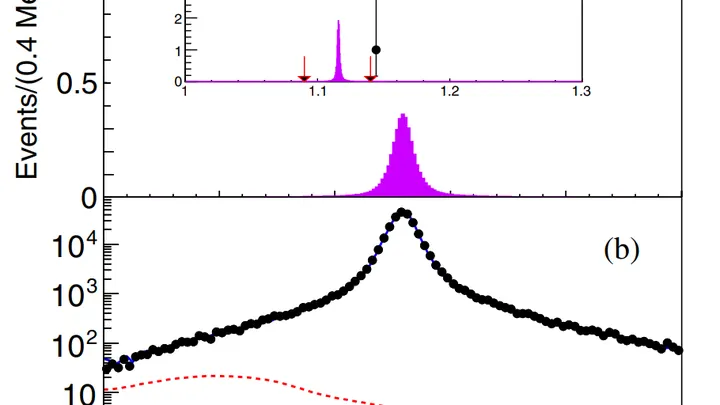
In the LHCb detector at the Large Hadron Collider, protons collide, and for a fleeting moment, particles that don't exist in ordinary matter are born. One of them is the neutral B meson. It lives for less than a billionth of a second and decays into two other particles: the narrow resonance J/ψ and the broader ρ(770).
In the BESIII detector, particles put on a show: they collide, are born, and decay, leaving flashes of light. But sometimes an actor can leave the stage unnoticed — through a hidden door that cameras don't see. Physicists were looking for exactly such 'quiet' decays, when a particle turns into something invisible to the instruments.
A pebble drops into a pond, and ripples spread across the water. But sometimes the pebble doesn't sink right away: it skims beneath the surface, travels a few meters, and only then surfaces, creating ripples in an unexpected spot.
Two spinning tops are set off simultaneously in opposite directions. If one spins left, the other always spins right — no matter how far apart they fly. That's roughly how quantum entanglement works, except instead of tops, we have top quarks, the heaviest known particles.
Inside protons accelerated to nearly the speed of light, a particle heavier than a gold atom is sometimes born — the top quark. It lives for tiny fractions of a second and decays, leaving a trace in the ATLAS detector. Physicists collected such traces for four years to understand how often the top quark and its mirror twin, the antiquark, appear.