Icy Wanderer Chiron Encircled by Rings and a Disk express
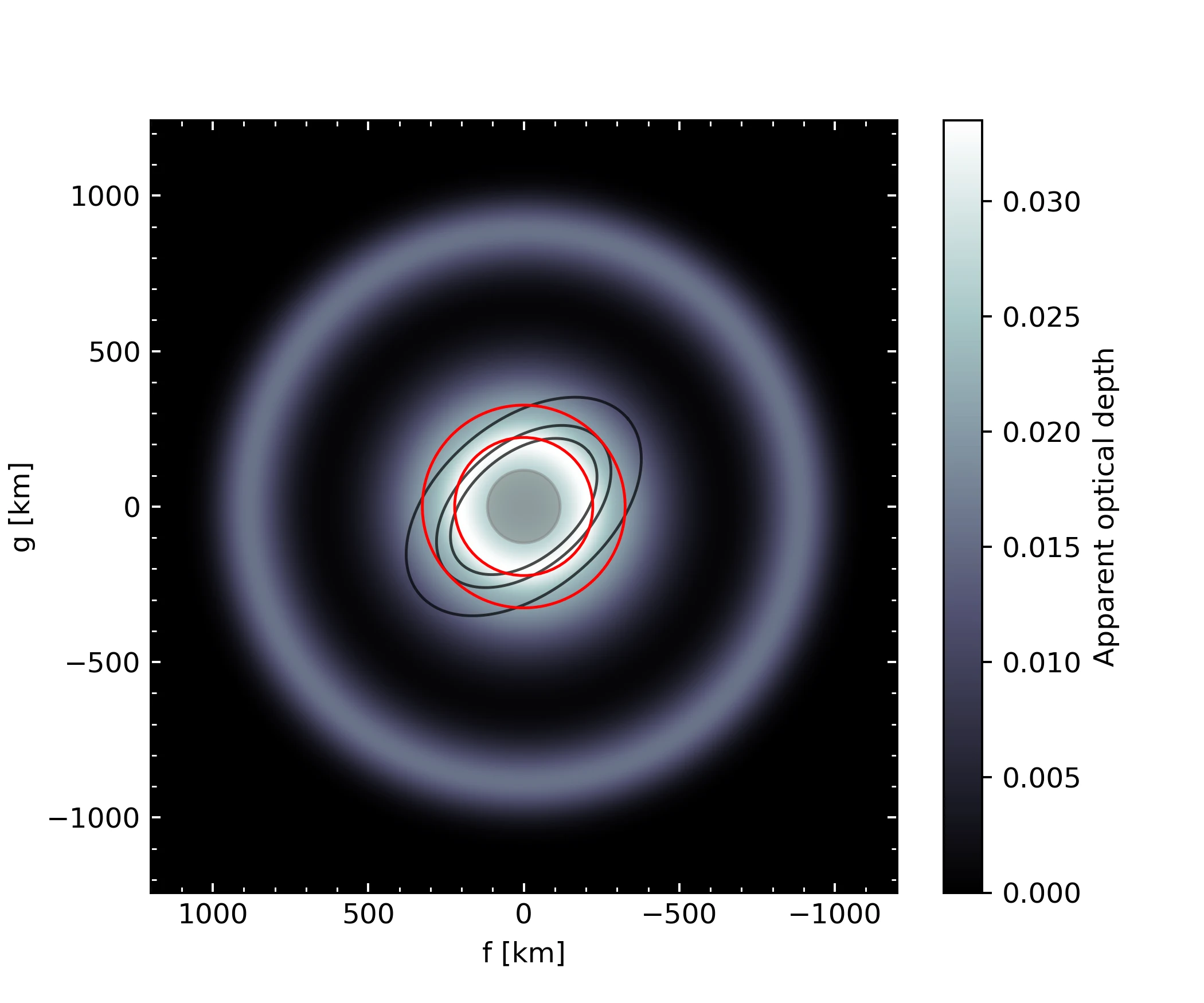
Only by passing in front of a star did Chiron reveal its secret. Three icy hoops encircle the 200-kilometer body — a hybrid of comet and asteroid. Previously, they were only hinted at by spectra of reflected light and brightness fluctuations. Now the star winked three times, and the icy round dance was unveiled.
Gravitational forces no longer tear the dust apart, allowing it to clump together. Why we see another hoop instead of a moon is unknown. Nearby — a dust disk and a tiny object off to the side: likely a moon embryo.
Comparing images over 30 years showed: the rings are changing. Today we see a new planetary system, of snow and stones, coiling around the icy wanderer.
Original abstract
as written by the authors arXiv:2510.12388
The centaur (2060) Chiron has long been a candidate for hosting material in orbit, based on occultation and photometric and spectroscopic data. Here, we present a multichord stellar occultation observed on 2023 September 10 UT that reveals new and complex structures surrounding Chiron. High-cadence light curves show multiple secondary events that are best explained (when compared with a multishell interpretation) with a system of three confined rings located at average radii of 273, 325, and 438 km, the outermost of which lies beyond Chiron's Roche limit. The rings appear coplanar, with a mean pole orientation of {\lambda} = 151{\deg} +/- 4{\deg} and \b{eta} = 20{\deg} +/- 6{\deg}. A broader, disklike structure extends from about 200 to 800 km, and a newly detected faint feature is observed at ~1380 km. Chiron thus appears as the fourth small solar system body known for hosting a ring system. Comparisons with previous occultation events that have occurred since 1994 show that these features are not permanent. With these observations, we may witness for the first time the ongoing formation and evolution of a ring system.
Chiron's rings can't be seen through a telescope: they're betrayed only by fast star winks during an occultation.