The classical electron radius is a length scale that emerges from treating the electron as a classical, point-like charge with a certain electromagnetic self-energy. It is defined as the radius at which the electrostatic potential energy of a sphere of charge equals the rest mass energy of the electron. Its value is approximately 2.818 × 10^-15 meters, about three femtometers.
History
The concept was introduced in the late 19th century by physicists such as Hendrik Lorentz and Max Abraham, who were exploring the idea that the electron's mass might be purely electromagnetic. It was later refined by others, but the classical electron radius remains a useful scale in classical electrodynamics.
How it works
The derivation assumes the electron's mass is entirely electromagnetic in origin. By equating the energy stored in the electric field of a uniformly charged sphere (given by Coulomb's law) to the electron's rest energy (E = mc²), one solves for the radius. This is a classical calculation that predates quantum mechanics and does not reflect the actual size of an electron, which experiments show to be point-like down to very small scales.
In practice
The classical electron radius appears in formulas for Thomson scattering (scattering of light by free electrons), in the calculation of the cross-section for electron-photon interactions, and as a natural unit in particle physics for comparing sizes of atomic and subatomic structures.
Fun fact
Despite its name, the classical electron radius is about 100,000 times smaller than the radius of a hydrogen atom, and modern experiments show the electron has no measurable size down to at least 10^-18 meters.
Two electrons that leave a metal needle tip almost simultaneously start to repel each other, like two people trying to squeeze through a narrow door at the same time. The closer they are, the more they get in each other's way.
If you shrank an ordinary black hole to the size of a grain of sand, it would shine like a tiny star and quickly vanish in a flash. That's Stephen Hawking's prediction: the event horizon acts like a hot surface emitting particles.
A magnetic field can hold a star against complete collapse: that's the idea behind a new kind of black hole. Instead of the usual point of infinite density, inside there is a field that prevents space from crunching down to zero. It's like a spring: the harder you squeeze, the more it pushes back.
Cosmic rays are not light but charged particles bombarding Earth from all directions. Most of them are protons (hydrogen nuclei), but heavier nuclei also show up: helium, nitrogen, iron.
According to ordinary mechanics, an electron in an atom should spiral into the nucleus and crash into it, like a surfer losing speed and falling off the board. But atoms live for billions of years. Because space isn’t empty. Even in absolute vacuum, an invisible electromagnetic sea ripples — the zero-point field. Its waves continuously nudge the electron.
An electron beam can be compared to the light from a laser pointer: if it diverges, the spot on the wall quickly spreads out. In the lab, physicists created such a narrow beam that it remained thin over a long distance, like the beam of a good pointer.
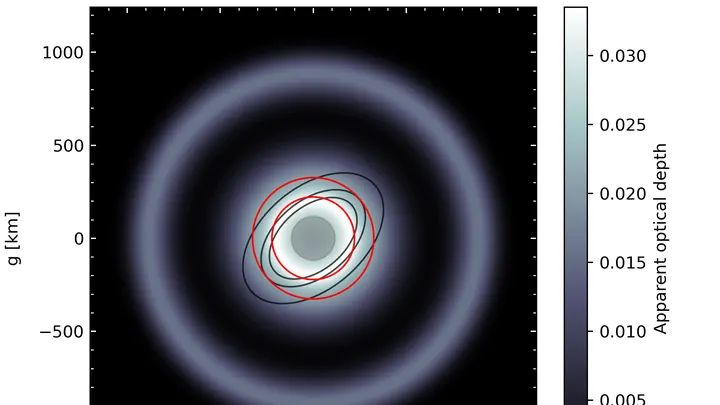
Only by passing in front of a star did Chiron reveal its secret. Three icy hoops encircle the 200-kilometer body — a hybrid of comet and asteroid. Previously, they were only hinted at by spectra of reflected light and brightness fluctuations.
The Event Horizon Telescope looks at M87* and sees more than just a ring of light around a dark void. That light is twisted, like a corkscrew. The wavefront carries a helical structure that physicists call orbital angular momentum.
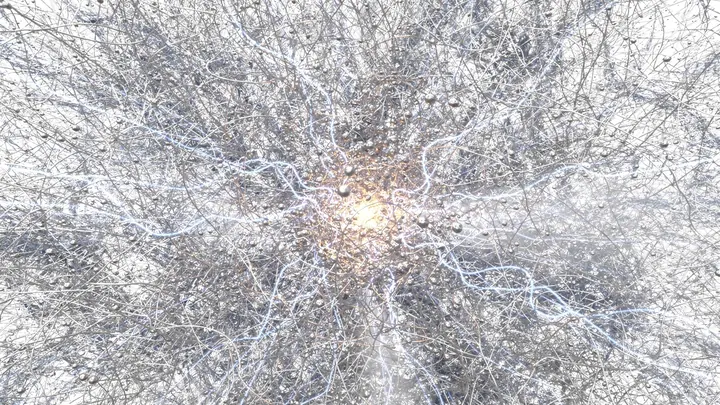
At night over the Siberian taiga, a faint blue light sometimes flickers. It's not the aurora borealis but a cosmic-ray shower: a single particle from deep space slams into the atmosphere and shatters into millions of secondary particles. They race toward the ground in a broad front, like a ripple from a stone dropped into water, and make the air glow.
High above Antarctica, a balloon carried an instrument that caught electrons from space. These particles come from distant stellar explosions and other powerful events. The instrument measured their energy, like the force of an impact. And in one energy range, there were more impacts than calculations predicted.