Are you one of the authors of this paper? Email us from your institutional or work email address mentioning this article's arXiv ID and we'll verify you and give you edit access to this page.
The tiny icy body Chiron sports a ring system—like its own miniature planetary system.
Abstract
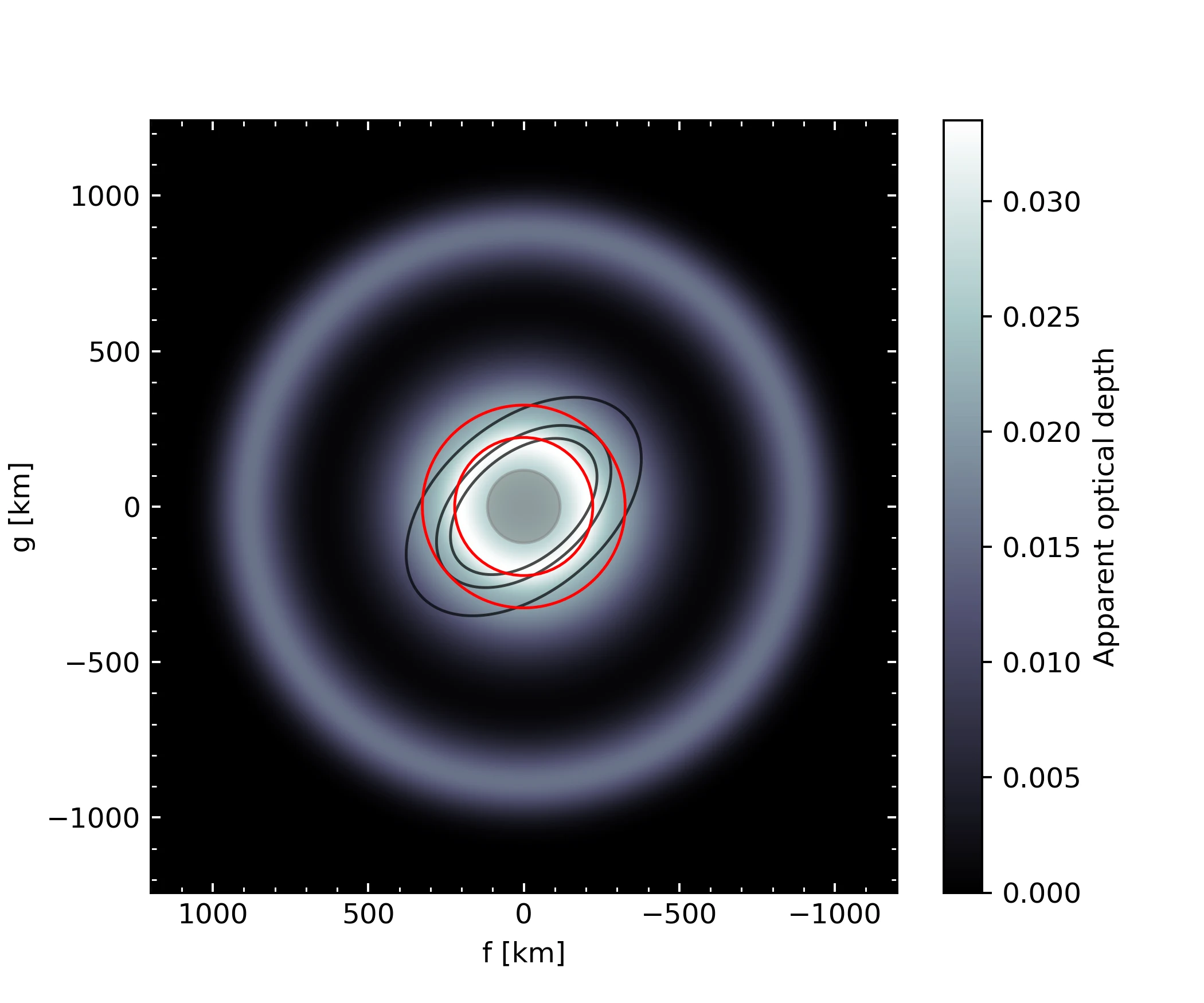
The centaur Chiron, an object orbiting between Saturn and Uranus, delivered a surprise: during an occultation of a distant star (when the body blocks its light), three narrow rings were discovered at distances of 273, 325, and 438 km from its center. The outer ring lies beyond the Roche limit—the boundary where tidal forces tear bodies apart; perhaps this material is forming moons. Chiron became the fourth small body in the Solar System known to have rings. Comparison with past observations revealed that the structure is changing, and scientists are witnessing the evolution of a ring system in real time for the first time.
Links in the knowledge graph 1
📄 Showing the "Simple" version — "Popular" is not ready yet. Add it to favorites to help prioritize it.
Only by passing in front of a star did Chiron reveal its secret. Three icy hoops encircle the 200-kilometer body—a hybrid of comet and asteroid. Previously, they were only hinted at by spectra of reflected light and brightness fluctuations. Now the star winked three times, and the icy round dance was unveiled.
The outermost ring lies in a forbidden zone: where, by the rules, moons should be born, not rings assemble.
Gravitational forces no longer tear the dust apart, allowing it to clump together. Why we see another hoop instead of a moon is unknown. Nearby—a dust disk and a tiny object off to the side: likely a moon embryo.
Chiron is only the fourth small world with rings, and its icy round dance turned out to be inconstant.
Comparing images over 30 years showed: the rings are changing. Today we see a new planetary system—of snow and stones—coiling around the icy wanderer.
🎯 Chiron's rings can't be seen through a telescope—they're betrayed only by fast star winks during an occultation.