Photo Editor for Quantum Computers express
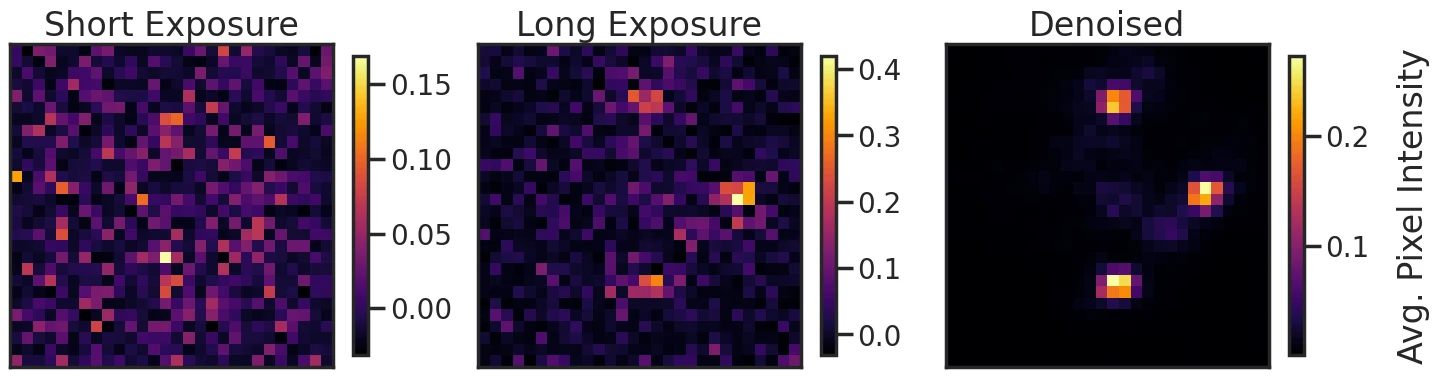
Atomic qubits 'snap' computations in microseconds, but capturing the result with a light-sensitive camera stretches out to milliseconds — thousands of times longer. During this time, the quantum state blurs (decoherence), accumulating uncertainty (entropy), like a photo taken with a long exposure on a shaky camera. Shortening the exposure isn't an option: then too few photons — particles of light traveling at the speed of light — hit the sensor, and the signal drowns in noise.
The GANDALF algorithm acts like a 'magical' sharpening tool: from a blurry, noisy one-second exposure, it reconstructs a crisp picture of the atoms' glow. In essence, it's a photo editor that understands the physics of quantum snapshots. As a result, readout speeds up by 1.6 times without loss of accuracy, and the full error correction cycle is twice as fast. An unexpected twist: the number of failures plunges by a factor of 35, because the algorithm doesn't just clean up noise — it guesses the true state from microscopic hints.
Original abstract
as written by the authors arXiv:2510.25982
Neutral atom quantum computers hold promise for scaling up to hundreds of thousands or more qubits, but their progress is constrained by slow qubit readout. Parallel measurement of qubit arrays currently takes milliseconds, much longer than the underlying quantum gate operations-making readout the primary bottleneck in deploying quantum error correction. Because each round of QEC depends on measurement, long readout times increase cycle duration and slow down program execution. Reducing the readout duration speeds up cycles and reduces decoherence errors that accumulate while qubits idle, but it also lowers the number of collected photons, making measurements noisier and more error-prone. This tradeoff leaves neutral atom systems stuck between slow but accurate readout and fast but unreliable readout. We show that image denoising can resolve this tension. Our framework, GANDALF, uses explicit denoising using image translation to reconstruct clear signals from short, low-photon measurements, enabling reliable classification at up to 1.6x shorter readout times. Combined with lightweight classifiers and a pipelined readout design, our approach both reduces logical error rate by up to 35x and overall QEC cycle time up to 1.77x compared to state-of-the-art convolutional neural network (CNN)-based readout for Cesium (Cs) Neutral Atom arrays.
Each qubit emits just a handful of photons — as much light as the eye catches from a barely visible star. It is this microscopic signal that GANDALF amplifies.