Photo Editor for Quantum Computers express
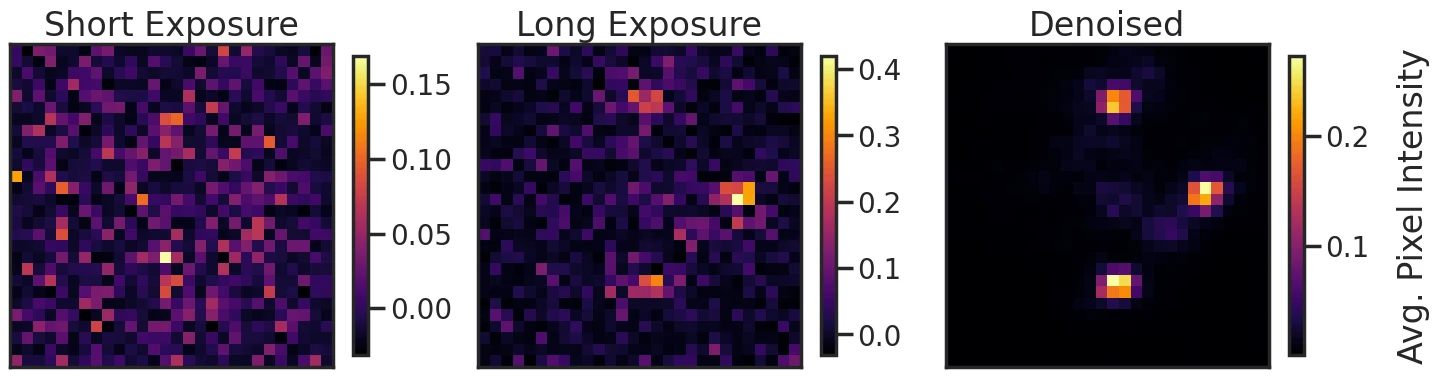
Atomic qubits 'snap' computations in microseconds, but capturing the result with a light-sensitive camera stretches out to milliseconds — thousands of times longer. During this time, the quantum state blurs (decoherence), accumulating uncertainty (entropy), like a photo taken with a long exposure on a shaky camera. Shortening the exposure isn't an option: then too few photons — particles of light traveling at the speed of light — hit the sensor, and the signal drowns in noise.
The GANDALF algorithm acts like a 'magical' sharpening tool: from a blurry, noisy one-second exposure, it reconstructs a crisp picture of the atoms' glow. In essence, it's a photo editor that understands the physics of quantum snapshots. As a result, readout speeds up by 1.6 times without loss of accuracy, and the full error correction cycle is twice as fast. An unexpected twist: the number of failures plunges by a factor of 35, because the algorithm doesn't just clean up noise — it guesses the true state from microscopic hints.
Each qubit emits just a handful of photons — as much light as the eye catches from a barely visible star. It is this microscopic signal that GANDALF amplifies.