Quantum Particles Can Flow Backward express
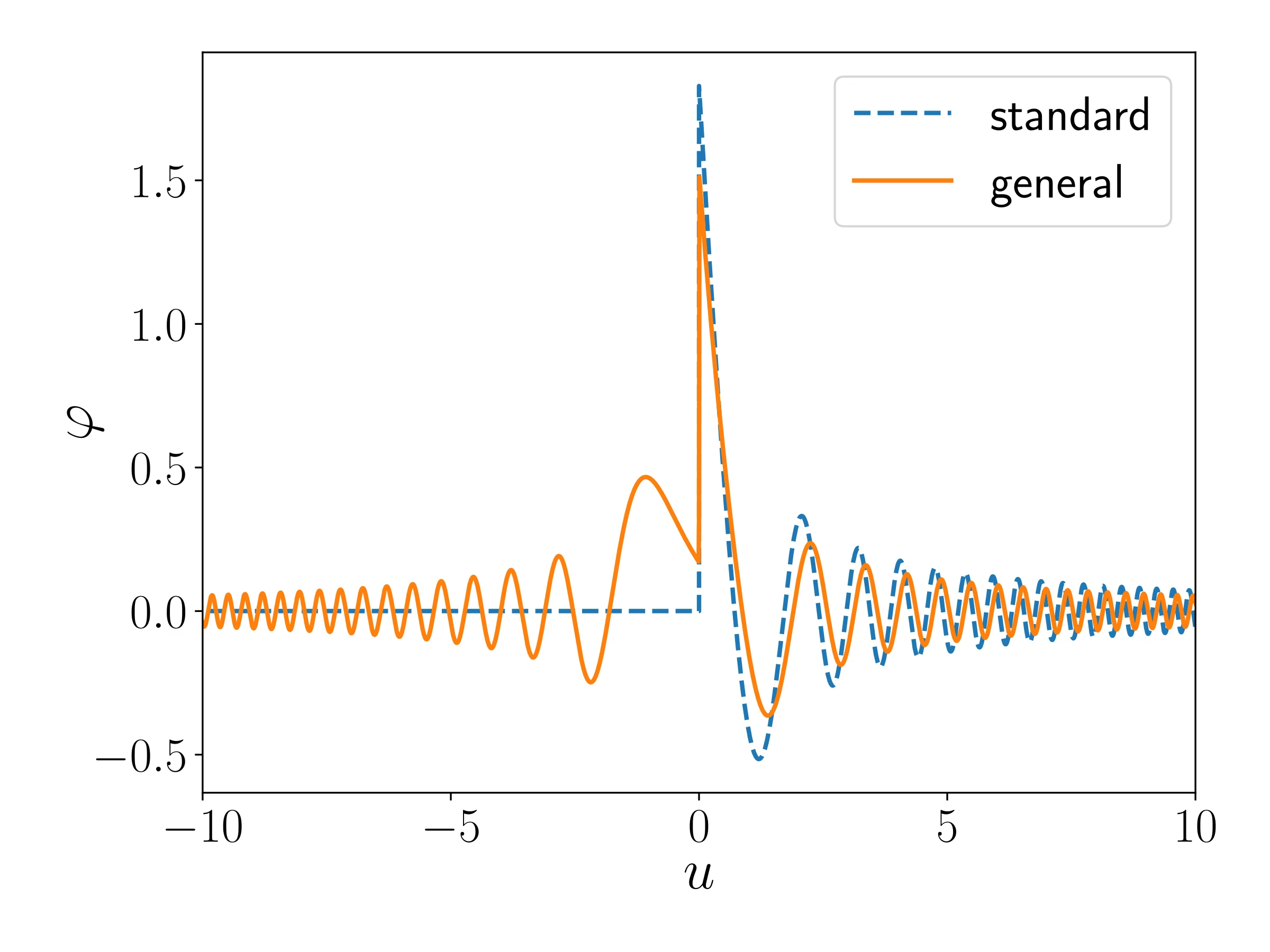
A quantum particle of the microworld quantum particle can move backward even if overall it's flying forward. It's like a river, where individual currents suddenly turn against the flow, creating disorder. Previously, it was thought that such backflow didn't exceed 4% — as if only a small part of the water in a river moves backwards.
Now scientists realize: under real-world conditions, when the particle is not perfectly directed, the proportion of backward motion grows to nearly 13%. That's three times higher than the previous estimate. This discovery simplifies experiments — you don't need flawless particles, just ordinary ones. For almost a century, physicists have known about backflow's existence, but they haven't been able to directly observe it. Perhaps now this strange effect will become visible.
Original abstract
as written by the authors arXiv:2511.10155
Quantum backflow is a counterintuitive phenomenon in which the probability density of a quantum particle propagates opposite to its momentum. Experimental observation of backflow has remained elusive due to two main challenges: (i) the effect is intrinsically small, with less than 4% of the probability able to flow backward, and (ii) it requires wave packets with a well-defined momentum direction, which are difficult both to prepare and to verify under realistic, noisy conditions. Here, we overcome these challenges by introducing a general formulation of quantum backflow applicable to arbitrary momentum distributions. The framework recovers the standard backflow limit for unidirectional states and identifies general backflow as probability flow exceeding that predicted by the particle's momentum distribution alone. We show that this excess can reach nearly 13%, surpassing the standard backflow bound by more than a factor of three. Furthermore, we extend the framework to the closely related phenomenon of quantum reentry, provide explicit examples of quantum states exhibiting large general backflow and reentry, and discuss the foundational implications of these nonclassical effects. Our results open a pathway toward the experimental observation of quantum backflow in realistic settings.
Backflow is one of the most elusive effects in quantum mechanics. Although it follows from the equations, it hasn't been directly observed in almost a hundred years.