Transversemomentum is the component of a particle's momentum that is perpendicular to the beam axis in a colliderexperiment. In particle physics, when two beams of particles collide head-on, the total momentum along the beam direction is conserved and is essentially zero before the collision. Any particle produced in the collision that has momentum perpendicular to the beam must be balanced by other particles with opposite transverse momentum, so the vector sum of all transverse momenta in an event is zero. This makes transverse momentum a powerful tool for identifying particles that escape detection, such as neutrinos, which carry away momentum without leaving a trace in the detector.
History
The concept of transversemomentum became central with the development of collidingbeamexperiments in the 1960s and 1970s, particularly at CERN and Fermilab, where it was used to analyze the products of high-energy collisions.
How it works
In a collider, the beam axis defines the z-direction. For each detected particle, its momentum vector is decomposed into a longitudinal component (along the beam) and a transverse component (in the plane perpendicular to the beam). The transverse momentum is calculated from the particle's energy and its angle relative to the beam. Because the initial transverse momentum is zero, any imbalance in the detected transverse momenta indicates the presence of invisible particles. This is the basis for many searches for new physics, such as dark matter candidates, which would appear as missing transverse momentum.
In practice
Transversemomentum is used in every particle colliderexperiment to measure the properties of known particles, discover new ones, and search for physics beyond the Standard Model, such as supersymmetry or extra dimensions.
Fun fact
The transversemomentum of particles in a jet can be used to infer the mass of the original quark or gluon that produced the jet, a technique that helped discover the Higgs boson.
Units by system: SI: kgms1 · CGS: gcms1 · Planck: m pc · natural: gev
A billiard ball hangs in midair. Tiny peas shoot at it from a blowgun. Each hit is barely perceptible, but if the ball is very light and barely trembles from heat, you can make out individual nudges. That's essentially the setup: a glass sphere the size of a bacterium levitates in a vacuum while a narrow beam of xenon atoms flies at it.
Sugar dissolves in tea, and then with a single motion gathers back into the spoon. In an ordinary kitchen, you won't see that — viscosity and disorder get in the way. But in the world of ultra-slow motions, where inertia vanishes, such tricks become reality.
A tiny glass bead hangs in a laser beam like a speck of dust in sunlight. Around it is a rarefied gas: atoms of krypton, xenon, and heavy molecules of sulfur hexafluoride. They collide with the bead, and each hit transfers a tiny impulse, like a pea thrown at a taut sheet makes it tremble.
Impulse is a measure of motion: mass times velocity.
Light usually pushes an atom straight ahead, like wind pushing a sail. But if the beam is twisted into a corkscrew, the picture changes: the atom can fly off to the side, as if caught by a spinning wheel. In the new work, physicists calculated that such a vortex photon can transfer almost all of its rotation to the atom — up to 100 percent.
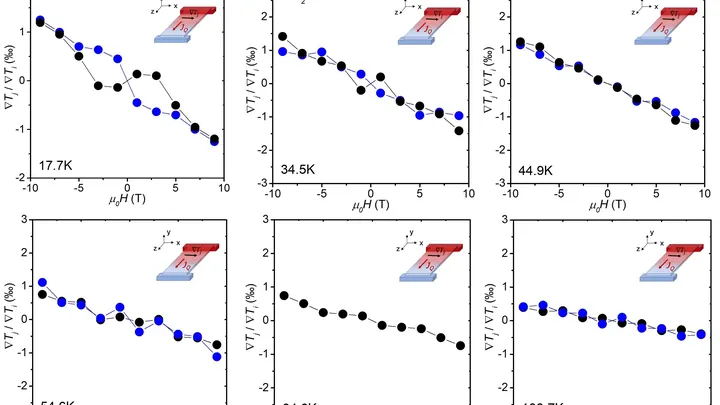
In an insulating crystal, heat usually flows from the hot end to the cold end. But when you switch on a magnetic field, part of the heat flow veers sideways, like water running down a slope that drifts to the side when the wind pushes it. This behavior is called the thermal Hall effect.
At the Large Hadron Collider, protons are smashed into lead nuclei. At the moment of impact, hundreds of new particles are born, and some of them fly out in narrow beams — jets. Inside such a jet, like in a dense stream, protons and neutrons can stick together to form larger nuclei, for example a deuteron — the nucleus of heavy hydrogen.
In a plasma accelerator, particles are accelerated like surfers riding a wave created in the plasma. If the leading bunch and the trailing bunch are not aligned, an instability arises that shakes the trailing bunch. It's as if a surfer on a wave starts wobbling from side to side: their trajectory gets messed up, and they might fall off the wave.
An ordinary sensor is like a scale that always shakes a little on its own. Even in total silence and at zero temperature, every particle jitters — this is quantum jitter, and it limits the precision of any measurement.
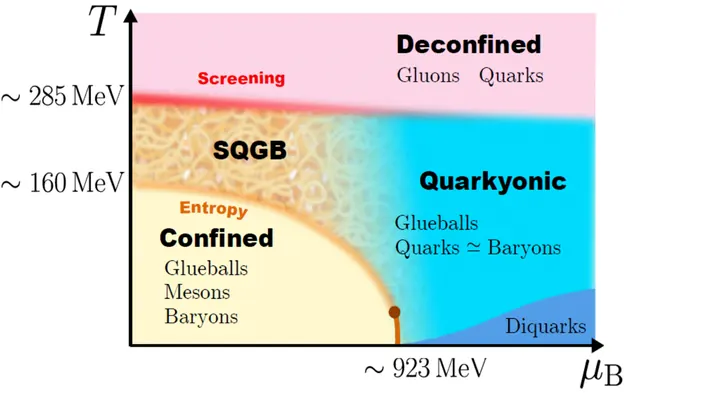
Water in a kettle heats to 100 degrees, and stops being water, turning into steam. Something similar happens to atomic nuclei when they are smashed together at enormous speeds in the Large Hadron Collider.
All bodies in vacuum fall with the same acceleration: this principle, formulated by Einstein in general relativity, underpins our understanding of gravity. Yet so far it has been experimentally confirmed only for particles of ordinary matter.
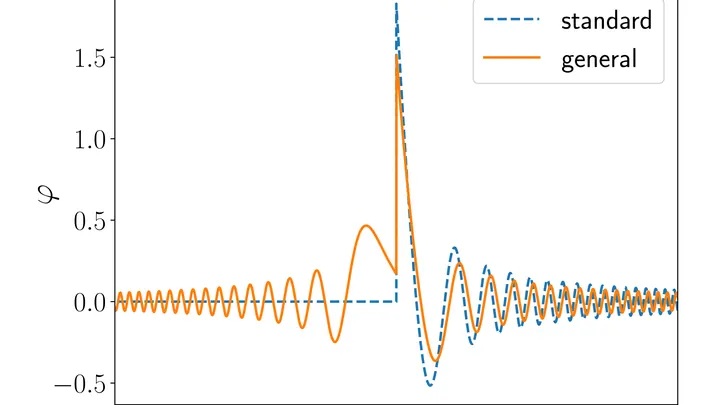
A quantum particle quantum particle can exhibit backward motion even if its overall direction is forward. Imagine a river: the main current rushes toward the mouth, but individual currents suddenly swirl and momentarily dart against the flow, creating local disorder.