The complementarity principle states that quantum objects exhibit mutually exclusive properties, such as particle-like or wave-like behavior, depending on the experimental context.
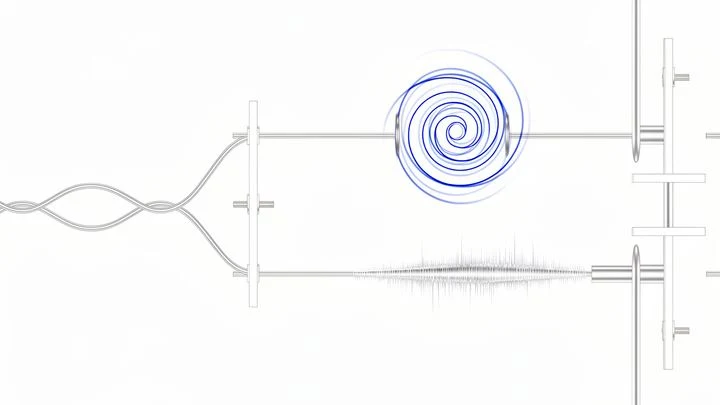
The principle was formulated by Niels Bohr in 1927 as a resolution of the paradoxes of quantum mechanics. The essence: a complete description of a micro-object requires two mutually exclusive experimental setups — one reveals wave properties (interference), the other — particle properties (trajectory). In the double-slit experiment, if we try to peek through which slit the electron passed, the interference pattern disappears. Complementarity is not just a limitation of knowledge, but a way of existence of quantum reality.
History
Niels Bohr developed the principle in 1927 during the famous debates with Albert Einstein, who insisted on the incompleteness of quantum mechanics. Bohr argued that classical concepts of particle and wave are adequate only separately, and their combination requires additional perspectives. John Archibald Wheeler later proposed the delayed-choice thought experiment, showing that the decision of whether to observe a wave or a particle can be made after the photon has passed through the apparatus. In the 1970s, Wootters and Zurek gave a quantitative form of complementarity, which allowed experimental testing of the boundary between wave and particle behavior.
How it works
The complementarity principle underlies quantum cryptography technologies, where any attempt at eavesdropping inevitably disturbs the state and is detected by the disruption of interference. Limits of applicability: for macroscopic objects, complementarity is practically indistinguishable due to rapid decoherence (loss of quantum properties through interaction with the environment), but formally it always holds. In quantum computing, the principle is used for error correction through redundant encoding.
In practice
Understanding complementarity is necessary for the development of quantum computers and the interpretation of double-slit experiments with electrons.
Fun fact
Niels Bohr was so fascinated by the idea of complementarity that he later tried to apply it in biology (life and physico-chemical processes) and psychology, considering them complementary aspects of reality.
In a hall with a thousand spectators, applause blends into a general noise, but if someone falls out of rhythm — a ripple runs through the crowd. The quantum world works similarly: atoms in a trap can behave as a single whole, or they can fall apart into independent individuals.
An ordinary microwave cavity resembles a music box: it responds only to strictly defined frequencies: its own notes. But what if you could make it sound different? Scientists changed the rules of the game by making the walls "one-way." Inside such a cavity, a wave can only run forward, never reflecting back.
Two pendulums hang from the same crossbar. A push, and they start swinging, gradually falling into and out of sync. In a topological qubit, Majorana particles, special excitations that can store quantum information, play the role of these pendulums.
An atomic nucleus is like a crowded bus. To free up space, a group of two protons and two neutrons — a helium nucleus, an alpha particle — exits through the front door: this is alpha decay, described by George Gamow as tunneling under an energy barrier.
For almost a century, cosmologists have been grappling with the mystery: what makes the Universe expand ever faster? The standard answer — dark energy — creates a monstrous discrepancy between the theoretical vacuum density and observations. But there's another path, one that turns causality on its head.
A quantum computer is like an orchestra: each musician plays their own part, but the slightest noise from the audience can throw off the whole ensemble. The particles that store information easily lose their coherence from thermal jolts or stray magnetic fields.
An old mechanical alarm clock ticks on the shelf. You hear the steady sound, see the hands moving, and you're certain time is passing. But if you take the clock apart, you won't find a single part labeled "time." Only springs and gears.
Two simultaneous interpreters sit in the same booth. The first translates from English into Russian but swallows half the words. The second goes from Russian into French, and also loses half. If you put them together, you'd expect a mess: the losses would add up, and only a quarter of the meaning would reach the listener. But what if they start correcting each other?
Two particles behave like a pair of unusual dice: thrown at opposite ends of the universe, they always land on the same face. Physicist John Stewart Bell calculated: if the dice had hidden rules, the frequency of matches would have a strict limit.
Throw a stone into a pond, and ripples spread across the water. Throw two stones nearby, and the ripples intersect, creating a pattern of reinforced and canceled waves. That's interference.
In 1965, Penrose unleashed a mathematical thunderbolt on physics: any sufficiently massive star, shrinking under its own weight, inevitably collapses into a singularity — a region where spacetime curvature becomes infinite and the laws of physics break down.
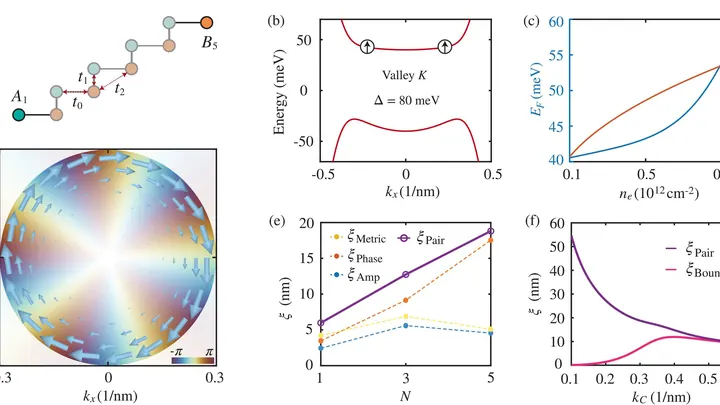
In a superconductor, electrons pair up like dancers holding hands. Usually, the distance between them, the pair size, depends on how fast they move and how strongly they are bound. But sometimes the dance floor almost disappears, and there's nowhere to move. This happens in materials with flat electronic bands: electrons nearly freeze, and the usual rules stop working.
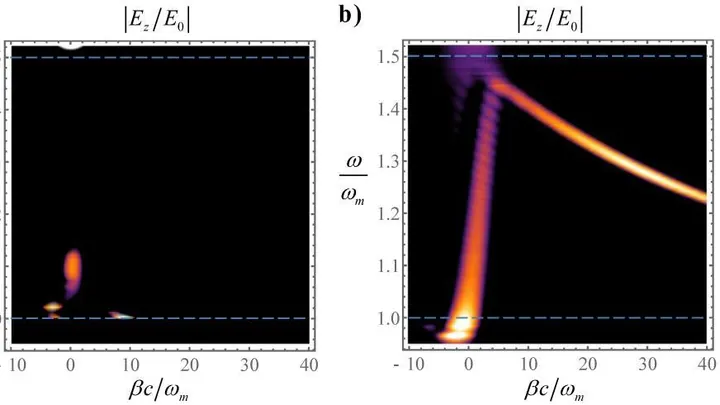
A conventional antenna array is like a choir: many voices singing in unison, with the sound amplified in only one direction. To catch a signal from another side, you have to rearrange the whole choir. Now imagine a single voice that can change its timbre so that the sound itself focuses in the desired direction.
Before measurement, a quantum object lives in a world of possibilities, where wave amplitudes add up like sound waves in a studio before pressing the “record” button. Crests amplify each other, troughs cancel out.
In every cell lives a tireless scribe — an enzyme that copies the long thread of DNA. It moves along it like a read head over a tape, building a new strand alongside. It picks letters by strict rule: opposite A it always places T, opposite G it places C. But sometimes, very rarely, its hand trembles, and a different letter slips in.
A quantum particle, an inhabitant of the elementary particle world, resembles a coin spinning in the air: neither heads nor tails, but a blend of possibilities. Yet when it lands on the table, the outcome becomes definite. What serves as the table in a measurement?
Dark matter makes up 85% of the matter in the Universe, yet remains invisible. It only reveals itself through gravity. We can catch it by its cosmic 'hum' — a faint vibration that permeates space. A single detector is powerless here: the signal is too quiet.
Physicists turn many sensors into a quantum ensemble.
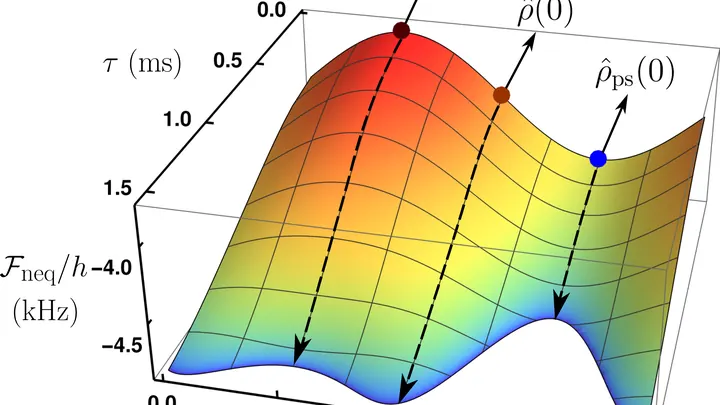
The Mpemba paradox, hot water sometimes freezes faster than cold, has gained a quantum sequel. In the microworld, a particle pushed farther from the finish line gets there first. Experimenters demonstrated this on a single spin: like a racer, they pushed it farther from equilibrium, and it reached it faster than after a weak nudge.
A quantum particle quantum particle can exhibit backward motion even if its overall direction is forward. Imagine a river: the main current rushes toward the mouth, but individual currents suddenly swirl and momentarily dart against the flow, creating local disorder.
A turnstile lets you through only forward, and not a step back. Physicists have implemented a similar principle on a tiny semiconductor chip for single photons — particles of light.
Intelligent action begins with a plan. Just as an architect needs blueprints to evaluate options, any agent with will needs to repeatedly copy data about reality.
A quantum system, once born, does not forget it. Even after dozens of lifetimes, a trace of the initial state remains in its decay: a slowly decreasing power-law tail. For two fluorescent dyes, erythrosine B and eosin Y, this tail has been observed for the first time in two spectral channels simultaneously.
In an empty concert hall, two musicians play a single part. First the violin, then the cello, or the other way around. It has always been this way: every note has its place in time, its own "earlier" and "later." But what if an orchestra could play both versions at once, in a quantum superposition of two orders?
Two particles begin their dance in complete independence. Neither knows of the other's existence. But under the invisible music of deformed spacetime, their motions gradually synchronize: entanglement is born in the system—that very quantum connection Einstein called 'spooky action at a distance.'
In the ordinary world, energies add up simply: take the energy of…
Niels Bohr insisted: you cannot simultaneously know which path a photon took and see interference. For a long time, this was considered a limitation of knowledge — we simply cannot obtain both types of information at once.
Two couriers leave the same city in opposite directions. An hour later, each opens an envelope: one contains a slip marked “plus,” the other “minus.” How did they know who would get which?
Light strikes a metal plate, and electrons fly out. This is the photoelectric effect, and it works only if the light has enough energy to cross the threshold that holds electrons inside.