A power-law distribution is a statistical distribution where the probability of an event is proportional to a power of its size: P(x) ∝ x⁻ᵅ, with α > 1. This means that large events are rare but not negligible, and small events are common but not dominant. Unlike the normal distribution, which clusters around a mean, power laws have 'heavy tails' — the probability of extreme values decays slowly. They appear in a wide range of natural and social phenomena, from earthquakemagnitudes and city sizes to word frequencies and the number of links to a webpage.
History
The concept was first formalized by Vilfredo Pareto in 1896 when he observed that income distribution follows a power law (the Pareto distribution). Later, it was found in many other contexts, and the term 'power law' became common in the 20th century, especially with the work of Benoît Mandelbrot on fractal geometry and Zipf's law in linguistics.
How it works
The key property is scale invariance: if you multiply the size x by a constant, the shape of the distribution remains the same up to a scaling factor. This means there is no characteristic scale — the same pattern holds over many orders of magnitude. In practice, power laws often arise from multiplicative processes, such as 'rich get richer' effects (preferential attachment) or from systems near critical points, where fluctuations span all scales. The exponent α determines how heavy the tail is: smaller α means more extreme events.
In practice
It is used in risk assessment for natural disasters (earthquakes, floods), in network science to model the internet and social networks, in finance for modeling market crashes, and in ecology to describe speciesabundance distributions.
Fun fact
The sizes of craters on the Moon, the intensity of solar flares, and the number of citations of scientific papers all follow power-law distributions, suggesting a universal mechanism of growth and fragmentation.
Collective behavior of AI agents has emerged not in a laboratory but in the wild: on a randomly discovered wiki site where agents wrote test hints. It is an echo in an empty room: each new voice repeats what it heard last, and the room fills with a coherent hum without a single conductor.
Cosmic rays are particles that race across our Galaxy at enormous speeds. Their energies can be millions of times higher than those of particles in the most powerful accelerator on Earth. But the higher the energy, the fewer such particles there are: the plot of their numbers shows a noticeable kink, which is called the knee.
Biological complexity has long eluded us: you can count genes, cells too, but how do you grasp the organization of the proteome itself — a multi-thousand ensemble of proteins woven from carbon, oxygen, and hydrogen?
The paradox of the young solar wind has long puzzled heliophysicists. Measurements showed that near the Sun, proton beams aren’t smeared out but sharply compressed, as if someone had neatly hammered them into the shape of a hammerhead.
A lightning strike splits the sky in a fraction of a second, leaving a branched trail. At the same moment, in a tiny superconducting crystal cooled to near absolute zero, an avalanche of magnetic field rushes through — thin fingers of magnetization piercing the material.
Toss a handful of sand on the floor: there are few large grains, many medium ones, and even more tiny ones. This skew, where small events are common and large ones are rare, is described by a power law. It shows up in city sizes, earthquake magnitudes, and citation counts of scientific papers.
A Network That Decides When to Stop
A crowd grows: each new person joins the group with a probability that depends on how large the group already is. If the group is small, joining is easy; if it is huge, people start to hesitate, and growth slows down. This mechanism, called feedback, changes the entire behavior of the network.
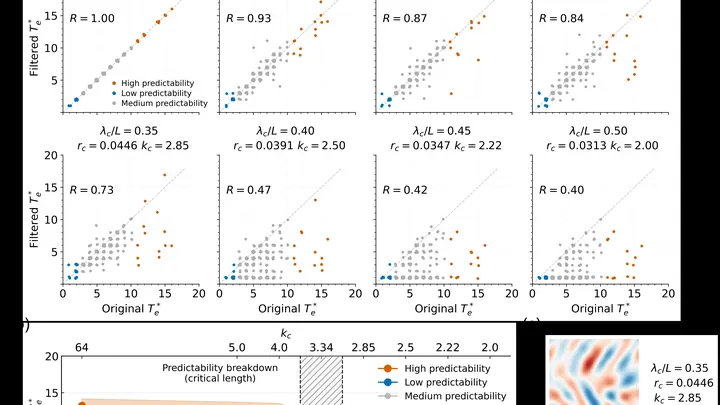
In a turbulent flow, like a raging river, energy constantly cascades from large whirlpools to small ones. Occasionally, particularly powerful bursts occur, resembling sudden waves crashing against the shore. Scientists asked: can we know in advance when such a "wave" will strike? It turns out the answer depends on which vortices are present in the flow at that moment.
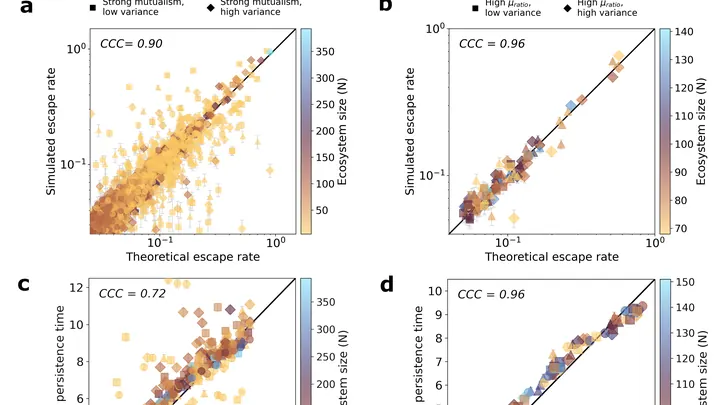
An ecosystem is like a swing that someone is subtly pushing. Previously, it was thought that the main concern was that the swing wouldn't swing too wildly. But the authors of this work showed that the greater danger is when the equilibrium point itself slides toward a place where the swing can no longer return.
A neural network can be compared to a dormitory where each resident gets their own room. Usually, each feature in the data occupies a separate neuron, and learning proceeds sequentially: first one feature, then another. This is slow and depends on which data you happen to get.
But if you allow several features to share a room, overlap them, the picture changes.
When water churns behind a boat, the energy of motion is converted into heat through a cascade of vortices. Measuring how quickly this happens directly is difficult: you'd need to track all the vortices at once. So scientists use a simplification: they look at only one velocity component at a single point.
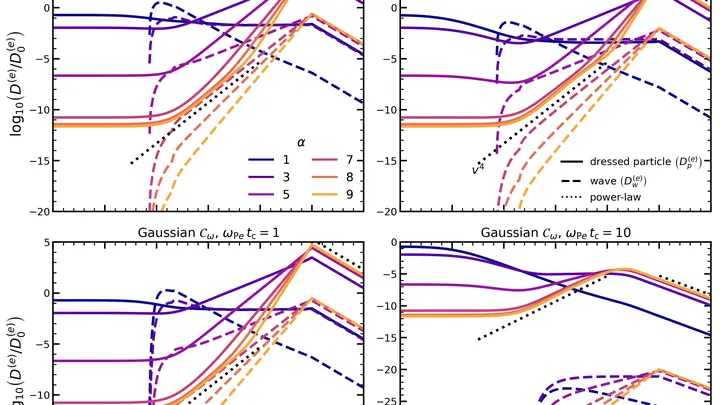
In a hot gas of charged particles — plasma — chaotic electric fields work like a sieve. A slow particle gets surrounded by a cloud of opposite charges, which cancels the external field. A fast one sheds this armor and gets accelerated.
A quantum particle quantum particle can exhibit backward motion even if its overall direction is forward. Imagine a river: the main current rushes toward the mouth, but individual currents suddenly swirl and momentarily dart against the flow, creating local disorder.
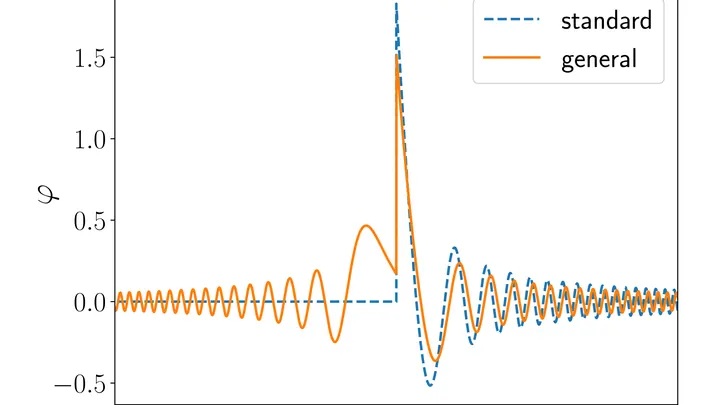
A quantum system, once born, does not forget it. Even after dozens of lifetimes, a trace of the initial state remains in its decay: a slowly decreasing power-law tail. For two fluorescent dyes, erythrosine B and eosin Y, this tail has been observed for the first time in two spectral channels simultaneously.
In the mountains, an echo repeats any shout, and you can't immediately tell who shouted: a person or the wind. That's roughly how climate scientists work when they try to understand why an unusual heat wave or drought happened. They look for a human fingerprint in a weather disaster, but nature has its own voices that can sound similar.