Vortices Play Leapfrog in Liquid Light express
Superfluid helium flows without friction, and vortices are born within it — microscopic funnels, much like whirlpools in water. Two such vortices can play leapfrog: one jumps over the other, and they hop in a circle. This game was predicted by Richard Feynman back in the 1950s. Only now has it been directly observed.
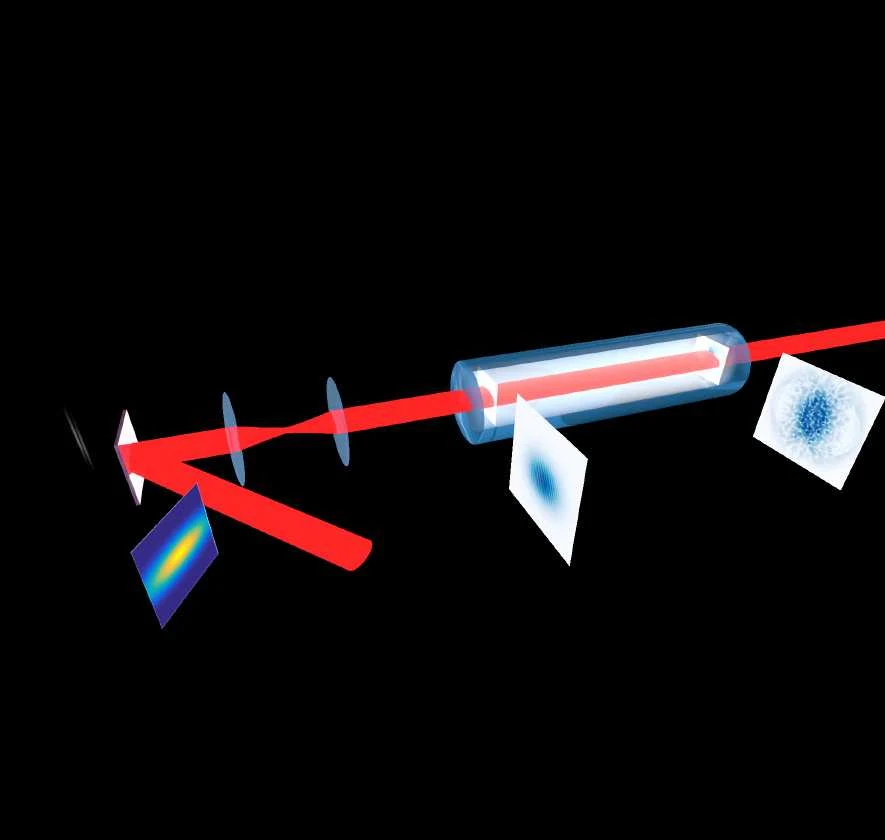
Now physicists have staged leapfrog in "liquid light"—a medium where light behaves like a superfluid. They created vortices with a laser and tracked their motion with an ultrafast camera. When the vortices were sped up too much, a sharp jolt occurred — a shock wave. The game broke down: the vortices collided and vanished, releasing heat. That’s the only way such a perfect fluid can lose energy. Capturing the moment was possible thanks to ultra-high-speed filming.
This discovery helps understand how motion decays in superfluid media and could lead to ultra-precise rotation sensors.
Original abstract
as written by the authors arXiv:2512.07935
We report the experimental observation of vortex leapfrogging in a two-dimensional fluid of light. By imprinting two vortex-antivortex pairs and tracking their real-time evolution through phase-resolved imaging, we observe a dynamics that is accurately described by a point-vortex model with an outward background flow. By precisely controlling the initial vortex separation, we identify configurations in which leapfrogging breaks down and determine the corresponding dissipation mechanisms. The first originates from phase-slip events occurring at large injected velocities. The second arises when the injection of multi-charged vortices leads to the formation of a dispersive shock wave which acts as a continuous source of phase slippage. These mechanisms advance our understanding of vortex dynamics and dissipation in superfluids.
Feynman predicted vortex leapfrog while pondering the mysteries of turbulence, and it's only now been physically seen — in laser light.
Liquid light is almost like a lightsaber from science fiction, where energy becomes tangible.