Quantum Leapfrog: How Vortices Play in Liquid Light express
In superfluid helium, a state where liquid flows without friction, quantized vortices spontaneously arise: microscopic funnels resembling whirlpools in ordinary Water, but governed by quantum mechanics. Back in the 1950s, Richard Feynman theoretically predicted that a pair of such vortices could exhibit surprising dynamics—'leapfrogging': one vortex jumps over the other, and together they move along a circular orbit. For a long time, this remained a hypothesis until modern experimental techniques allowed direct observation.
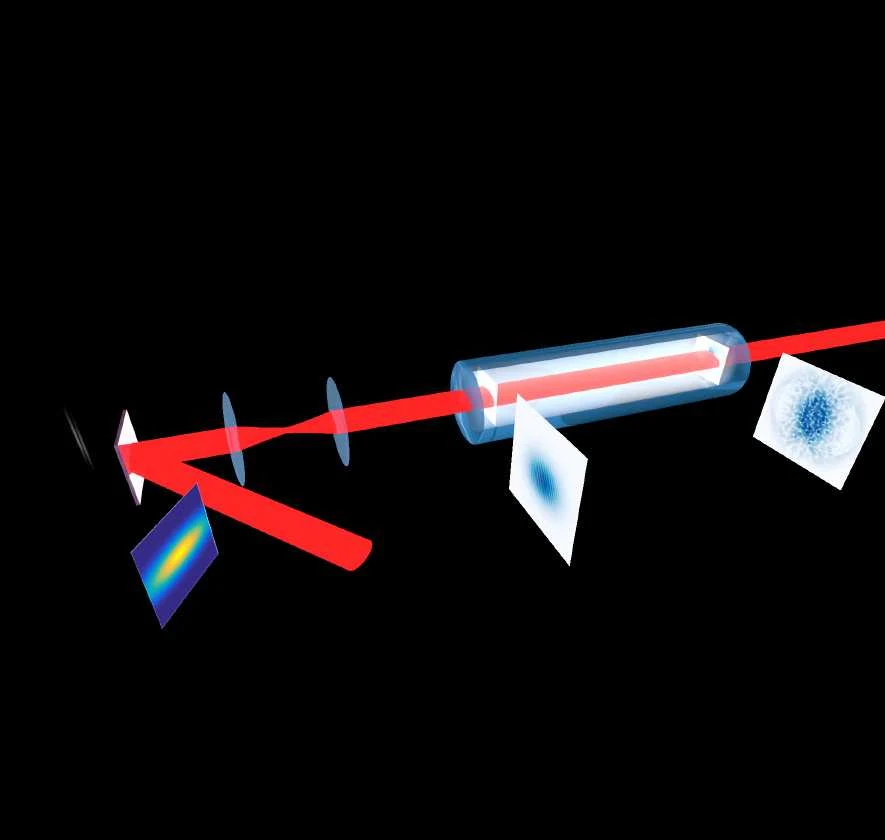
In the new experiment, physicists recreated leapfrogging in an exotic medium called 'liquid light.' This is a system where light confined in a semiconductor microstructure acquires collective superfluid properties. Vortices were generated with a laser beam, and their motion was tracked with an ultrafast camera capable of femtosecond resolution. When the vortices were accelerated to a critical speed, a sharp jolt, a shock wave, arose in the medium. The leapfrog broke down: the vortices collided and annihilated, their energy dissipating as heat. For a superfluid system devoid of viscous friction, this is the only known energy-loss mechanism. Capturing such a fleeting event was possible precisely thanks to high-speed imaging.
Understanding how motion decays in superfluid media not only deepens fundamental knowledge of quantum hydrodynamics but also paves the way for practical applications — for instance, creating ultra-precise rotation sensors based on vortex states in liquid light.
Feynman predicted vortex leapfrogging while pondering the mysteries of turbulence, but it was only physically observed now — in laser light.
Liquid light is almost like a lightsaber from science fiction, where energy becomes tangible.