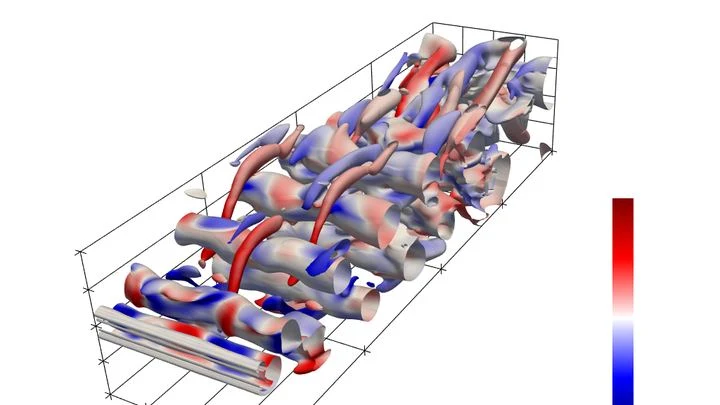
An energy cascade is the process by which energy in a turbulentfluid flows from large scales of motion down to smaller scales, until it is dissipated as heat at the smallest scales. This concept is central to understanding turbulence, which appears in everything from ocean currents and atmospheric flows to blood flow and star-forming clouds. The cascade explains why turbulence looks similar across vastly different systems: energy is injected at a large scale, then transferred stepwise through a hierarchy of eddies.
History
The concept was formalized by Lewis Fry Richardson in the 1920s, who described the cascade in a famous rhyme: 'Big whorls have little whorls, which feed on their velocity; and little whorls have lesser whorls, and so on to viscosity.' Kolmogorov's 1941 theory gave it a rigorous mathematical foundation.
How it works
In a turbulentflow, large eddies (whirls) are unstable and break into smaller eddies, which themselves break into even smaller ones. This continues until the eddies are so small that molecular viscosity becomes important, and their kinetic energy is converted into heat. The Russian mathematician Andrey Kolmogorov showed in 1941 that, in the 'inertial range' between the injection and dissipation scales, the energy spectrum follows a universal power law, independent of the fluid's details.
In practice
Understanding energy cascades helps improve weather prediction models, design more efficient aircraft wings, and even optimize industrial mixing processes.
Fun fact
The same cascade physics applies to quantum fluids like superfluid helium, where energyflows through quantized vortices instead of classical eddies.
A hydrogen bubble on a platinum electrode behaves like a swimmer trying to surface, but every time it almost breaks free, something below grabs its legs. In the lab, high-speed cameras captured this behavior: a millimeter-sized bubble hangs near the surface, even though buoyancy pulls it upward with a force thousands of times stronger than surface tension can hold.
The orchestra starts playing, but each musician has their own tempo. If everyone plays at roughly the same speed, the music flows in a continuous stream. But if one group of instruments plays noticeably slower than the rest, the sound gathers into a dense clump that slowly moves forward.
A sphere rolls down a chute. What shape should the chute be to make the descent as quick as possible? Three centuries ago, the answer was the cycloid — a curve resembling the arc of an upside-down bridge. But submerge the chute in a thick liquid, and everything changes: the fluid slows the sphere, and the fastest path becomes something else.
A choir where every singer hits the notes precisely sounds louder than you'd expect from a simple sum of voices. A hundred singers aren't just a hundred times louder than one: they're ten thousand times louder. In the world of atoms, something similar happens. In collective behavior discovered by Robert H.
295 000 meters per second. Not even particles in solar coronal ejecta move that fast. But at the center of the galaxy cluster H1821+643, hot gas does exactly that. The quasar at its heart takes a breath, and its breath stirs everything around for 60 thousand light-years.
An ocean current hundreds of kilometers wide lives its own life, fed by energy from tiny eddies. Something similar happens in the atmosphere: small swirls pass their power on to huge air currents. This process, the inverse energy cascade, has been known for a long time.
A stone falls into a pond, and ripples spread evenly in all directions. But some media behave as if the wave knows which way to turn, like water that only swirls clockwise. This asymmetry comes from odd viscosity and odd elasticity — properties of media with broken mirror symmetry.
Ordinary water freezes as expected. But sometimes hot water turns to ice faster than cold — the Mpemba effect. Recently, a similar rule-breaking was found in quantum entanglement — the invisible link between particles discovered by Erwin Schrödinger.
A clap of the hands compresses the air, and it flies outward — the simplest shock. In space, exploding stars play the role of hands: their shock waves sharply compress gas and trigger chaotic mixing — turbulence.
A lightning strike splits the sky in a fraction of a second, leaving a branched trail. At the same moment, in a tiny superconducting crystal cooled to near absolute zero, an avalanche of magnetic field rushes through — thin fingers of magnetization piercing the material.
The mystery of dark energy is a chasm. Quantum field theory predicts a density 10¹²⁰ times larger than observed. In the string landscape, this abyss takes shape — myriads of vacua with different energies, and we are nestled in one of them.
In a pot of boiling soup, churning currents carry heat to the walls, and the soup cools. In a tokamak, a huge magnetic bottle for plasma, the same thing happens: turbulent eddies carry energy outward, hindering the ignition of a fusion reaction. But sometimes the plasma seems to find a way to calm itself.
A pot of water has just been stirred: the whirlpools and eddies gradually calm down, and the liquid becomes smooth. A similar process, but in the quantum world, occurs in superfluid helium or in a cloud of ultracold atoms.
Water churns behind a rock in a river, air swirls behind an airplane wing: it seems like completely random motion. But the authors of the study found a rigid kitchen recipe in this chaos.
They decomposed the fluid's rotation (angular momentum) into two independent parts.
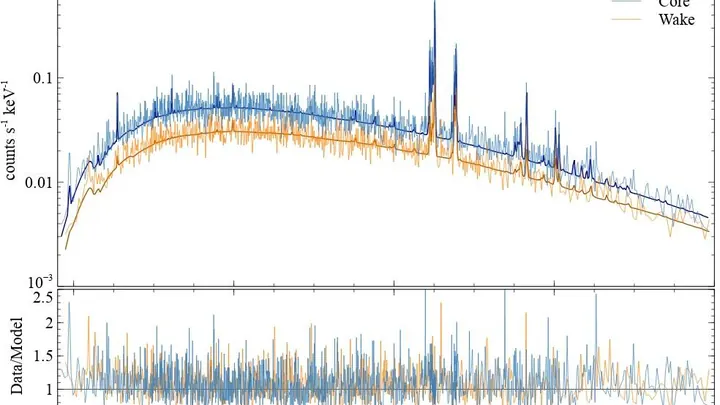
At the heart of the Ophiuchus galaxy cluster floats a bubble of hot plasma the size of several galaxies. It rises like a giant hot-air balloon in the atmosphere, leaving a wake behind it — a region where gas is set in motion.
In superfluid helium, a vortex is like a tornado in a bottle, but instead of water, it's a quantum liquid that flows without friction. Such a vortex doesn't dissipate on its own, so the question of where its energy goes has long remained open.
Beneath Enceladus's icy crust churns an ocean, acting like a perfect heat pump. It pushes heat from the equator to the poles, spending a thousand times less energy than it transports — like a perpetual motion machine built into the moon. The secret lies in salt.
In a wind tunnel, air accelerates to enormous speeds and breaks into a chaos of eddies. To see how this chaos dies on the smallest scales, scientists took a sensor thinner than a human hair and placed it in the flow.
Inside the tunnel, they created a shear layer — a region where fast air rubs against slow air, spawning vortices.
Above the Sun's surface hang long ribbons of glowing gas — streamers. They look like giant harps stretched across the corona. When a wave runs along such a ribbon, it trembles and bends like a string after being plucked.
For a long time, it was thought that only a very fast ejection of material, one traveling at more than 500 kilometers per second, could launch such a wave.
Hot plasma in a tokamak is like a temperamental beast: you need to hold it in, but not let it overheat. In the ASDEX Upgrade reactor, researchers found a regime where plasma eddies solve this problem on their own. Stochastic modeling showed that oscillations at the plasma edge fling out blobs, like bubbles from a boiling pot.
A calm river suddenly starts churning in the middle of a flat stretch: that's the puzzle the authors of a new study set out to solve. They took a thin layer of charged gas with a very weak magnetic field and tracked on a computer what would happen to it. At first, everything flows smoothly, like water from a tap.
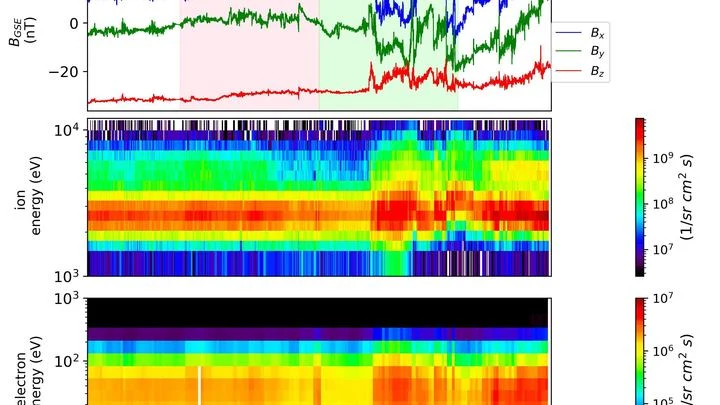
October 10, 2024. The Sun hurled a cloud of magnetized plasma toward Earth, and four spacecraft, stationed at a single point between the Sun and Earth, simultaneously recorded how that cloud churned. The distance between the outermost probes was just 80 Earth radii, about half a million kilometers.
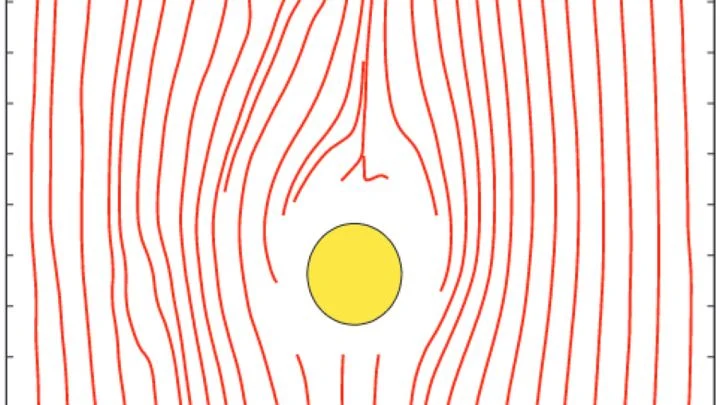
Liquid helium cooled to near absolute zero behaves like two fluids at once: a normal viscous part and a superfluid part that flows without friction. When such a flow hits a cylinder, vortices are born behind it. But sometimes vortices appear in front of the cylinder — where classical laws say they shouldn't be.
A crowd of people in a subway station moves slower than individuals: everyone gets in everyone else's way. A similar picture emerges in a dense cloud of magnetic atoms exchanging energy. Previously, it was thought that the transfer rate depended only on the atoms' own properties.
A blunt cylinder flying at six times the speed of sound isn't the most elegant object, but it's the star of a new simulation. The surface of such a vehicle is never perfectly smooth: during atmospheric entry, the heat shield ablates, leaving bumps and pits.
A thin plate stands across a flow of water or air. Behind it, a wake forms — a region where the flow becomes tangled and mixed. Usually, such a wake becomes turbulent when the flow speed is high enough, quantified by the Reynolds number.
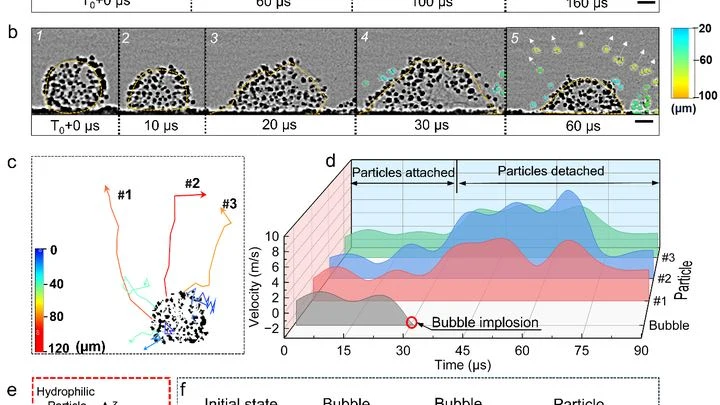
In a glass of water, ultrasound creates tiny bubbles. They grow and shrink, and sometimes they collapse sharply, like a popping soap bubble, but thousands of times faster. Near these bubbles float small particles — for example, nickel spheres the size of dust motes.
Sound in a thin plate behaves like ripples on water: it travels, reflects off edges, and changes shape. But sound has a peculiar trait: it can pass through places where waves are forbidden to exist. It's as if ripples on a pond suddenly vanished before a stone barrier and reappeared on the other side, without going around it.
Water swirls into a ring, and that ring flies through the bulk without breaking apart. Such vortex rings, from smoke rings to underwater currents, follow laws that are hard to capture on paper. Usually, the flow is divided into millions of cubic cells, and each one is tracked.
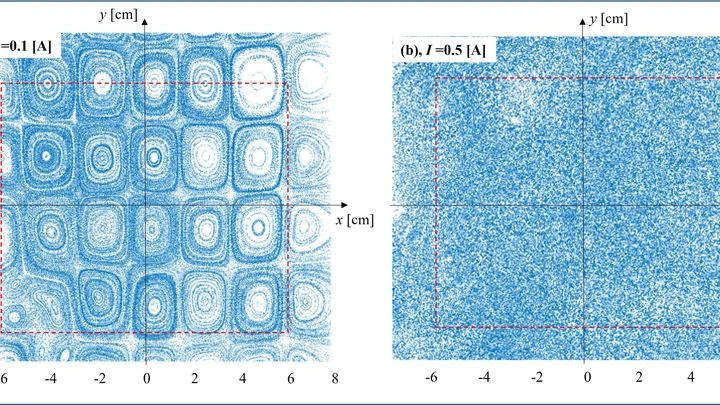
Water in a puddle after rain swirls differently than in a deep lake. A thin layer of fluid feels the bottom, and that changes the nature of its vortices. Scientists created such a layer in the lab: they poured in an electrolyte, ran a current and a magnetic field, and the fluid began to move.
In superfluid helium, a state where liquid flows without friction, quantized vortices spontaneously arise: microscopic funnels resembling whirlpools in ordinary Water, but governed by quantum mechanics.
Five superconducting qubits on a chip: the stage for a performance of quantum chaos. Four qubits form the system, and the fifth acts as the environment, introducing dissipation. After a short evolution, the environment is discarded, leaving the system with an open quantum map, an operator that transforms the system's state.